
成年早期的高雄激素血症是中年时期糖代谢异常的独立危险因素。
Hyperandrogenemia in Early Adulthood Is an Independent Risk Factor for Abnormal Glucose Metabolism in Middle Age.
机构信息
Department of Obstetrics and Gynecology, University of Oulu and Oulu University Hospital, Medical Research Center, PEDEGO Research Unit, Oulu, Finland.
MRC-PHE Centre for Environment and Health, Department of Epidemiology and Biostatistics, School of Public Health, Imperial College London, London, UK.
出版信息
J Clin Endocrinol Metab. 2021 Oct 21;106(11):e4621-e4633. doi: 10.1210/clinem/dgab456.
CONTEXT
The role of androgen excess as a contributing factor to abnormal glucose metabolism (AGM) and insulin resistance in women remains controversial.
OBJECTIVE
To investigate whether hyperandrogenemia (HA) estimated by serum testosterone (T) level and free androgen index (FAI) at ages 31 and 46 years is associated with insulin resistance, insulin secretion and AGM by age 46.
DESIGN
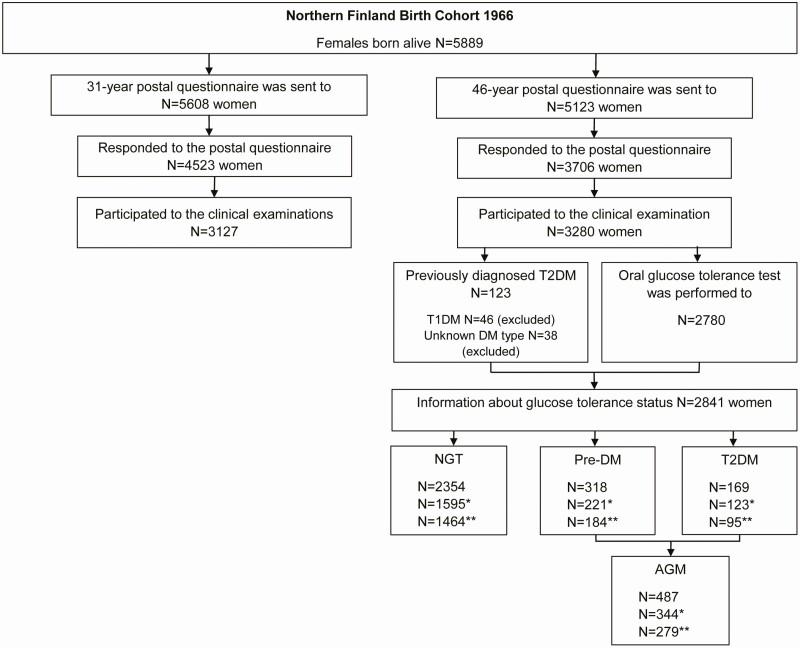
Prospective study including 5889 females followed at ages 31 and 46 years.
SETTING
General community.
PARTICIPANTS
Women with HA were compared with normoandrogenic women at ages 31 and 46 years.
INTERVENTION
None.
MAIN OUTCOME MEASUREMENTS
AGM, including prediabetes and type 2 diabetes mellitus, homeostatic model assessments of insulin resistance (HOMA-IR) and of pancreatic β-cell function (HOMA-B).
RESULTS
At age 31 years, HA women displayed increased HOMA-IR (P = 0.002), HOMA-B (P = 0.007), and higher fasting insulin (P = 0.03) than normoandrogenic women after adjusting for body mass index (BMI). At age 46 years, there was a nonsignificant trend toward higher fasting glucose (P = 0.07) and glycated hemoglobin A1 (P = 0.07) levels in HA women. Women in the highest T quartile (odds ratio [OR] = 1.80; 95%CI, 1.15-2.82) at age 31 years and in the 2 highest FAI quartiles at ages 31 (Q4: OR = 3.76; 95% CI, 2.24-6.32) and 46 (Q4: OR = 2.79; 95% CI, 1.74-4.46) years had increased risk for AGM, independently of BMI, when compared with women in Q1. SHBG was inversely associated with AGM (at age 31 years: Q4: OR = 0.37; 95% CI, 0.23-0.60, at age 46 years: Q4: OR = 0.28; 95% CI, 0.17-0.44).
CONCLUSION
Hyperandrogenemia and low SHBG in early and middle age associates with AGM independently of BMI.
背景
雄激素过多作为导致女性葡萄糖代谢异常(AGM)和胰岛素抵抗的一个因素,其作用仍存在争议。
目的
本研究旨在探讨 31 岁和 46 岁时血清睾酮(T)水平和游离雄激素指数(FAI)估计的高雄激素血症(HA)是否与 46 岁时的胰岛素抵抗、胰岛素分泌和 AGM 有关。
设计
前瞻性研究,包括在 31 岁和 46 岁时接受随访的 5889 名女性。
地点
普通社区。
参与者
将 HA 女性与 31 岁和 46 岁时的正常雄激素女性进行比较。
干预措施
无。
主要观察指标
AGM,包括糖尿病前期和 2 型糖尿病、稳态模型评估的胰岛素抵抗(HOMA-IR)和胰岛β细胞功能(HOMA-B)。
结果
31 岁时,HA 女性的 HOMA-IR(P=0.002)、HOMA-B(P=0.007)和空腹胰岛素水平(P=0.03)高于正常雄激素女性,调整体重指数(BMI)后差异有统计学意义。46 岁时,HA 女性空腹血糖(P=0.07)和糖化血红蛋白 A1(P=0.07)水平呈升高趋势,但差异无统计学意义。31 岁时 T 四分位最高(比值比[OR] = 1.80;95%CI,1.15-2.82)和 31 岁和 46 岁时 FAI 四分位最高(Q4:OR = 3.76;95%CI,2.24-6.32)和 Q4(OR = 2.79;95%CI,1.74-4.46)的女性,无论 BMI 如何,AGM 的风险均增加。SHBG 与 AGM 呈负相关(31 岁时 Q4:OR = 0.37;95%CI,0.23-0.60;46 岁时 Q4:OR = 0.28;95%CI,0.17-0.44)。
结论
中年早期的高雄激素血症和低 SHBG 与 BMI 无关,与 AGM 有关。
 Zotero 插件