
一种细菌炎症传感器调节 c-di-GMP 信号转导、黏附和生物膜形成。
A Bacterial Inflammation Sensor Regulates c-di-GMP Signaling, Adhesion, and Biofilm Formation.
机构信息
Institute of Molecular Biology, University of Oregon, Eugene, Oregon, USA.
Biozentrum, University of Basel, Basel, Switzerland.
出版信息
mBio. 2021 Jun 29;12(3):e0017321. doi: 10.1128/mBio.00173-21. Epub 2021 Jun 22.
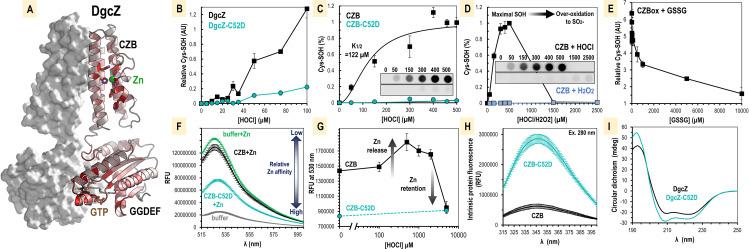
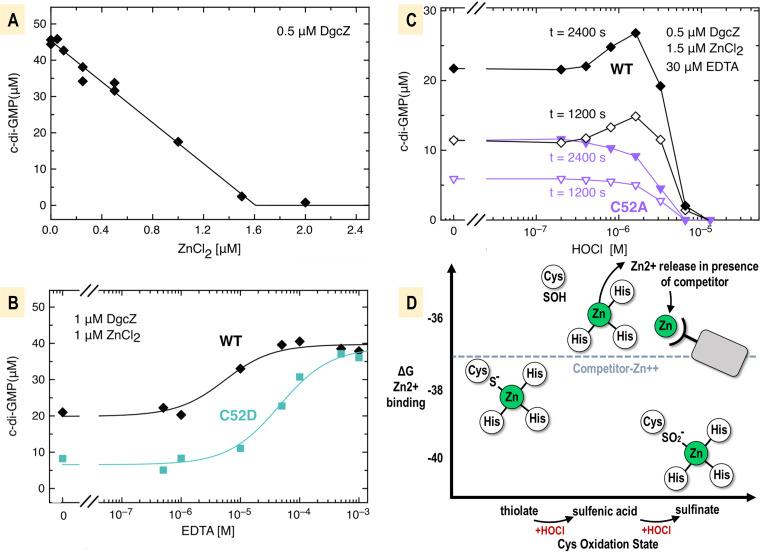
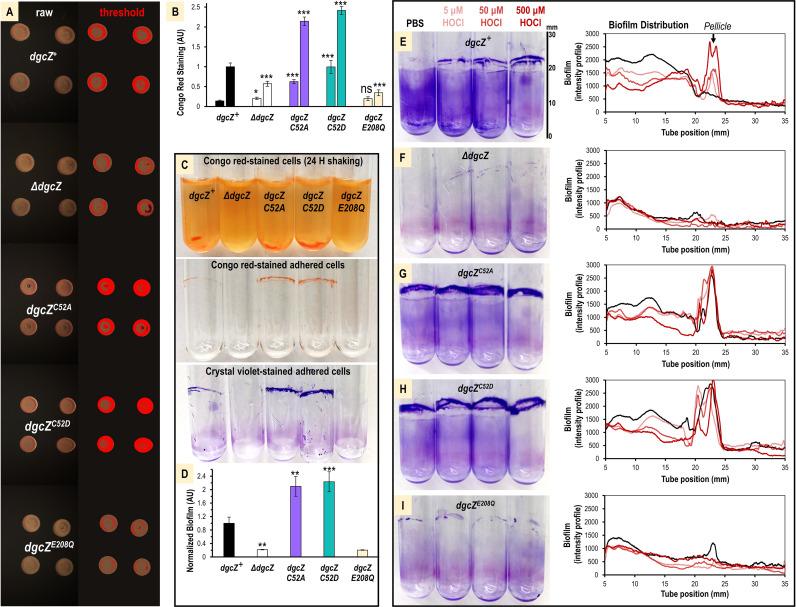
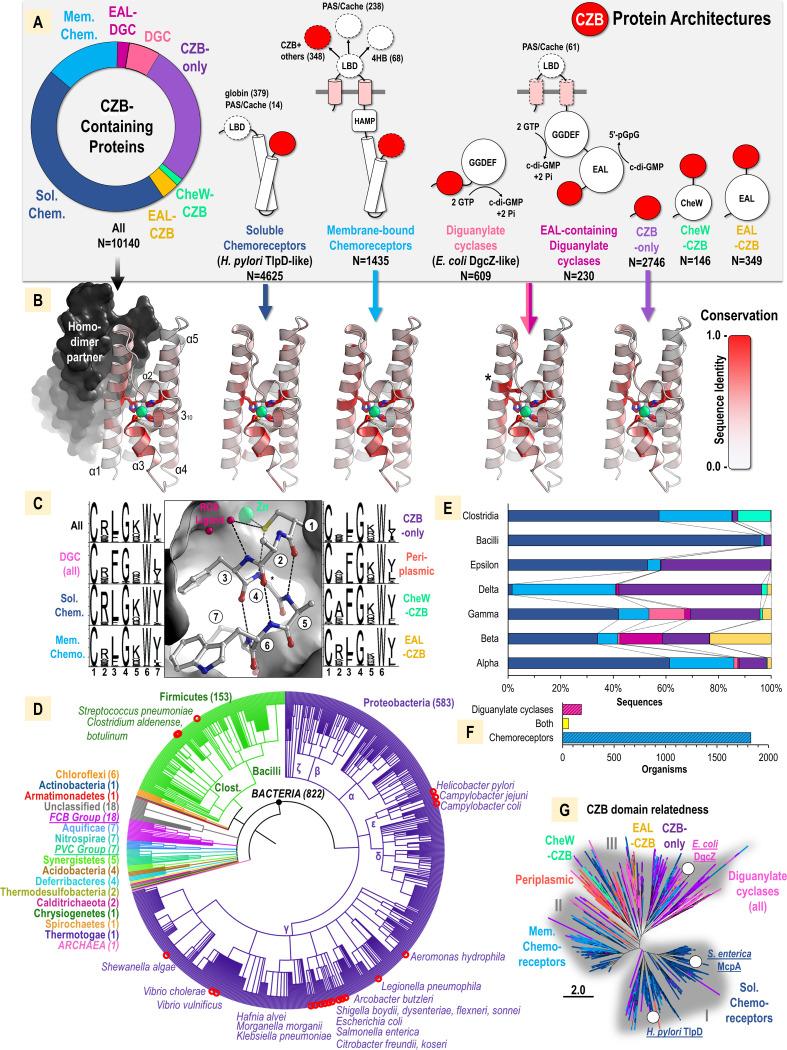
Bacteria that colonize animals must overcome, or coexist, with the reactive oxygen species products of inflammation, a front-line defense of innate immunity. Among these is the neutrophilic oxidant bleach, hypochlorous acid (HOCl), a potent antimicrobial that plays a primary role in killing bacteria through nonspecific oxidation of proteins, lipids, and DNA. Here, we report that in response to increasing HOCl levels, Escherichia coli regulates biofilm production via activation of the diguanylate cyclase DgcZ. We identify the mechanism of DgcZ sensing of HOCl to be direct oxidation of its regulatory chemoreceptor zinc-binding (CZB) domain. Dissection of CZB signal transduction reveals that oxidation of the conserved zinc-binding cysteine controls CZB Zn occupancy, which in turn regulates the catalysis of c-di-GMP by the associated GGDEF domain. We find DgcZ-dependent biofilm formation and HOCl sensing to be regulated by the conserved zinc-coordinating cysteine. Additionally, point mutants that mimic oxidized CZB states increase total biofilm. A survey of bacterial genomes reveals that many pathogenic bacteria that manipulate host inflammation as part of their colonization strategy possess CZB-regulated diguanylate cyclases and chemoreceptors. Our findings suggest that CZB domains are zinc-sensitive regulators that allow host-associated bacteria to perceive host inflammation through reactivity with HOCl. Immune cells are well equipped to eliminate invading bacteria, and one of their primary tools is the synthesis of bleach, hypochlorous acid (HOCl), the same chemical used as a household disinfectant. In this work, we present findings showing that many host-associated bacteria possess a bleach-sensing protein that allows them to adapt to the presence of this chemical in their environment. We find that the bacterium Escherichia coli responds to bleach by hunkering down and producing a sticky matrix known as biofilm, which helps it aggregate and adhere to surfaces. This behavior may play an important role in pathogenicity for E. coli and other bacteria, as it allows the bacteria to detect and adapt to the weapons of the host immune system.
定植于动物体内的细菌必须克服或共存于炎症产生的活性氧物质,这是先天免疫的第一道防线。其中包括嗜中性粒细胞氧化剂次氯酸(HOCl),这是一种有效的抗菌物质,通过非特异性氧化蛋白质、脂质和 DNA 来发挥主要的杀菌作用。在这里,我们报告大肠杆菌通过激活二鸟苷酸环化酶 DgcZ 来响应 HOCl 水平的增加来调节生物膜的产生。我们确定了 DgcZ 感应 HOCl 的机制是其调节化学感受器锌结合(CZB)域的直接氧化。CZB 信号转导的剖析表明,保守的锌结合半胱氨酸的氧化控制着 CZB Zn 的占有,进而调节与相关 GGDEF 域相关的 c-二鸟苷酸的催化。我们发现 DgcZ 依赖性生物膜形成和 HOCl 感应受保守锌配位半胱氨酸的调节。此外,模拟氧化 CZB 状态的点突变会增加总生物膜。对细菌基因组的调查表明,许多作为其定植策略的一部分来操纵宿主炎症的致病菌都具有 CZB 调节的二鸟苷酸环化酶和化学感受器。我们的发现表明 CZB 结构域是锌敏感的调节剂,使宿主相关细菌能够通过与 HOCl 的反应来感知宿主炎症。 免疫细胞具有很好的消除入侵细菌的能力,它们的主要工具之一是合成漂白剂次氯酸(HOCl),这是一种用于家庭消毒的化学物质。在这项工作中,我们提出了发现,表明许多宿主相关细菌都具有一种漂白剂感应蛋白,使它们能够适应环境中这种化学物质的存在。我们发现大肠杆菌对漂白剂的反应是蜷缩起来并产生一种粘性基质,称为生物膜,这有助于它聚集并附着在表面上。这种行为可能在大肠杆菌和其他细菌的致病性中发挥重要作用,因为它使细菌能够检测和适应宿主免疫系统的武器。



 Zotero 插件