
比较在患有谵妄、痴呆和无认知障碍的住院患者中进行的月份倒背测试的表现:一项探索性研究。
Comparing performance on the Months of the Year Backwards test in hospitalised patients with delirium, dementia, and no cognitive impairment: an exploratory study.
机构信息
University Department of Geriatric Medicine FELIX PLATTER Basel, Burgfelderstrasse, 101 4055, Basel, Switzerland.
Geriatric Medicine, Edinburgh Delirium Research Group, Usher Institute, University of Edinburgh, Edinburgh, Scotland, UK.
出版信息
Eur Geriatr Med. 2021 Dec;12(6):1257-1265. doi: 10.1007/s41999-021-00521-4. Epub 2021 Jun 22.
PURPOSE
To investigate performance of the Months of the Year Backwards (MOTYB) test in older hospitalised patients with delirium, dementia, and no cognitive impairment.
METHODS
Secondary analysis of data from a case-control study of 149 hospitalised patients aged ≥ 65 years with delirium [with or without dementia (N = 50)], dementia [without delirium (N = 46)], and no cognitive impairment (N = 53). Verbatim transcripts of MOTYB audio recordings were analysed to determine group differences in response patterns.
RESULTS
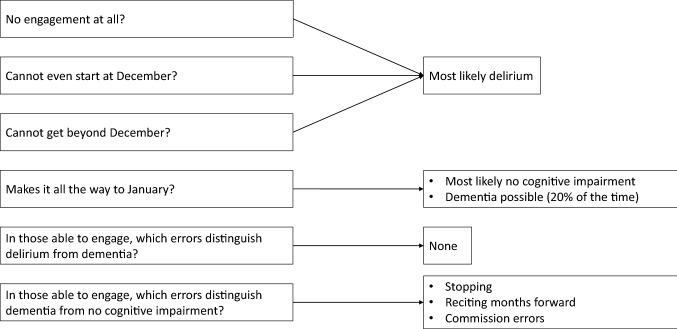
In the total sample [median age 85y (IQR 80-88), 82% female], patients with delirium were more often unable to recite months backward to November (36/50 = 72%) than patients with dementia (21/46 = 46%; p < 0.01) and both differed significantly from patients without cognitive impairment (2/53 = 4%; p's < 0.001). 121/149 (81%) of patients were able to engage with the test. Patients with delirium were more often unable to engage with MOTYB (23/50 = 46%; e.g., due to reduced arousal) than patients with dementia (5/46 = 11%; p < 0.001); both groups differed significantly (p's < 0.001) from patients without cognitive impairment (0/53 = 0%). There was no statistically significant difference between patients with delirium (2/27 = 7%) and patients with dementia (8/41 = 20%) in completing MOTYB to January, but performance in both groups differed (p < 0.001 and p < 0.02, respectively) from patients without cognitive impairment (35/53 = 66%).
CONCLUSION
Delirium was associated with inability to engage with MOTYB and low rates of completion. In patients able to engage with the test, error-free completion rates were low in delirium and dementia. Recording of engagement and patterns of errors may add useful information to MOTYB scoring.
目的
研究 Months of the Year Backwards(MOTYB)测试在患有谵妄、痴呆和认知功能正常的住院老年患者中的表现。
方法
对 149 名年龄≥65 岁的住院患者的病例对照研究数据进行二次分析,这些患者患有谵妄[伴有或不伴有痴呆(N=50)]、痴呆[无谵妄(N=46)]和认知功能正常(N=53)。分析 MOTYB 音频记录的逐字记录,以确定组间反应模式的差异。
结果
在总样本中[中位数年龄 85 岁(IQR 80-88),82%为女性],患有谵妄的患者不能背诵到 11 月的情况(36/50=72%)比患有痴呆的患者(21/46=46%;p<0.01)更常见,且与认知功能正常的患者差异显著(2/53=4%;p 值均<0.001)。149 名患者中有 121 名(81%)能够参与测试。患有谵妄的患者比患有痴呆的患者更不能参与 MOTYB(23/50=46%;例如,由于觉醒降低)(5/46=11%;p<0.001);两组与认知功能正常的患者(p 值均<0.001)差异显著(0/53=0%)。患有谵妄的患者(2/27=7%)和患有痴呆的患者(8/41=20%)完成 MOTYB 到 1 月的情况没有统计学上的显著差异,但两组的表现(p 值分别<0.001 和<0.02)与认知功能正常的患者(53 名中的 35 名=66%)不同。
结论
谵妄与不能参与 MOTYB 和完成率低有关。在能够参与测试的患者中,谵妄和痴呆患者错误率低。记录参与情况和错误模式可能会为 MOTYB 评分增加有用的信息。

 Zotero 插件