
骨髓间充质干细胞来源的外泌体 miR-206 通过降低 Elf3 促进骨关节炎成骨细胞增殖和分化。
Bone marrow mesenchymal stem cell-derived exosomal miR-206 promotes osteoblast proliferation and differentiation in osteoarthritis by reducing Elf3.
机构信息
Department of Orthopaedic, The Second Affiliated Hospital and Yuying Children's Hospital of Wenzhou Medical University, Wenzhou, China.
Key Laboratory of Orthopaedics of Zhejiang Province, Wenzhou, China.
出版信息
J Cell Mol Med. 2021 Aug;25(16):7734-7745. doi: 10.1111/jcmm.16654. Epub 2021 Jun 23.
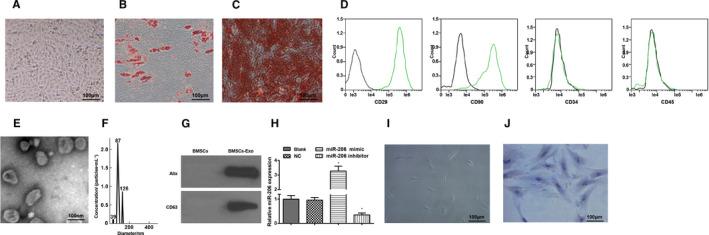
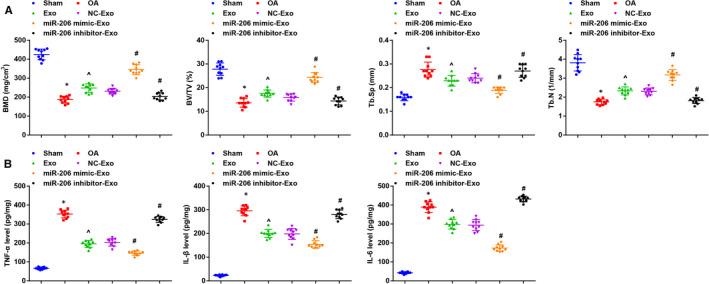
MicroRNAs (miRNAs) serve as gene silencers involved in essential cell functions. The role of miR-206 and E74-like factor 3 (Elf3) has been identified in osteoarthritis (OA), while the effect of exosomal miR-206 from bone marrow mesenchymal stem cells (BMSCs) in OA remains largely unknown. Thus, we aim to explore the role of exosomal miR-206 from BMSCs in OA with the involvement of Elf3. BMSCs and BMSC-derived exosomes (BMSC-exos) were obtained and identified. OA mouse models were constructed by anterior cruciate ligament transection and then treated with BMSC-exos or BMSC-exos containing miR-206 mimic/inhibitor. The expression of miR-206, Elf3, inflammatory factors, osteocalcin (OCN) and bone morphogenetic protein 2 (BMP2) in mouse femoral tissues was assessed. The pathological changes in mouse femur tissues were observed. The mouse osteoblasts were identified and treated with untransfected or transfected BMSC-exos, and then, the expression of miR-206, Elf3, OCN and BMP2 was determined. The alkaline phosphatase (ALP) activity, calcium deposition level, OCN secretion, proliferation, apoptosis and cell cycle arrest in osteoblasts were measured. MiR-206 was down-regulated while Elf3 was up-regulated in OA animal and cellular models. Exosomal miR-206 ameliorated inflammation and increased expression of OCN and BMP2 in mouse femoral tissues. Moreover, exosomal miR-206 promoted ALP activity, calcium deposition level, OCN secretion and proliferation and inhibited apoptosis in OA osteoblasts. Overexpressed Elf3 reversed miR-206 up-regulation-induced effects on OA osteoblasts. BMSC-derived exosomal miR-206 promotes proliferation and differentiation of osteoblasts in OA by reducing Elf3. Our research may provide novel targets for OA treatment.
微小 RNA(miRNAs)作为参与细胞基本功能的基因沉默子。miR-206 和 E74 样因子 3(Elf3)在骨关节炎(OA)中已有报道,而骨髓间充质干细胞(BMSCs)来源的外泌体 miR-206 在 OA 中的作用仍知之甚少。因此,我们旨在探讨 BMSCs 来源的外泌体 miR-206 通过 Elf3 在 OA 中的作用。获得并鉴定 BMSCs 和 BMSC 衍生的外泌体(BMSC-exos)。通过前交叉韧带切断术构建 OA 小鼠模型,然后用 BMSC-exos 或含有 miR-206 模拟物/抑制剂的 BMSC-exos 进行处理。评估小鼠股骨组织中 miR-206、Elf3、炎症因子、骨钙素(OCN)和骨形态发生蛋白 2(BMP2)的表达。观察小鼠股骨组织的病理变化。鉴定并转染未转染或转染的 BMSC-exos 的小鼠成骨细胞,然后测定 miR-206、Elf3、OCN 和 BMP2 的表达。测量成骨细胞的碱性磷酸酶(ALP)活性、钙沉积水平、OCN 分泌、增殖、凋亡和细胞周期停滞。OA 动物和细胞模型中 miR-206 下调而 Elf3 上调。外泌体 miR-206 改善了小鼠股骨组织的炎症,增加了 OCN 和 BMP2 的表达。此外,外泌体 miR-206 促进了 OA 成骨细胞中 ALP 活性、钙沉积水平、OCN 分泌和增殖,并抑制了其凋亡。过表达 Elf3 逆转了 miR-206 上调对 OA 成骨细胞的作用。BMSC 衍生的外泌体 miR-206 通过减少 Elf3 促进 OA 成骨细胞的增殖和分化。我们的研究可能为 OA 的治疗提供新的靶点。




 Zotero 插件