
植物小RNA世界不断扩大:tRNA衍生片段,调控过程中的长期参与者。
Plant Small RNA World Growing Bigger: tRNA-Derived Fragments, Longstanding Players in Regulatory Processes.
作者信息
Alves Cristiane S, Nogueira Fabio T S
机构信息
Cold Spring Harbor Laboratory, Cold Spring Harbor, NY, United States.
Laboratório de Genética Molecular do Desenvolvimento Vegetal, Departamento de Ciências Biológicas, ESALQ/USP, Piracicaba, Brazil.
出版信息
Front Mol Biosci. 2021 Jun 7;8:638911. doi: 10.3389/fmolb.2021.638911. eCollection 2021.
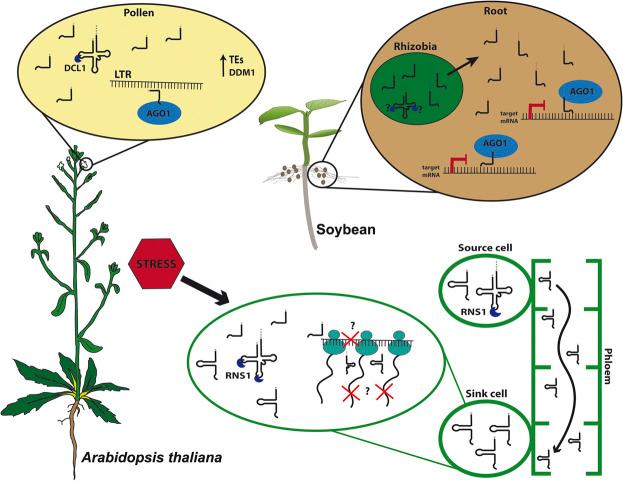
In the past 2 decades, the discovery of a new class of small RNAs, known as tRNA-derived fragments (tRFs), shed light on a new layer of regulation implicated in many biological processes. tRFs originate from mature tRNAs and are classified according to the tRNA regions that they derive from, namely 3'tRF, 5'tRF, and tRF-halves. Additionally, another tRF subgroup deriving from tRNA precursors has been reported, the 3'U tRFs. tRF length ranges from 17 to 26 nt for the 3'and 5'tRFs, and from 30 to 40 nt for tRF-halves. tRF biogenesis is still not yet elucidated, although there is strong evidence that Dicer (and DICER-LIKE) proteins, as well as other RNases such as Angiogenin in mammal and RNS proteins family in plants, are responsible for processing specific tRFs. In plants, the abundance of those molecules varies among tissues, developmental stages, and environmental conditions. More recently, several studies have contributed to elucidate the role that these intriguing molecules may play in all organisms. Among the recent discoveries, tRFs were found to be involved in distinctive regulatory layers, such as transcription and translation regulation, RNA degradation, ribosome biogenesis, stress response, regulatory signaling in plant nodulation, and genome protection against transposable elements. Although tRF biology is still poorly understood, the field has blossomed in the past few years, and this review summarizes the most recent developments in the tRF field in plants.
在过去的20年里,一类新的小RNA,即tRNA衍生片段(tRFs)的发现,为涉及许多生物过程的新调控层面带来了曙光。tRFs源自成熟的tRNA,并根据其来源的tRNA区域进行分类,即3'tRF、5'tRF和tRF-半体。此外,还报道了另一个源自tRNA前体的tRF亚组,即3'U tRFs。3'和5'tRFs的长度范围为17至26个核苷酸,tRF-半体的长度范围为30至40个核苷酸。尽管有强有力的证据表明Dicer(和类Dicer)蛋白以及其他核糖核酸酶,如哺乳动物中的血管生成素和植物中的RNS蛋白家族,负责加工特定的tRFs,但tRF的生物合成仍未阐明。在植物中,这些分子的丰度在不同组织、发育阶段和环境条件下有所不同。最近,几项研究有助于阐明这些有趣的分子在所有生物体中可能发挥的作用。在最近的发现中,tRFs被发现参与了独特的调控层面,如转录和翻译调控、RNA降解、核糖体生物合成、应激反应、植物结瘤中的调控信号以及针对转座元件的基因组保护。尽管tRF生物学仍知之甚少,但该领域在过去几年中蓬勃发展,本综述总结了植物tRF领域的最新进展。
 Zotero 插件