
塞内加尔东部 Assoni 村学龄前儿童肠血吸虫病的 12 年随访。
A 12-year follow-up of intestinal schistosomiasis in pre-school-aged children in Assoni Village, Eastern Senegal.
机构信息
Normandy University, INSERM U1086 ANTICIPE (Interdisciplinary Research Unit for Cancer Prevention and Treatment), BioTICLA Axis (Biology and Innovative Therapeutics for Ovarian Cancers), Caen, France.
Faculty of Pharmaceutical Sciences, Department of Biodiversity Health, Microbiology, Biotechnology, UNICAEN, Caen, France.
出版信息
Infect Dis Poverty. 2021 Jun 27;10(1):89. doi: 10.1186/s40249-021-00867-8.
BACKGROUND
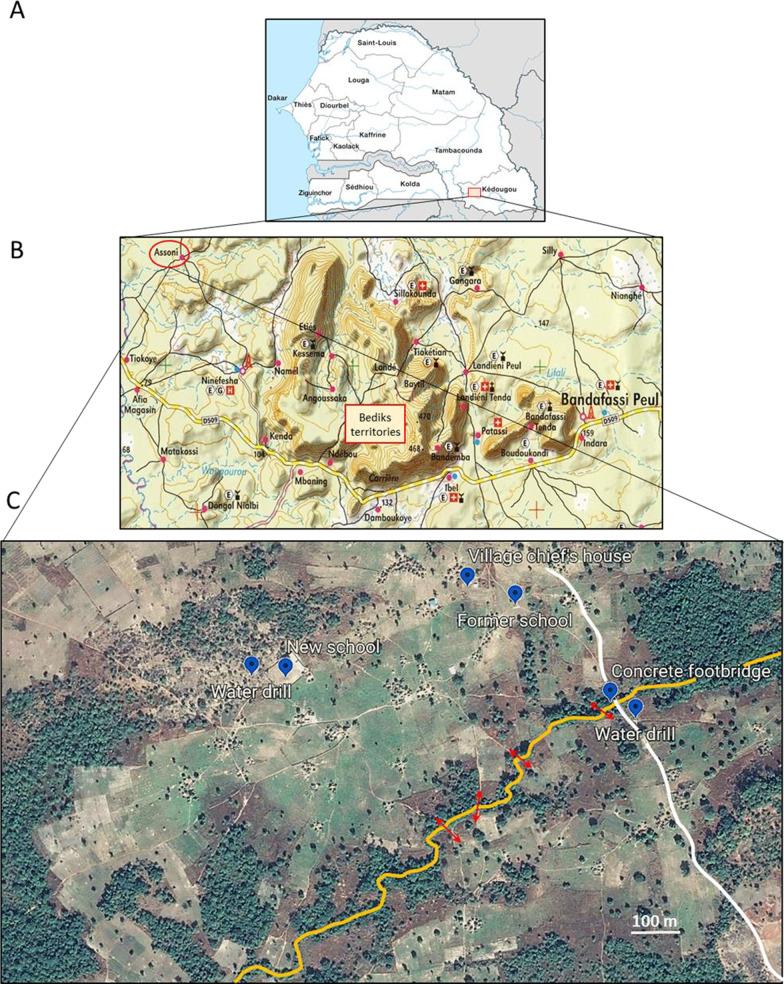
To monitor the prevalence of schistosomiasis in school-aged children (SAC), the National Bilharzia Control Program (PNLB) was set up by the Senegalese authorities; however, geographically isolated Bedik ethnic groups that did not benefit from this program were found to be heavily infected with Schistosoma mansoni. This observation led us to implement a new schistosomiasis control program in 2008 under the aegis of the non-governmental organization "Le Kaïcedrat" and in partnership with the PNLB/WHO to monitor the prevalence of schistosomiasis in this area. In the village of Assoni, where 100% of SAC were infected, analysis of the stools of pre-school-aged children (PSAC) showed that they were massively infected, so we decided to focus our program on them.
METHODS
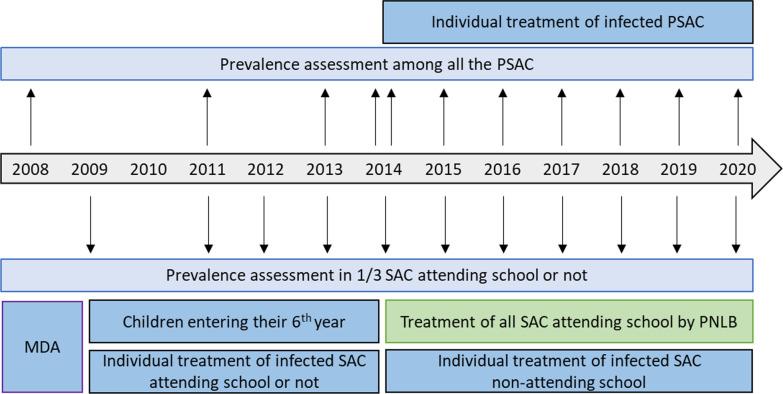
From 2008 to 2020, we (i) monitored the prevalence of S. mansoni in PSAC in Assoni using double-stool smear preparation, (ii) treated the infected PSAC with a standard dose of praziquantel 40 mg/kg, (iii) ran educational campaigns each year in the village, and (iv) built latrines to improve sanitation and reduce schistosomiasis transmission. Linear regression was used to examine the trend in the annual schistosomiasis prevalence and a two-sided of Chi-squared test was used to compare prevalence between the different age groups of PSAC.
RESULTS
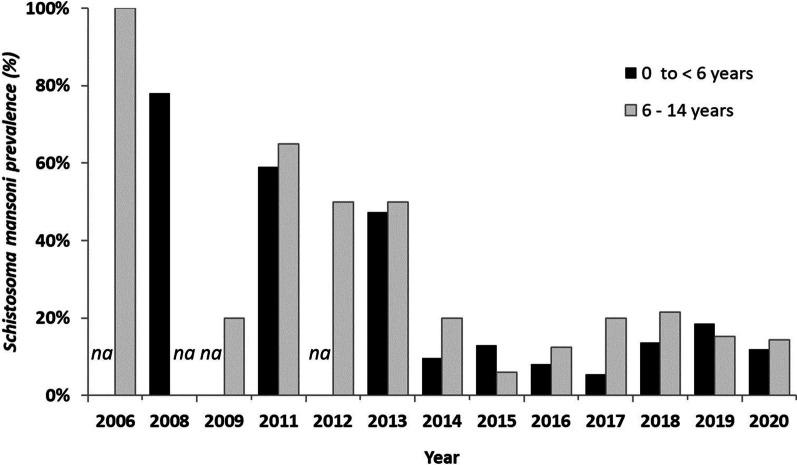
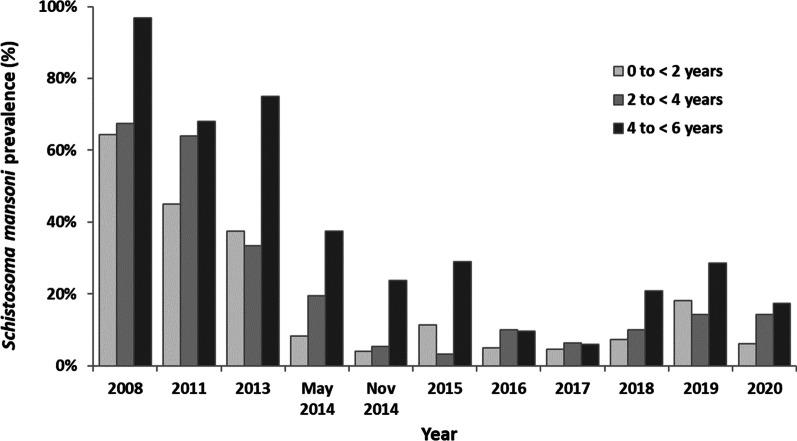
We observed an extremely high prevalence of schistosomiasis (78%) in PSAC before implementation of the program in 2008. Contamination occurred in very young children, as 64.3% of children under 2 years old were infected. Moreover, prevalence increased with age and reached 96.8% in children 4 to < 6 years old. Our annual interventions in Assoni Village raised awareness among villagers that water bodies were areas of significant infestation, allowed the building of 88 latrines and led to a decrease in prevalence in PSAC as only 11% of these children were infected in 2020.
CONCLUSION
Our study allowed Assoni to be the first village in Senegal to treat PSAC since 2014, but only on an individual basis. It also shows that schistosomiasis is difficult to eradicate and that multi-sectorial actions are required to keep its prevalence at a low level.
背景
为了监测学龄儿童(SAC)中的血吸虫病流行情况,塞内加尔当局设立了国家血吸虫病控制规划(PNLB);然而,我们发现地理上与世隔绝的贝多克族群受到了曼氏血吸虫的严重感染,而这些族群并没有受益于该规划。这一观察结果促使我们在 2008 年在非政府组织“Le Kaïcedrat”的支持下,并与 PNLB/WHO 合作,实施了一项新的血吸虫病控制规划,以监测该地区的血吸虫病流行情况。在 Assoni 村,100%的 SAC 受到感染,对学龄前儿童(PSAC)的粪便进行分析显示,他们受到了严重感染,因此我们决定将我们的方案重点放在他们身上。
方法
从 2008 年到 2020 年,我们(i)通过双粪涂片制备监测 Assoni 村 PSAC 中的曼氏血吸虫病流行情况,(ii)用标准剂量的吡喹酮 40mg/kg 治疗感染的 PSAC,(iii)每年在村里开展教育活动,以及(iv)建造厕所以改善卫生状况并减少血吸虫病传播。线性回归用于检查年度血吸虫病流行率的趋势,双侧卡方检验用于比较 PSAC 不同年龄组的流行率。
结果
我们观察到,在 2008 年实施该方案之前,PSAC 的血吸虫病流行率极高(78%)。污染发生在非常年幼的儿童身上,因为 64.3%的 2 岁以下儿童受到感染。此外,流行率随年龄增长而增加,在 4 至<6 岁的儿童中达到 96.8%。我们在 Assoni 村的年度干预措施提高了村民对水体是严重感染区的认识,建造了 88 个厕所,导致 PSAC 的流行率下降,因为 2020 年只有 11%的这些儿童受到感染。
结论
我们的研究使 Assoni 成为 2014 年以来塞内加尔第一个治疗 PSAC 的村庄,但只是个体治疗。它还表明,血吸虫病难以根除,需要采取多部门行动将其流行率保持在低水平。
 Zotero 插件