
整合人类动脉粥样硬化的多组学分析揭示了一个与斑块内出血相关的血清反应因子驱动的网络。
Integrative multiomics analysis of human atherosclerosis reveals a serum response factor-driven network associated with intraplaque hemorrhage.
机构信息
Department of Pathology, School for Cardiovascular Diseases (CARIM), Maastricht UMC+, Maastricht, The Netherlands.
PJ Consulting, Natick, Massachusetts, USA.
出版信息
Clin Transl Med. 2021 Jun;11(6):e458. doi: 10.1002/ctm2.458.
BACKGROUND
While single-omics analyses on human atherosclerotic plaque have been very useful to map stage- or disease-related differences in expression, they only partly capture the array of changes in this tissue and suffer from scale-intrinsic limitations. In order to better identify processes associated with intraplaque hemorrhage and plaque instability, we therefore combined multiple omics into an integrated model.
METHODS
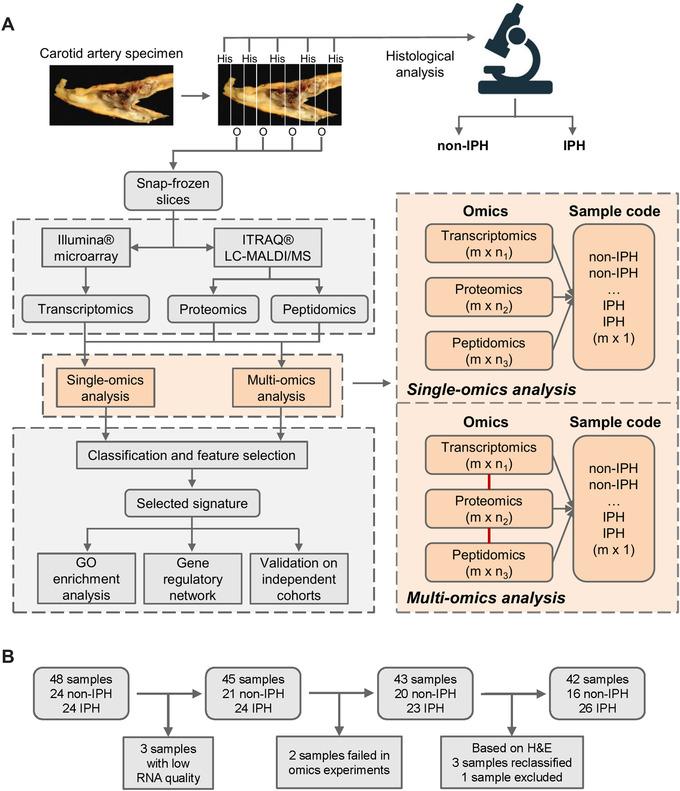
In this study, we compared protein and gene makeup of low- versus high-risk atherosclerotic lesion segments from carotid endarterectomy patients, as judged from the absence or presence of intraplaque hemorrhage, respectively. Transcriptomic, proteomic, and peptidomic data of this plaque cohort were aggregated and analyzed by DIABLO, an integrative multivariate classification and feature selection method.
RESULTS
We identified a protein-gene associated multiomics model able to segregate stable, nonhemorrhaged from vulnerable, hemorrhaged lesions at high predictive performance (AUC >0.95). The dominant component of this model correlated with αSMA PDGFRα fibroblast-like cell content (p = 2.4E-05) and Arg1 macrophage content (p = 2.2E-04) and was driven by serum response factor (SRF), possibly in a megakaryoblastic leukemia-1/2 (MKL1/2) dependent manner. Gene set overrepresentation analysis on the selected key features of this model pointed to a clear cardiovascular disease signature, with overrepresentation of extracellular matrix synthesis and organization, focal adhesion, and cholesterol metabolism terms, suggestive of the model's relevance for the plaque vulnerability. Finally, we were able to corroborate the predictive power of the selected features in several independent mRNA and proteomic plaque cohorts.
CONCLUSIONS
In conclusion, our integrative omics study has identified an intraplaque hemorrhage-associated cardiovascular signature that provides excellent stratification of low- from high-risk carotid artery plaques in several independent cohorts. Further study revealed suppression of an SRF-regulated disease network, controlling lesion stability, in vulnerable plaque, which can serve as a scaffold for the design of targeted intervention in plaque destabilization.
背景
虽然对人类动脉粥样硬化斑块的单一组学分析对于绘制与阶段或疾病相关的表达差异非常有用,但它们仅部分地捕捉了该组织中的一系列变化,并受到固有尺度的限制。为了更好地识别与斑块内出血和斑块不稳定相关的过程,我们因此将多种组学组合成一个综合模型。
方法
在这项研究中,我们比较了颈动脉内膜切除术患者的低风险和高风险动脉粥样硬化病变段的蛋白质和基因组成,分别根据斑块内是否存在出血来判断。对该斑块队列的转录组、蛋白质组和肽组数据进行了汇总,并通过 DIABLO 进行了分析,DIABLO 是一种综合的多变量分类和特征选择方法。
结果
我们鉴定了一个能够以高预测性能(AUC>0.95)将稳定、无出血的病变与易损、出血的病变区分开来的蛋白质-基因相关多组学模型。该模型的主要组成部分与αSMA PDGFRα成纤维细胞样细胞含量(p=2.4E-05)和 Arg1 巨噬细胞含量(p=2.2E-04)相关,并且由血清反应因子(SRF)驱动,可能以巨核细胞白血病-1/2(MKL1/2)依赖的方式驱动。对该模型的选定关键特征进行基因集过表达分析表明,存在明确的心血管疾病特征,其中细胞外基质合成和组织、焦点黏附以及胆固醇代谢术语过度表达,提示该模型与斑块易损性相关。最后,我们能够在几个独立的 mRNA 和蛋白质组学斑块队列中证实选定特征的预测能力。
结论
总之,我们的综合组学研究已经确定了与斑块内出血相关的心血管特征,该特征可在几个独立的队列中对低风险和高风险颈动脉斑块进行出色的分层。进一步的研究表明,在易损斑块中,一种受 SRF 调节的疾病网络受到抑制,该网络控制着病变的稳定性,可作为设计靶向斑块不稳定的干预措施的支架。



 Zotero 插件