
炎症性肠病和肠易激综合征中小肠细菌过度生长与甲烷阳性的关系:系统评价和荟萃分析。
Methane positive small intestinal bacterial overgrowth in inflammatory bowel disease and irritable bowel syndrome: A systematic review and meta-analysis.
机构信息
Faculty of Medicine, The University of Queensland, Queensland, Australia.
Department of Gastroenterology & Hepatology, Princess Alexandra Hospital, Brisbane, Queensland, Australia.
出版信息
Gut Microbes. 2021 Jan-Dec;13(1):1933313. doi: 10.1080/19490976.2021.1933313.
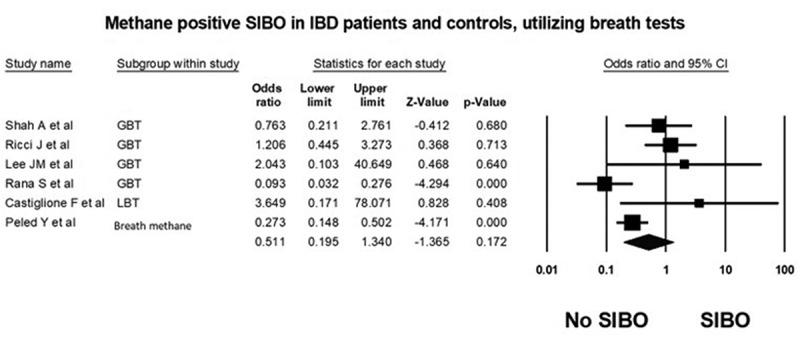
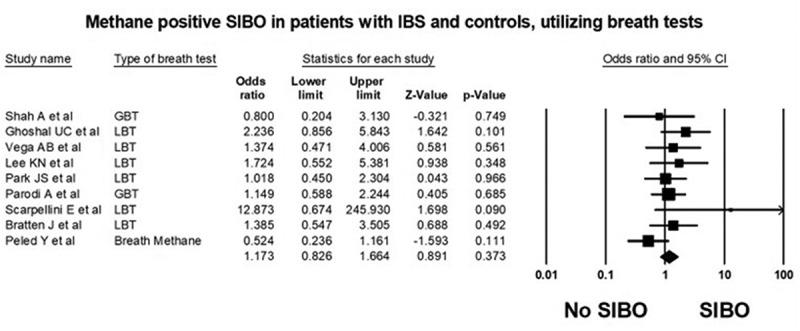
Several studies reported a potential role of methane producing archaea in the pathophysiology of irritable bowel syndrome (IBS) and inflammatory bowel disease (IBD). We conducted a systematic review and meta-analysis to assess the prevalence of methane positive small intestinal bacterial overgrowth (SIBO) in IBS and IBD compared with controls. MEDLINE (PubMed) and Embase electronic databases were searched from inception until March 2021 for case-control and prevalence studies reporting SIBO in IBS and IBD. We extracted data from published studies and calculated pooled prevalence of SIBO in IBS or IBD, odds ratios (OR), and 95% CIs, utilizing a random effects model. The final dataset included 17 independent studies assessing the prevalence of methane positive SIBO in 1,653 IBS-patients and 713 controls, and 7 studies assessing the prevalence of methane positive SIBO in 626 IBD-patients and 497 controls, all utilizing breath test for SIBO diagnosis. Prevalence of methane positive SIBO in IBS and IBD was 25.0% (95% CI 18.8-32.4) and 5.6% (95% CI 2.6-11.8), respectively. Methane positive SIBO in IBS was not increased compared to controls (OR = 1.2, 95% CI 0.8-1.7, = .37) but was significantly more prevalent in IBS-C as compared to IBS-D (OR = 3.1, 95% CI 1.7-5.6, = .0001). The prevalence of methane-positive SIBO in patients with IBD was 3-fold lower at 7.4% (95% CI 5.4-9.8) compared to 23.5% (95% CI 19.8-27.5) in controls. The prevalence of methane positive SIBO was significantly lower in Crohn's disease as compared to ulcerative colitis, (5.3%, 95% CI 3.0-8.5 vs. 20.2%, 95% CI 12.8-29.4). This systematic review and meta-analysis suggests methane positivity on breath testing is positively associated with IBS-C and inversely with IBD. However, the quality of evidence is low largely due to clinical heterogeneity of the studies. Thus, causality is uncertain and further studies are required.
几项研究报告称,产甲烷古菌在肠易激综合征(IBS)和炎症性肠病(IBD)的病理生理学中可能发挥作用。我们进行了系统评价和荟萃分析,以评估与对照相比,IBS 和 IBD 中小肠细菌过度生长(SIBO)甲烷阳性的患病率。从开始到 2021 年 3 月,我们在 MEDLINE(PubMed)和 Embase 电子数据库中搜索了报告 IBS 和 IBD 中 SIBO 的病例对照和患病率研究。我们从已发表的研究中提取数据,并利用随机效应模型计算 IBS 或 IBD 中 SIBO 的 pooled 患病率、比值比(OR)和 95%置信区间。最终数据集包括 17 项独立研究,评估了 1653 名 IBS 患者和 713 名对照中甲烷阳性 SIBO 的患病率,以及 7 项研究评估了 626 名 IBD 患者和 497 名对照中甲烷阳性 SIBO 的患病率,所有研究均采用呼吸试验诊断 SIBO。IBS 和 IBD 中甲烷阳性 SIBO 的患病率分别为 25.0%(95%CI 18.8-32.4)和 5.6%(95%CI 2.6-11.8)。与对照相比,IBS 中甲烷阳性 SIBO 并未增加(OR=1.2,95%CI 0.8-1.7, =.37),但在 IBS-C 中比 IBS-D 更为常见(OR=3.1,95%CI 1.7-5.6, =.0001)。与 23.5%(95%CI 19.8-27.5)的对照相比,IBD 患者中甲烷阳性 SIBO 的患病率低 3 倍,为 7.4%(95%CI 5.4-9.8)。与溃疡性结肠炎相比,克罗恩病中甲烷阳性 SIBO 的患病率明显较低,(5.3%,95%CI 3.0-8.5 vs. 20.2%,95%CI 12.8-29.4)。本系统评价和荟萃分析表明,呼吸试验的甲烷阳性与 IBS-C 呈正相关,与 IBD 呈负相关。然而,由于研究的临床异质性很大,证据质量较低。因此,因果关系不确定,需要进一步研究。
 Zotero 插件