
前瞻性评估多联液体活检在转移性前列腺癌中针对多种耐药机制的临床结局。
Prospective Evaluation of Clinical Outcomes Using a Multiplex Liquid Biopsy Targeting Diverse Resistance Mechanisms in Metastatic Prostate Cancer.
机构信息
Department of Medicine, Carbone Cancer Center, University of Wisconsin, Madison, WI.
Moores Cancer Center, University of California San Diego, La Jolla, CA.
出版信息
J Clin Oncol. 2021 Sep 10;39(26):2926-2937. doi: 10.1200/JCO.21.00169. Epub 2021 Jul 1.
PURPOSE
Nearly all men with prostate cancer treated with androgen receptor (AR) signaling inhibitors (ARSIs) develop resistance via diverse mechanisms including constitutive activation of the AR pathway, driven by AR genomic structural alterations, expression of AR splice variants (AR-Vs), or loss of AR dependence and lineage plasticity termed neuroendocrine prostate cancer. Understanding these de novo acquired ARSI resistance mechanisms is critical for optimizing therapy.
MATERIALS AND METHODS
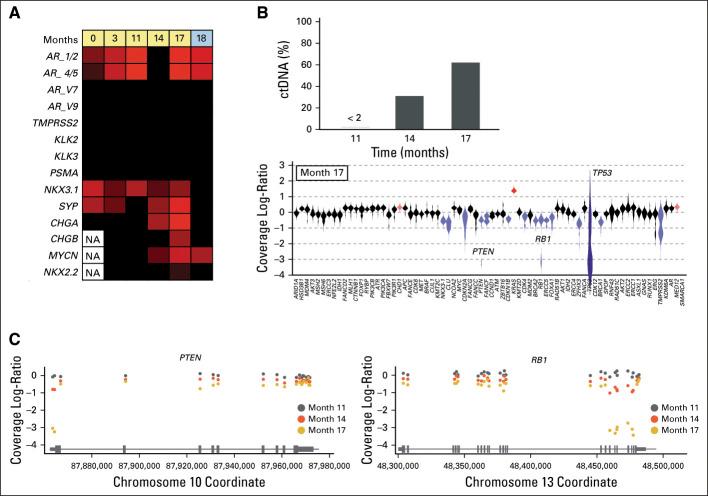
A novel liquid biopsy technology was used to collect mRNA from circulating tumor cells (CTCs) to measure expression of AR-Vs, AR targets, and neuroendocrine prostate cancer markers. An institutional review board-approved prospective cohort (N = 99) was used to identify patterns of gene expression. Two prospective multicenter phase II clinical trials of ARSIs for men with castration-resistant prostate cancer (ClinicalTrials.gov: NCT01942837 [enzalutamide, N = 21] and NCT02025010 [abiraterone, N = 27]) were used to further validate these findings.
RESULTS
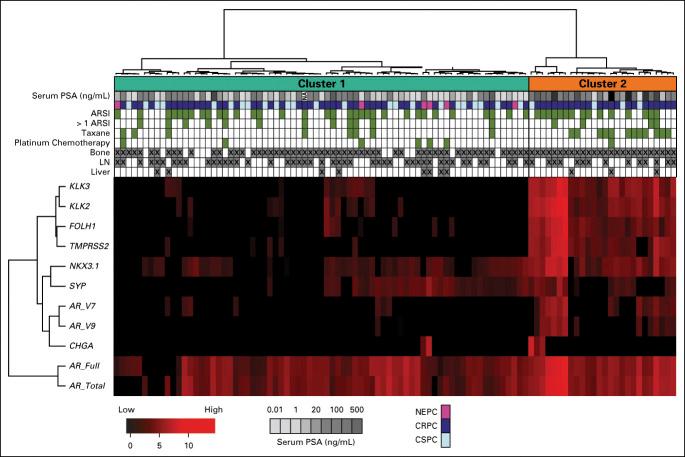
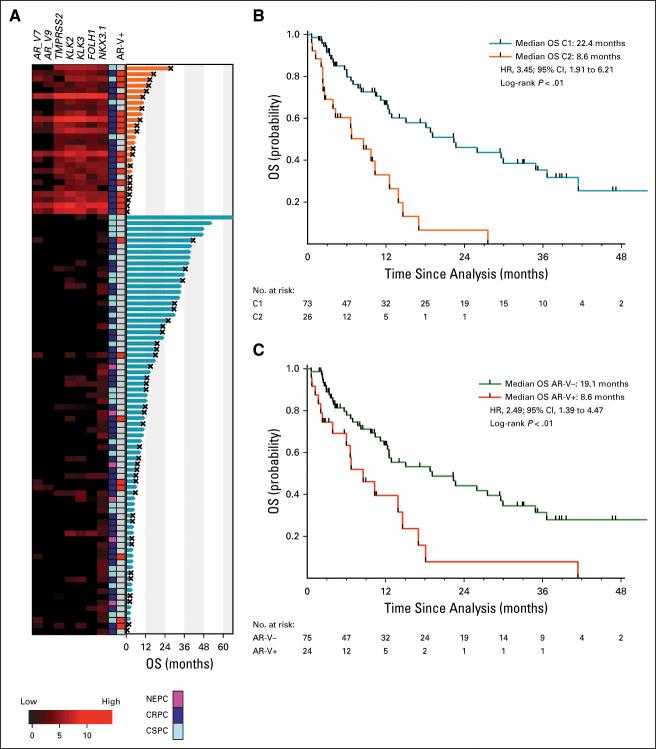
Hierarchical clustering of CTC transcripts identified two distinct clusters. Cluster 2 (C2) exhibited increased expression of AR-regulated genes and was associated with worse overall survival (median 8.6 22.4 months; < .01; hazard ratio [HR] = 3.45 [1.9 to 6.14]). In multivariable analysis, C2 was prognostic independent of other clinicopathologic variables. AR-V status was not significant when accounting for C2. Upon further validation in pooled multicenter phase II trials, C2 was associated with worse overall survival (15.2 months not reached; < .01; HR = 8.43 [2.74 to 25.92]), prostate-specific antigen progression-free survival (3.6 12 months; < .01; HR = 4.64 [1.53 to 14.11]), and radiographic progression-free survival (2.7 40.6 months; < .01; HR = 4.64 [1.82 to 17.41]).
CONCLUSION
We demonstrate that a transcriptional profile detectable in CTCs obtained from liquid biopsies can serve as an independent prognostic marker beyond AR-V7 in patients with metastatic prostate cancer and can be used to identify the emergence of multiple ARSI resistance mechanisms. This is currently being investigated in additional prospective trials.
目的
几乎所有接受雄激素受体 (AR) 信号抑制剂 (ARSIs) 治疗的前列腺癌患者都会通过多种机制产生耐药性,包括 AR 通路的组成性激活、AR 基因组结构改变驱动、AR 剪接变体 (AR-Vs) 的表达、或称为神经内分泌前列腺癌的 AR 依赖性和谱系可塑性丧失。了解这些新获得的 ARSI 耐药机制对于优化治疗至关重要。
材料和方法
使用新型液体活检技术从循环肿瘤细胞 (CTC) 中收集 mRNA,以测量 AR-Vs、AR 靶标和神经内分泌前列腺癌标志物的表达。使用机构审查委员会批准的前瞻性队列 (N = 99) 来确定基因表达模式。两项前瞻性多中心 ARSI 治疗去势抵抗性前列腺癌的 II 期临床试验 (ClinicalTrials.gov:NCT01942837 [恩扎鲁胺,N = 21] 和 NCT02025010 [阿比特龙,N = 27]) 用于进一步验证这些发现。
结果
CTC 转录本的层次聚类鉴定出两个不同的簇。簇 2 (C2) 表现出 AR 调节基因的表达增加,与总生存期更差相关 (中位 8.6 22.4 个月;<0.01;风险比 [HR] = 3.45 [1.9 至 6.14])。在多变量分析中,C2 是独立于其他临床病理变量的预后因素。当考虑到 C2 时,AR-V 状态并不显著。在汇总的多中心 II 期试验中进一步验证后,C2 与总生存期更差相关 (15.2 个月未达到;<0.01;HR = 8.43 [2.74 至 25.92])、前列腺特异性抗原无进展生存期 (3.6 12 个月;<0.01;HR = 4.64 [1.53 至 14.11]) 和放射性无进展生存期 (2.7 40.6 个月;<0.01;HR = 4.64 [1.82 至 17.41])。
结论
我们证明,从液体活检中获得的 CTC 中检测到的转录谱可以作为转移性前列腺癌患者除 AR-V7 以外的独立预后标志物,并可用于识别多种 ARSI 耐药机制的出现。这目前正在其他前瞻性试验中进行研究。


 Zotero 插件