
尿细胞外囊泡:揭示与肾脏相关疾病病理过程的基础。
Urinary Extracellular Vesicles: Uncovering the Basis of the Pathological Processes in Kidney-Related Diseases.
机构信息
Laboratory of Translational Research in Paediatric Nephro-Urology, Fondazione Ca' Granda IRCCS Ospedale Maggiore Policlinico, 20122 Milan, Italy.
Pediatric Nephrology, Dialysis and Transplant Unit, Fondazione Ca' Granda IRCCS, Policlinico di Milano, 20122 Milan, Italy.
出版信息
Int J Mol Sci. 2021 Jun 17;22(12):6507. doi: 10.3390/ijms22126507.
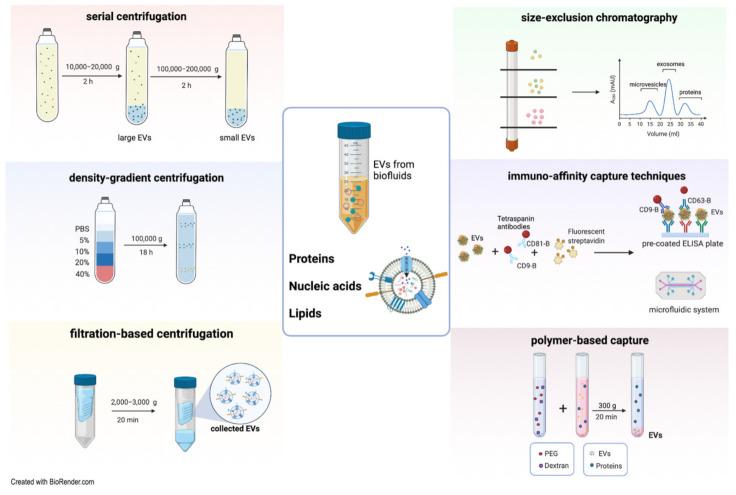
Intercellular communication governs multicellular interactions in complex organisms. A variety of mechanisms exist through which cells can communicate, e.g., cell-cell contact, the release of paracrine/autocrine soluble molecules, or the transfer of extracellular vesicles (EVs). EVs are membrane-surrounded structures released by almost all cell types, acting both nearby and distant from their tissue/organ of origin. In the kidney, EVs are potent intercellular messengers released by all urinary system cells and are involved in cell crosstalk, contributing to physiology and pathogenesis. Moreover, urine is a reservoir of EVs coming from the circulation after crossing the glomerular filtration barrier-or originating in the kidney. Thus, urine represents an alternative source for biomarkers in kidney-related diseases, potentially replacing standard diagnostic techniques, including kidney biopsy. This review will present an overview of EV biogenesis and classification and the leading procedures for isolating EVs from body fluids. Furthermore, their role in intra-nephron communication and their use as a diagnostic tool for precision medicine in kidney-related disorders will be discussed.
细胞间通讯控制着复杂生物中的多细胞相互作用。细胞可以通过多种机制进行通讯,例如细胞-细胞接触、旁分泌/自分泌可溶性分子的释放,或细胞外囊泡 (EVs) 的转移。EVs 是几乎所有细胞类型释放的被膜包围的结构,在其组织/器官起源的附近和远处发挥作用。在肾脏中,EVs 是泌尿系统所有细胞释放的强效细胞间信使,参与细胞串扰,有助于生理和发病机制。此外,尿液是循环系统中的 EVs 穿过肾小球滤过屏障后或在肾脏中产生的一种储库。因此,尿液是肾脏相关疾病生物标志物的替代来源,有可能替代包括肾活检在内的标准诊断技术。本文综述了 EV 的生物发生和分类,以及从体液中分离 EV 的主要方法。此外,还讨论了它们在肾单位内通讯中的作用及其作为肾脏相关疾病精准医学诊断工具的用途。

 Zotero 插件