
用 ICP OES 评估通过浸泡在酸性饮料(橙汁、可口可乐™ 和葡萄汁)中来量化和筛选牙齿脱矿的方法。
Methodology to Quantify and Screen the Demineralization of Teeth by Immersing Them in Acidic Drinks (Orange Juice, Coca-Cola™, and Grape Juice): Evaluation by ICP OES.
机构信息
Group of Spectroscopy and Bioinformatics Applied Biodiversity and Health (GEBABS), Post-Graduate Program in Health and Development in the Midwest Region, School of Medicine, Federal University of Mato Grosso do Sul, Campo Grande 79070-900, Brazil.
Physics Institute, Federal University of Mato Grosso do Sul, Campo Grande 79070-900, Brazil.
出版信息
Molecules. 2021 Jun 1;26(11):3337. doi: 10.3390/molecules26113337.
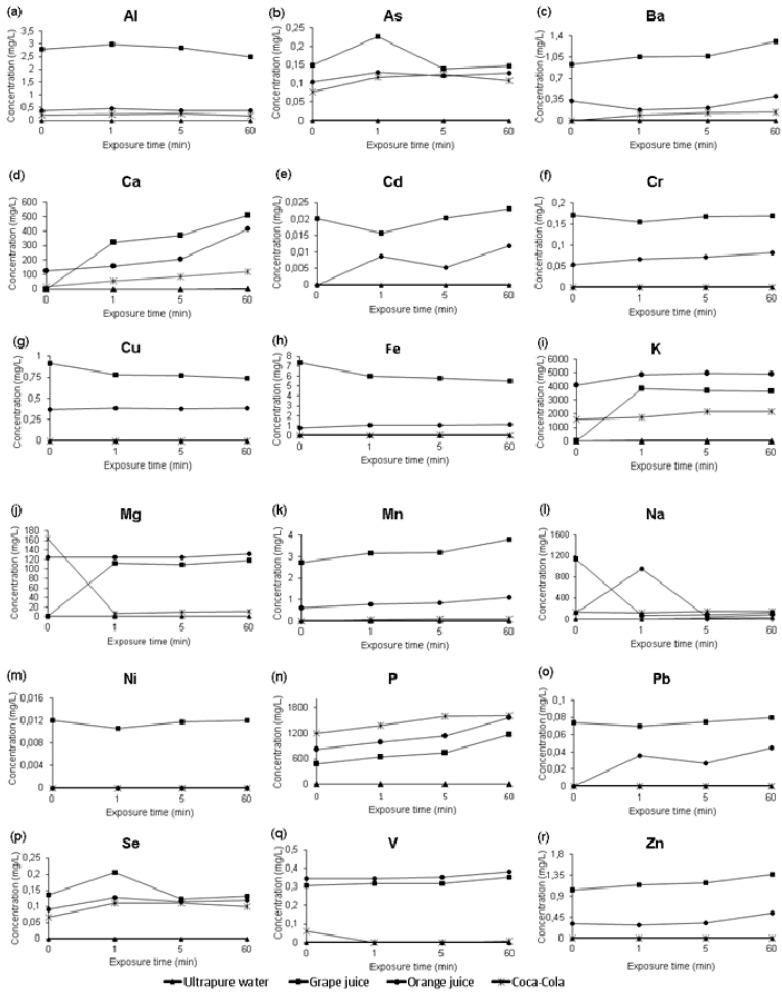
Oral health problems may occur as a result of the ingestion of acid drinks. The objective of this in vitro study was to quantify and screen the concentration of potassium (K), phosphorus (P), calcium (Ca), magnesium (Mg), manganese (Mn), zinc (Zn), iron (Fe), copper (Cu), barium (Ba), lead (Pb), arsenic (As), cadmium (Cd), aluminum (Al), cobalt (Co), chromium (Cr), molybdenum (Mo), sodium (Na), nickel (Ni), selenium (Se), and vanadium (V) released from bovine incisors during an erosive challenge at different times of exposure when immersed in Coca-Cola™, orange juice, and grape juice. A total of 240 samples of bovine incisor teeth were used for the erosive challenge and allocated in groups. Digestion of drinks was performed using microwave-assisted digestion. The content in acidic drinks was monitored before and after the erosive challenge at exposure times of 1, 5, and 60 min using inductively coupled plasma optical emission spectrometry (ICP OES). The drinks' pH varied slightly during the erosive challenge but remained below the critical value of pH 5 to cause tooth demineralization. The concentrations of elements released from the bovine incisors during the in vitro erosive challenge depend on exposure times when immersed in acidic beverages. For some elements such as Ca, Mn, Zn, Fe, Cu, Ba, Pb, As, and Cd, quantified in acidic drinks, grape juice had greater erosive potential than Coca-Cola™ and orange juice. Quantification and monitoring of chemical elements in bovine teeth can be performed considering a longer erosive time and other types of acidic drinks. Further analysis using human teeth is still not available and must be conducted. The demineralization of teeth not only occurs in acidic beverages; physical and chemical factors play other roles and should be investigated.
口腔健康问题可能是由于摄入酸性饮料而产生的。本体外研究的目的是定量和筛选牛切牙在不同暴露时间浸泡于可口可乐 ™、橙汁和葡萄汁中受到侵蚀性挑战时释放的钾(K)、磷(P)、钙(Ca)、镁(Mg)、锰(Mn)、锌(Zn)、铁(Fe)、铜(Cu)、钡(Ba)、铅(Pb)、砷(As)、镉(Cd)、铝(Al)、钴(Co)、铬(Cr)、钼(Mo)、钠(Na)、镍(Ni)、硒(Se)和钒(V)的浓度。共使用 240 个牛切牙样本进行侵蚀性挑战,并将其分组。使用微波辅助消化对饮料进行消化。使用电感耦合等离子体发射光谱法(ICP OES)在暴露时间为 1、5 和 60 分钟时,在侵蚀性挑战前后监测酸性饮料中的含量。在侵蚀性挑战过程中,饮料的 pH 值略有变化,但仍低于导致牙齿脱矿的 pH5 临界值。牛切牙在体外侵蚀性挑战过程中释放的元素浓度取决于浸泡于酸性饮料时的暴露时间。对于一些元素,如 Ca、Mn、Zn、Fe、Cu、Ba、Pb、As 和 Cd,在酸性饮料中定量,葡萄汁比可口可乐 ™和橙汁具有更大的侵蚀潜力。可以考虑更长的侵蚀时间和其他类型的酸性饮料来进行牛牙中化学元素的定量和监测。使用人牙进行进一步分析仍然不可用,必须进行。牙齿脱矿不仅发生在酸性饮料中;物理和化学因素也起着其他作用,应该进行调查。
 Zotero 插件