
小麦转录组对麦角菌(引起麦角病的病原菌)感染的重编程。
Reprogramming of the wheat transcriptome in response to infection with Claviceps purpurea, the causal agent of ergot.
机构信息
NIAB, 93 Lawrence Weaver Road, Cambridge, CB3 0LE, UK.
Department of Plant Sciences, University of Cambridge, Downing Street, Cambridge, CB2 3EA, UK.
出版信息
BMC Plant Biol. 2021 Jul 2;21(1):316. doi: 10.1186/s12870-021-03086-3.
BACKGROUND
Ergot, caused by the fungal pathogen Claviceps purpurea, infects the female flowers of a range of cereal crops, including wheat. To understand the interaction between C. purpurea and hexaploid wheat we undertook an extensive examination of the reprogramming of the wheat transcriptome in response to C. purpurea infection through floral tissues (i.e. the stigma, transmitting and base ovule tissues of the ovary) and over time.
RESULTS
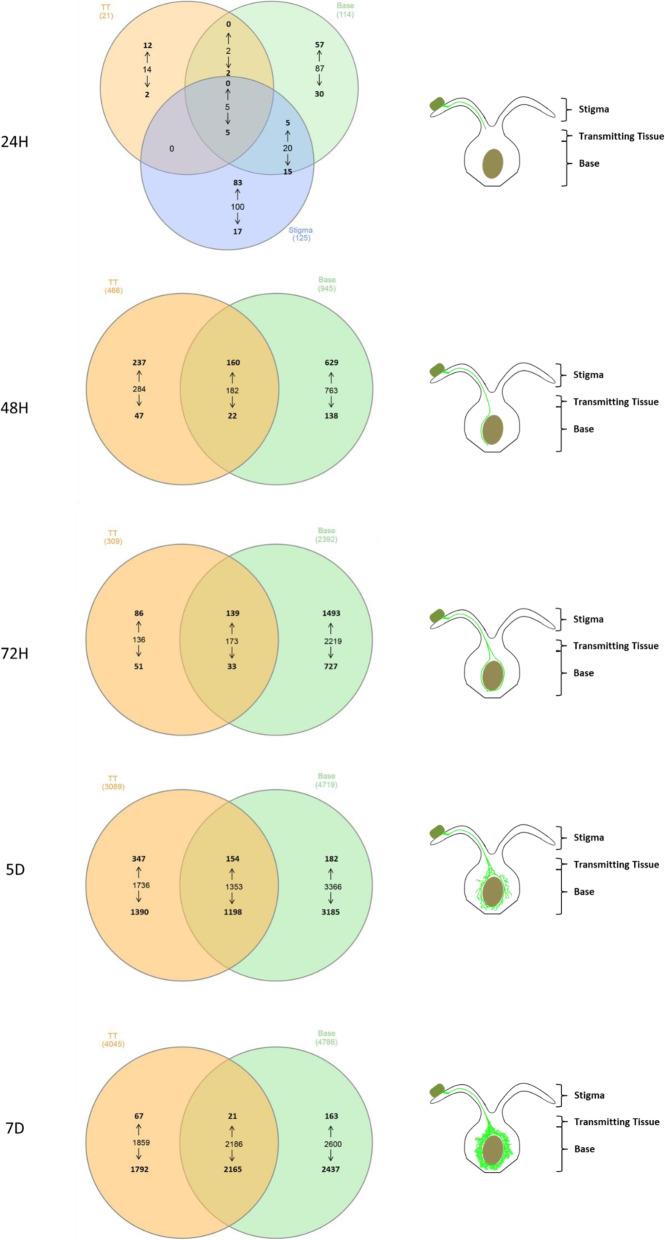
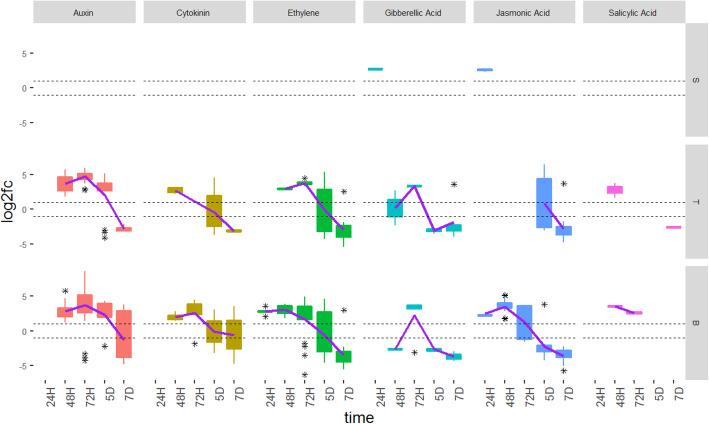
C. purpurea hyphae were observed to have grown into and down the stigma at 24 h (H) after inoculation. By 48H hyphae had grown through the transmitting tissue into the base, while by 72H hyphae had surrounded the ovule. By 5 days (D) the ovule had been replaced by fungal tissue. Differential gene expression was first observed at 1H in the stigma tissue. Many of the wheat genes differentially transcribed in response to C. purpurea infection were associated with plant hormones and included the ethylene (ET), auxin, cytokinin, gibberellic acid (GA), salicylic acid and jasmonic acid (JA) biosynthetic and signaling pathways. Hormone-associated genes were first detected in the stigma and base tissues at 24H, but not in the transmitting tissue. Genes associated with GA and JA pathways were seen in the stigma at 24H, while JA and ET-associated genes were identified in the base at 24H. In addition, several defence-related genes were differential expressed in response to C. purpurea infection, including antifungal proteins, endocytosis/exocytosis-related proteins, NBS-LRR class proteins, genes involved in programmed cell death, receptor protein kinases and transcription factors. Of particular interest was the identification of differential expression of wheat genes in the base tissue well before the appearance of fungal hyphae, suggesting that a mobile signal, either pathogen or plant-derived, is delivered to the base prior to colonisation.
CONCLUSIONS
Multiple host hormone biosynthesis and signalling pathways were significantly perturbed from an early stage in the wheat - C. purpurea interaction. Differential gene expression at the base of the ovary, ahead of arrival of the pathogen, indicated the potential presence of a long-distance signal modifying host gene expression.
背景
麦角菌由真菌病原体麦角菌引起,感染包括小麦在内的一系列谷类作物的雌性花朵。为了了解麦角菌和六倍体小麦之间的相互作用,我们通过花组织(即柱头、传递组织和子房基部胚珠组织)对小麦转录组在麦角菌感染下的重编程进行了广泛的研究,并随时间推移进行了研究。
结果
在接种后 24 小时(H)观察到麦角菌菌丝长入并向下延伸到柱头。到 48H 时,菌丝已穿过传递组织进入基部,而到 72H 时,菌丝已包围胚珠。到第 5 天(D),胚珠已被真菌组织取代。在柱头组织中,差异表达基因首先在 1H 时观察到。对麦角菌感染有反应的许多小麦基因与植物激素有关,包括乙烯(ET)、生长素、细胞分裂素、赤霉素(GA)、水杨酸和茉莉酸(JA)的生物合成和信号通路。在 24H 时,在柱头和基部组织中首先检测到与激素相关的基因,但在传递组织中没有检测到。在 24H 时,在柱头中观察到与 GA 和 JA 途径相关的基因,而在基部中观察到 JA 和 ET 相关的基因。此外,一些与防御相关的基因也对麦角菌感染有差异表达,包括抗真菌蛋白、内吞/外排相关蛋白、NBS-LRR 类蛋白、参与细胞程序性死亡的基因、受体蛋白激酶和转录因子。特别有趣的是,在真菌菌丝出现之前,就已经在基部组织中鉴定出了小麦基因的差异表达,这表明在定植之前,一种移动信号(无论是病原体还是植物来源的)被传递到基部。
结论
在小麦 - 麦角菌相互作用的早期阶段,多个宿主激素生物合成和信号通路受到显著干扰。在胚珠基部的差异基因表达,在病原体到达之前,表明可能存在一种远距离信号,修饰宿主基因表达。




 Zotero 插件