
用于单酰甘油脂肪酶成像的高特异性F标记不可逆正电子发射断层显像剂的研发。
Development of a highly-specific F-labeled irreversible positron emission tomography tracer for monoacylglycerol lipase mapping.
作者信息
Chen Zhen, Mori Wakana, Rong Jian, Schafroth Michael A, Shao Tuo, Van Richard S, Ogasawara Daisuke, Yamasaki Tomoteru, Hiraishi Atsuto, Hatori Akiko, Chen Jiahui, Zhang Yiding, Hu Kuan, Fujinaga Masayuki, Sun Jiyun, Yu Qingzhen, Collier Thomas L, Shao Yihan, Cravatt Benjamin F, Josephson Lee, Zhang Ming-Rong, Liang Steven H
机构信息
Division of Nuclear Medicine and Molecular Imaging, Massachusetts General Hospital & Department of Radiology, Harvard Medical School, Boston, MA 02114, USA.
Department of Advanced Nuclear Medicine Sciences, National Institute of Radiological Sciences, National Institutes for Quantum and Radiological Science and Technology, Chiba 263-8555, Japan.
出版信息
Acta Pharm Sin B. 2021 Jun;11(6):1686-1695. doi: 10.1016/j.apsb.2021.01.021. Epub 2021 Apr 1.
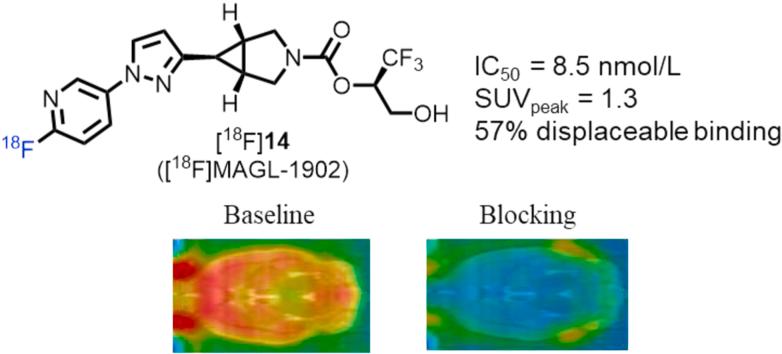
As a serine hydrolase, monoacylglycerol lipase (MAGL) is principally responsible for the metabolism of 2-arachidonoylglycerol (2-AG) in the central nervous system (CNS), leading to the formation of arachidonic acid (AA). Dysfunction of MAGL has been associated with multiple CNS disorders and symptoms, including neuroinflammation, cognitive impairment, epileptogenesis, nociception and neurodegenerative diseases. Inhibition of MAGL provides a promising therapeutic direction for the treatment of these conditions, and a MAGL positron emission tomography (PET) probe would greatly facilitate preclinical and clinical development of MAGL inhibitors. Herein, we design and synthesize a small library of fluoropyridyl-containing MAGL inhibitor candidates. Pharmacological evaluation of these candidates by activity-based protein profiling identified as a lead compound, which was then radiolabeled with fluorine-18 a facile SAr reaction to form 2-[F]fluoropyridine scaffold. Good blood-brain barrier permeability and high specific binding was demonstrated for radioligand [F] (also named as [F]MAGL-1902). This work may serve as a roadmap for clinical translation and further design of potent F-labeled MAGL PET tracers.
作为一种丝氨酸水解酶,单酰甘油脂肪酶(MAGL)主要负责中枢神经系统(CNS)中2-花生四烯酸甘油酯(2-AG)的代谢,从而导致花生四烯酸(AA)的形成。MAGL功能障碍与多种中枢神经系统疾病和症状相关,包括神经炎症、认知障碍、癫痫发生、伤害感受和神经退行性疾病。抑制MAGL为治疗这些病症提供了一个有前景的治疗方向,而MAGL正电子发射断层扫描(PET)探针将极大地促进MAGL抑制剂的临床前和临床开发。在此,我们设计并合成了一个含氟吡啶基的MAGL抑制剂候选物的小型文库。通过基于活性的蛋白质谱分析对这些候选物进行药理学评估,确定了一种先导化合物,然后通过简便的亲核芳香取代(SAr)反应将其用氟-18进行放射性标记,以形成2-[F]氟吡啶支架。放射性配体[F](也称为[F]MAGL-1902)表现出良好的血脑屏障通透性和高特异性结合。这项工作可为有效的F标记MAGL PET示踪剂的临床转化和进一步设计提供路线图。



 Zotero 插件