
预约过多:评估医疗服务提供者和护士对门诊姑息治疗转诊障碍的看法。
Too Many Appointments: Assessing Provider and Nursing Perception of Barriers to Referral for Outpatient Palliative Care.
作者信息
Agne Julia L, Bertino Erin M, Grogan Madison, Benedict Jason, Janse Sarah, Naughton Michelle, Eastep Christine, Callahan Michael, Presley Carolyn J
机构信息
Division of Palliative Medicine, The Ohio State University Wexner Medical Center, Columbus, Ohio, USA.
Division of Medical Oncology, The Ohio State University James Comprehensive Cancer Center, Columbus, Ohio, USA.
出版信息
Palliat Med Rep. 2021 May 17;2(1):137-145. doi: 10.1089/pmr.2020.0114. eCollection 2021.
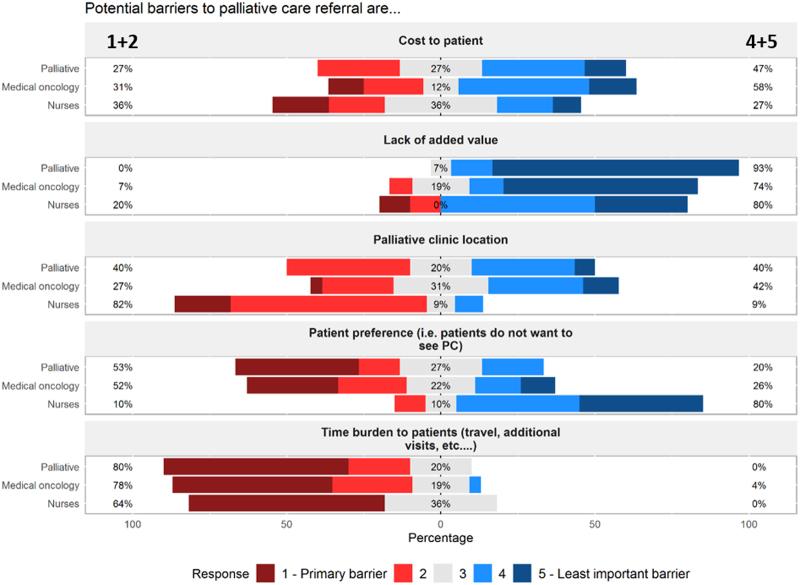
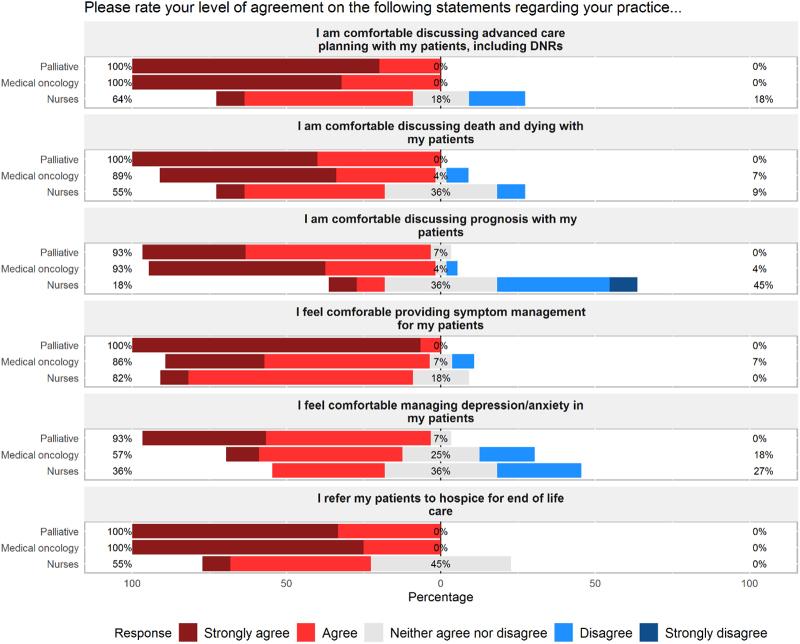
Integration of early outpatient palliative care for patients with advanced cancer requires overcoming logistical constraints as well as attitudinal barriers of referring providers. This pilot study assessed provider perception of logistical and attitudinal barriers to outpatient palliative care referral as well as provider acceptability of an embedded onco-palliative clinic model. This was a cross-sectional survey-based study of medical oncologists, palliative care physicians, advanced practice providers (APP), and oncology nurses at a large U.S. academic center. Participants were invited to participate through anonymous online survey. Participants rank ordered logistical barriers influencing referral to an outpatient palliative clinic. Respondents indicated level of agreement with attitudinal perception of palliative care and acceptability of an embedded palliative clinic model through five-item Likert-like scales. There were a total of 54 study participants (28 oncology physicians/APPs, 15 palliative physicians/APPs, and 11 oncology nurses). Across the three cohorts, most survey respondents ranked "time burden to patients" as the primary logistical barrier to outpatient palliative care referral. Both oncology and palliative providers indicated comfort with primary palliative care skills although palliative providers were more comfortable with symptom management compared with oncology providers (93.3% vs. 32.2%). A majority of participants (94.9%) were willing to refer to a palliative care provider embedded within an oncology clinic. Additional health care time cost to patients is a major barrier to outpatient palliative care referral. Embedding a palliative care provider in an oncology clinic may be an acceptable model to increase patient access to outpatient palliative care while supporting the oncology team.
为晚期癌症患者提供早期门诊姑息治疗,需要克服后勤方面的限制以及转诊医护人员的观念障碍。这项试点研究评估了医护人员对门诊姑息治疗转诊的后勤和观念障碍的看法,以及对嵌入式肿瘤姑息诊所模式的接受程度。这是一项基于横断面调查的研究,对象是美国一家大型学术中心的医学肿瘤学家、姑息治疗医生、高级执业医护人员(APP)和肿瘤护士。通过匿名在线调查邀请参与者参与。参与者对影响转诊至门诊姑息诊所的后勤障碍进行排序。受访者通过类似李克特量表的五项指标表明对姑息治疗观念的认同程度以及对嵌入式姑息诊所模式的接受程度。共有54名研究参与者(28名肿瘤医生/APP、15名姑息治疗医生/APP和11名肿瘤护士)。在这三个队列中,大多数受访者将“患者的时间负担”列为门诊姑息治疗转诊的主要后勤障碍。肿瘤和姑息治疗医护人员均表示对初级姑息治疗技能感到安心,不过与肿瘤医护人员相比,姑息治疗医护人员对症状管理更有信心(93.3%对32.2%)。大多数参与者(94.9%)愿意转诊至肿瘤诊所内的姑息治疗医护人员处。患者额外的医疗时间成本是门诊姑息治疗转诊的主要障碍。在肿瘤诊所安排一名姑息治疗医护人员,可能是一种可接受的模式,既能增加患者获得门诊姑息治疗的机会,又能支持肿瘤治疗团队。

 Zotero 插件