
III 型限制修饰系统通过使胞嘧啶的 N4 原子甲基化来保护宿主 DNA,这些系统在结构和功能上存在多样性。
Structural and functional diversity among Type III restriction-modification systems that confer host DNA protection via methylation of the N4 atom of cytosine.
机构信息
New England Biolabs, Ipswich, Massachusetts, United States of America.
Interdisciplinary Center for Biotechnology Research, University of Florida, Gainesville, Florida, United States of America.
出版信息
PLoS One. 2021 Jul 6;16(7):e0253267. doi: 10.1371/journal.pone.0253267. eCollection 2021.
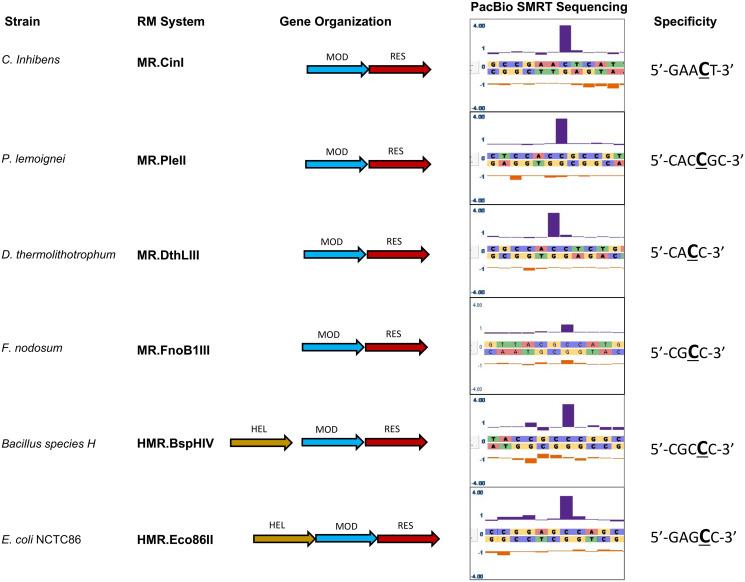
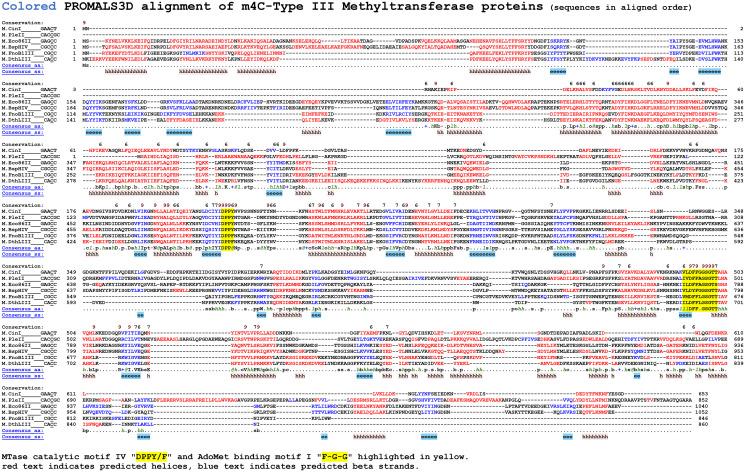
We report a new subgroup of Type III Restriction-Modification systems that use m4C methylation for host protection. Recognition specificities for six such systems, each recognizing a novel motif, have been determined using single molecule real-time DNA sequencing. In contrast to all previously characterized Type III systems which modify adenine to m6A, protective methylation of the host genome in these new systems is achieved by the N4-methylation of a cytosine base in one strand of an asymmetric 4 to 6 base pair recognition motif. Type III systems are heterotrimeric enzyme complexes containing a single copy of an ATP-dependent restriction endonuclease-helicase (Res) and a dimeric DNA methyltransferase (Mod). The Type III Mods are beta-class amino-methyltransferases, examples of which form either N6-methyl adenine or N4-methyl cytosine in Type II RM systems. The Type III m4C Mod and Res proteins are diverged, suggesting ancient origin or that m4C modification has arisen from m6A MTases multiple times in diverged lineages. Two of the systems, from thermophilic organisms, required expression of both Mod and Res to efficiently methylate an E. coli host, unlike previous findings that Mod alone is proficient at modification, suggesting that the division of labor between protective methylation and restriction activities is atypical in these systems. Two of the characterized systems, and many homologous putative systems, appear to include a third protein; a conserved putative helicase/ATPase subunit of unknown function and located 5' of the mod gene. The function of this additional ATPase is not yet known, but close homologs co-localize with the typical Mod and Res genes in hundreds of putative Type III systems. Our findings demonstrate a rich diversity within Type III RM systems.
我们报告了一类新的 III 型限制修饰系统亚类,它们利用 m4C 甲基化来保护宿主。使用单分子实时 DNA 测序技术,确定了六个具有独特基序的此类系统的识别特异性。与所有先前表征的 III 型系统不同,这些新系统通过在不对称的 4 到 6 个碱基对识别基序的一条链中对胞嘧啶碱基进行 N4-甲基化来实现对宿主基因组的保护性甲基化,而不是对腺嘌呤进行 m6A 修饰。III 型系统是包含单个 ATP 依赖性限制内切酶-解旋酶(Res)和二聚体 DNA 甲基转移酶(Mod)的异源三聚体酶复合物。III 型 Mod 是β类氨基甲基转移酶,其示例在 II 型 RM 系统中形成 N6-甲基腺嘌呤或 N4-甲基胞嘧啶。III 型 m4C Mod 和 Res 蛋白分化明显,表明其起源古老,或者 m4C 修饰在分化的谱系中多次从 m6A MTases 产生。其中两个来自嗜热生物的系统,需要表达 Mod 和 Res 才能有效地甲基化大肠杆菌宿主,这与之前的研究结果不同,即 Mod 单独就能够高效修饰,这表明在这些系统中,保护甲基化和限制活性之间的分工是非典型的。两个已表征的系统和许多同源的假定系统似乎包含第三个蛋白;一个功能未知的保守假定解旋酶/ATPase亚基,位于 Mod 基因的 5'端。这个额外的 ATPase 的功能尚不清楚,但密切的同源物与数百个假定的 III 型系统中的典型 Mod 和 Res 基因共定位。我们的研究结果表明 III 型 RM 系统具有丰富的多样性。

 Zotero 插件