
血管紧张素转换酶抑制剂与血管紧张素 II 受体拮抗剂对高血压患者胰岛素敏感性的影响:一项随机对照试验的荟萃分析。
Angiotensin-converting enzyme inhibitors versus angiotensin II receptor blockers on insulin sensitivity in hypertensive patients: A meta-analysis of randomized controlled trials.
机构信息
School of Second Clinical Medicine, Guangzhou University of Chinese Medicine, Guangzhou, China.
School of First Clinical Medicine, Guangzhou University of Chinese Medicine, Guangzhou, China.
出版信息
PLoS One. 2021 Jul 7;16(7):e0253492. doi: 10.1371/journal.pone.0253492. eCollection 2021.
INTRODUCTION
This meta-analysis aimed to summarize the available evidence to compare angiotensin-converting enzyme (ACE) inhibitors with angiotensin II receptor blockers (ARBs) on improving insulin sensitivity in hypertensive patients.
METHODS
Randomized controlled trials (RCTs) comparing ACE inhibitors versus ARBs published with outcomes on homeostasis model assessment of IR (HOMA-IR), glucose infusion rate (GIR), the quantitative insulin sensitivity check index (QUICKI), insulin sensitivity index (ISI) composite, fasting plasma glucose (FPG), fasting plasma insulin (FPI), systolic blood pressure (SBP), and diastolic blood pressure (DBP) were searched through 5 databases. Data were searched from their inception to July 5, 2020. Stata 14.0 was used to perform the meta-analysis.
RESULTS
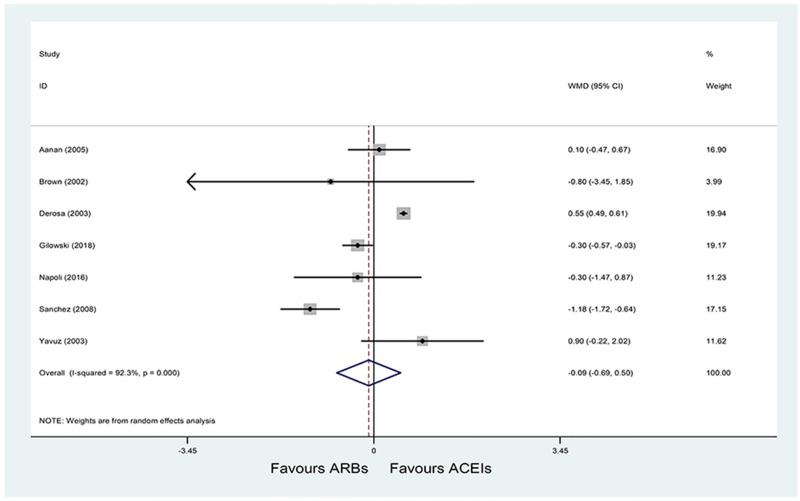
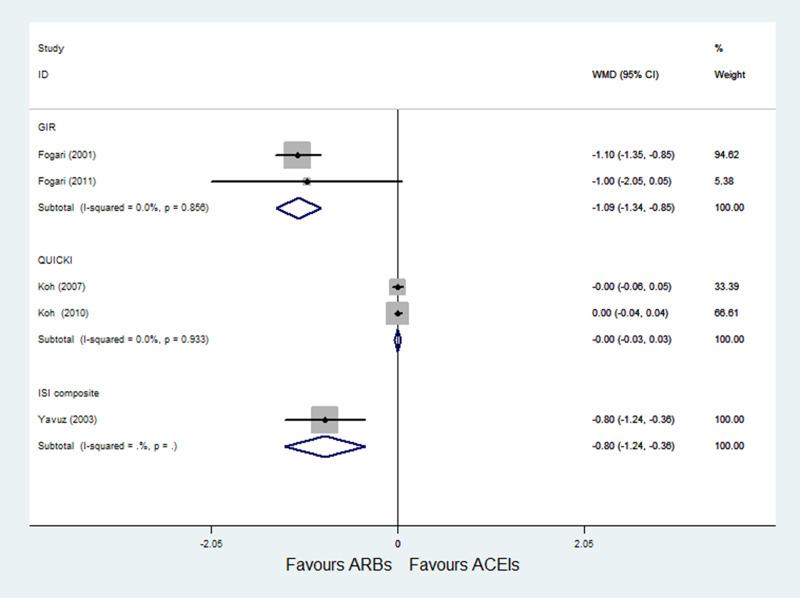
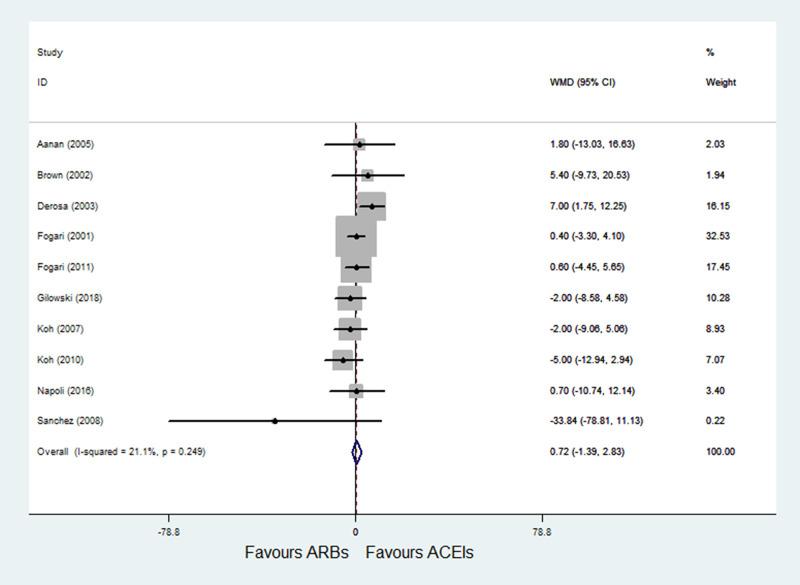
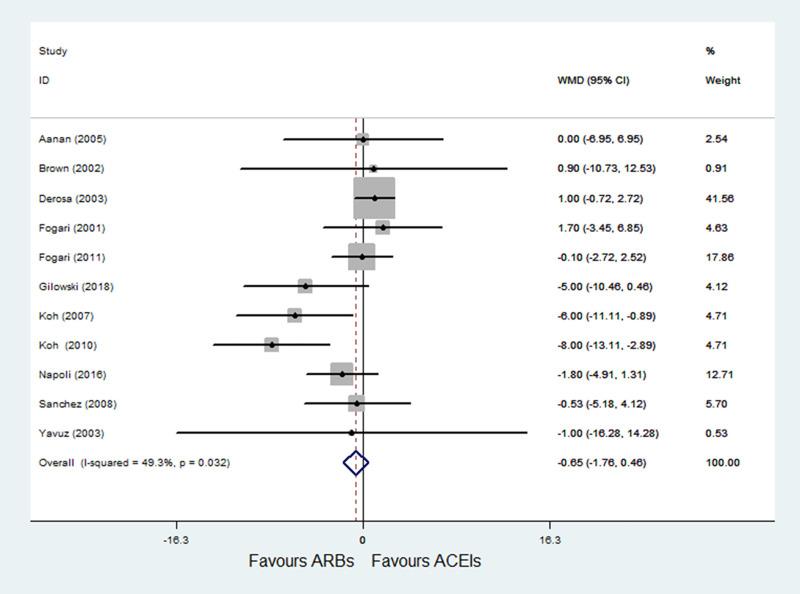
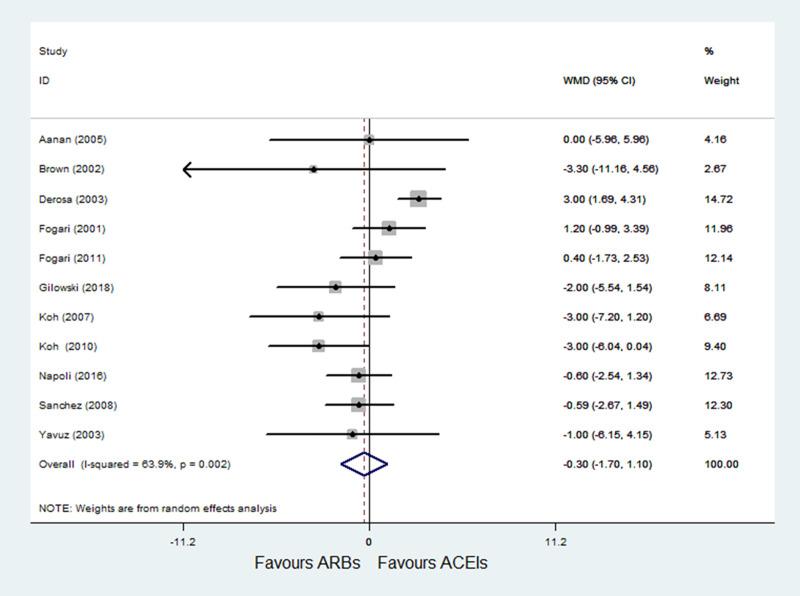
Eleven RCTs (n = 1015) were included in this meta-analysis. Pooled analysis of studies showed no significant difference in HOMA-IR between ARBs and ACE inhibitors (WMD = -0.09, 95% CI: -0.69 to 0.50, P = 0.755); however, subgroup analysis of therapeutic duration showed a significant difference in HOMA-IR between ARBs and ACE inhibitors among the long-term intervention subgroup (>12 weeks) (WMD = 0.41, 95% CI: 0.06 to 0.76, P = 0.022) and hypertensive patients with diabetes mellitus subgroup (WMD = 0.55, 95% CI: 0.49 to 0.61, P < 0.001); results showed no significant difference between ARBs and ACE inhibitors on QUICKI score (WMD = -0.00, 95% CI: -0.03 to 0.03, P = 0.953) in hypertensive patients; however, the efficacy of ACE inhibitors on improving GIR and ISI composite was significantly better than that of ARBs (WMD = -1.09, 95% CI: -1.34 to -0.85, P < 0.001; WMD = -0.80, 95% CI: -1.24 to -0.36, P < 0.001, respectively). Furthermore, no significant differences were noted on FPG (WMD = 0.72, 95% CI: -1.39 to 2.83, P = 0.505), FPI (WMD = -0.48, 95% CI: -1.60 to 0.64, P = 0.398), SBP (WMD = -0.65, 95% CI: -1.76 to 0.46, P = 0.254), and DBP (WMD = -0.30, 95% CI: -1.70 to 1.10, P = 0.675) between ARBs and ACE inhibitors.
CONCLUSION
Results from this meta-analysis showed that ACE inhibitors resulted in more effective improvement of HOMA-IR compared with ARBs among the long-term intervention and hypertensive patients with DM subgroup; furthermore, the efficacy of ACE inhibitors on improving GIR and ISI composite was significantly better than that of ARBs in hypertensive patients. However, ARBs had no significant difference in QUICKI score, FPG, FPI, SBP, and DBP compared with ACE inhibitors. Larger and better-designed studies are needed to further verify this conclusion.
简介
本荟萃分析旨在总结现有证据,比较血管紧张素转换酶(ACE)抑制剂和血管紧张素 II 受体阻滞剂(ARB)在改善高血压患者胰岛素敏感性方面的作用。
方法
通过 5 个数据库检索了比较 ACE 抑制剂与 ARB 的随机对照试验(RCT),并发表了关于稳态模型评估胰岛素抵抗(HOMA-IR)、葡萄糖输注率(GIR)、定量胰岛素敏感性检查指数(QUICKI)、胰岛素敏感性指数(ISI)综合、空腹血糖(FPG)、空腹胰岛素(FPI)、收缩压(SBP)和舒张压(DBP)的结果。数据检索时间从成立到 2020 年 7 月 5 日。使用 Stata 14.0 进行荟萃分析。
结果
荟萃分析纳入了 11 项 RCT(n=1015)。研究的汇总分析显示,ARB 和 ACE 抑制剂在 HOMA-IR 方面没有显著差异(WMD=-0.09,95%CI:-0.69 至 0.50,P=0.755);然而,根据治疗持续时间的亚组分析,ARB 和 ACE 抑制剂在长期干预亚组(>12 周)(WMD=0.41,95%CI:0.06 至 0.76,P=0.022)和高血压合并糖尿病患者亚组(WMD=0.55,95%CI:0.49 至 0.61,P<0.001)中存在显著差异;结果显示,ARB 和 ACE 抑制剂在高血压患者的 QUICKI 评分方面没有显著差异(WMD=-0.00,95%CI:-0.03 至 0.03,P=0.953);然而,ACE 抑制剂在改善 GIR 和 ISI 综合方面的疗效明显优于 ARB(WMD=-1.09,95%CI:-1.34 至 -0.85,P<0.001;WMD=-0.80,95%CI:-1.24 至 -0.36,P<0.001)。此外,ARB 和 ACE 抑制剂在 FPG(WMD=0.72,95%CI:-1.39 至 2.83,P=0.505)、FPI(WMD=-0.48,95%CI:-1.60 至 0.64,P=0.398)、SBP(WMD=-0.65,95%CI:-1.76 至 0.46,P=0.254)和 DBP(WMD=-0.30,95%CI:-1.70 至 1.10,P=0.675)方面也没有显著差异。
结论
荟萃分析结果表明,与 ARB 相比,ACE 抑制剂在长期干预和高血压合并糖尿病患者亚组中更有效地改善 HOMA-IR;此外,ACE 抑制剂在改善 GIR 和 ISI 综合方面的疗效明显优于 ARB 在高血压患者中的疗效。然而,ARB 在 QUICKI 评分、FPG、FPI、SBP 和 DBP 方面与 ACE 抑制剂相比没有显著差异。需要更大和设计更好的研究来进一步验证这一结论。



 Zotero 插件