
多模态特质情绪智力预测——通过非接触式生理测量手段测量情感变化。
Multimodal prediction of trait emotional intelligence-Through affective changes measured using non-contact based physiological measures.
机构信息
Advanced Technology Development Centre, Indian Institute of Technology Kharagpur, Kharagpur, West Bengal, India.
Centre for Education Technology, Indian Institute of Technology Kharagpur, Kharagpur, West Bengal, India.
出版信息
PLoS One. 2021 Jul 9;16(7):e0254335. doi: 10.1371/journal.pone.0254335. eCollection 2021.
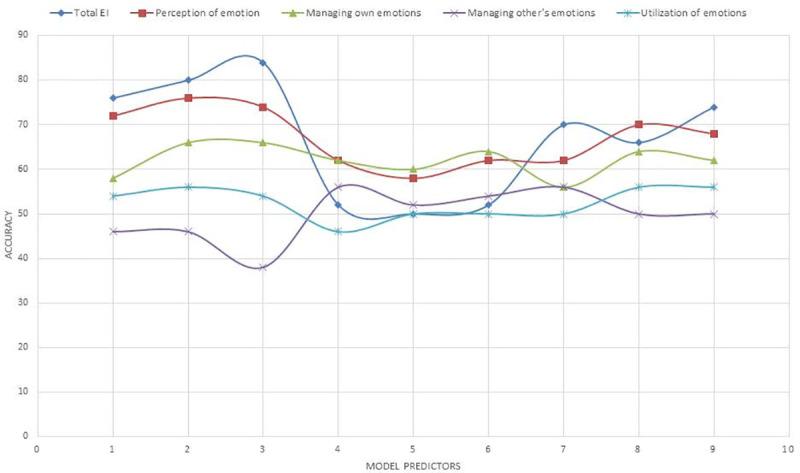
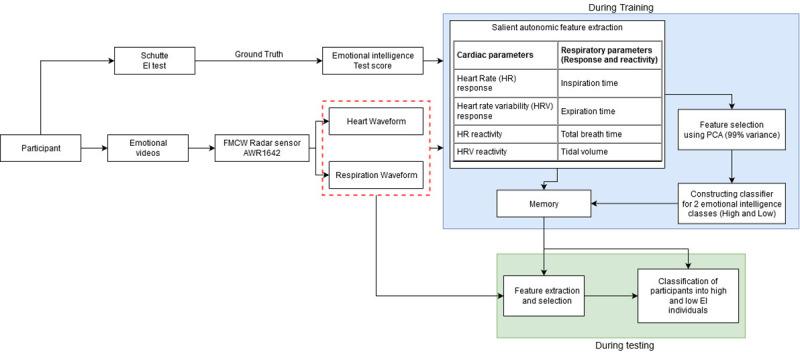
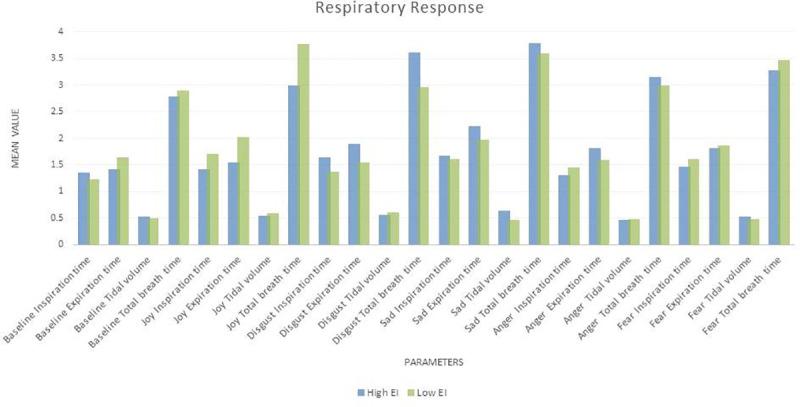
Inability to efficiently deal with emotionally laden situations, often leads to poor interpersonal interactions. This adversely affects the individual's psychological functioning. A higher trait emotional intelligence (EI) is not only associated with psychological wellbeing, educational attainment, and job-related success, but also with willingness to seek professional and non-professional help for personal-emotional problems, depression and suicidal ideation. Thus, it is important to identify low (EI) individuals who are more prone to mental health problems than their high EI counterparts, and give them the appropriate EI training, which will aid in preventing the onset of various mood related disorders. Since people may be unaware of their level of EI/emotional skills or may tend to fake responses in self-report questionnaires in high stake situations, a system that assesses EI using physiological measures can prove affective. We present a multimodal method for detecting the level of trait Emotional intelligence using non-contact based autonomic sensors. To our knowledge, this is the first work to predict emotional intelligence level from physiological/autonomic (cardiac and respiratory) response patterns to emotions. Trait EI of 50 users was measured using Schutte Self Report Emotional Intelligence Test (SSEIT) along with their cardiovascular and respiratory data, which was recorded using FMCW radar sensor both at baseline and while viewing affective movie clips. We first examine relationships between users' Trait EI scores and autonomic response and reactivity to the clips. Our analysis suggests a significant relationship between EI and autonomic response and reactivity. We finally attempt binary EI level detection using linear SVM. We also attempt to classify each sub factor of EI, namely-perception of emotion, managing own emotions, managing other's emotions, and utilization of emotions. The proposed method achieves an EI classification accuracy of 84%, while accuracies ranging from 58 to 76% is achieved for recognition of the sub factors. This is the first step towards identifying EI of an individual purely through physiological responses. Limitation and future directions are discussed.
无法有效地处理情绪化的情况,通常会导致人际交往不佳。这会对个人的心理功能产生不利影响。较高的特质情绪智力(EI)不仅与心理健康、教育程度和与工作相关的成功相关,还与愿意为个人情感问题、抑郁和自杀意念寻求专业和非专业帮助相关。因此,识别那些比高 EI 个体更容易出现心理健康问题的低(EI)个体,并为他们提供适当的 EI 培训,这对于预防各种与情绪相关的障碍的发生非常重要。由于人们可能不知道自己的 EI/情绪技能水平,或者在高风险情况下可能倾向于在自我报告问卷中伪造反应,因此使用生理测量来评估 EI 的系统可能会产生影响。我们提出了一种使用非接触式自主传感器检测特质情绪智力水平的多模态方法。据我们所知,这是首次从生理/自主(心脏和呼吸)对情绪的反应模式来预测情绪智力水平的工作。使用 Schutte 自我报告情绪智力测试(SSEIT)测量了 50 名用户的特质 EI,同时记录了他们的心血管和呼吸数据,使用 FMCW 雷达传感器在基线和观看情感电影片段时进行记录。我们首先研究了用户特质 EI 分数与自主反应之间的关系以及对片段的反应性。我们的分析表明 EI 与自主反应和反应性之间存在显著关系。我们最后尝试使用线性 SVM 进行二元 EI 水平检测。我们还尝试对 EI 的每个子因素进行分类,即情绪感知、管理自己的情绪、管理他人的情绪和利用情绪。该方法的 EI 分类准确率达到 84%,而对各子因素的识别准确率在 58%到 76%之间。这是通过生理反应识别个体 EI 的第一步。讨论了限制和未来方向。





 Zotero 插件