
核 cGAS:守卫还是囚徒?
Nuclear cGAS: guard or prisoner?
机构信息
Gene Center, Ludwig-Maximilians-Universität, Munich, Germany.
Department of Biochemistry, Ludwig-Maximilians-Universität, Munich, Germany.
出版信息
EMBO J. 2021 Aug 16;40(16):e108293. doi: 10.15252/embj.2021108293. Epub 2021 Jul 12.
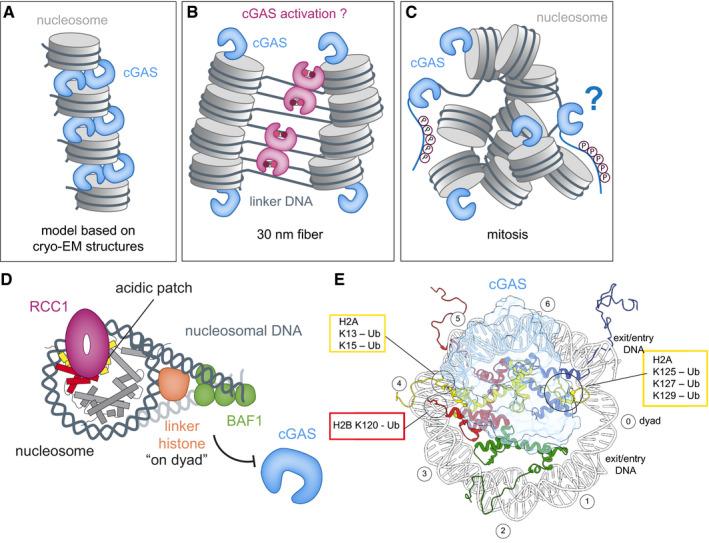
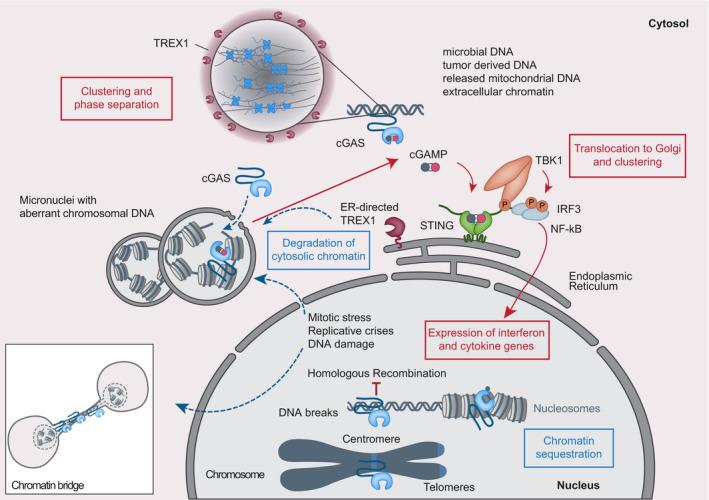
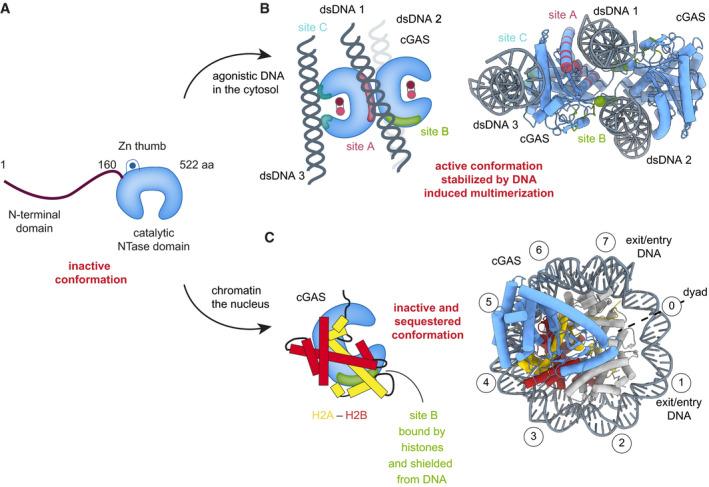
cGAS, an innate immune sensor of cellular stress, recognizes double-stranded DNA mislocalized in the cytosol upon infection, mitochondrial stress, DNA damage, or malignancy. Early models suggested that cytosolic localization of cGAS prevents autoreactivity to nuclear and mitochondrial self-DNA, but this paradigm has shifted in light of recent findings of cGAS as a predominantly nuclear protein tightly bound to chromatin. This has raised the question how nuclear cGAS is kept inactive while being surrounded by chromatin, and what function nuclear localization of cGAS may serve in the first place? Cryo-EM structures have revealed that cGAS interacts with nucleosomes, the minimal units of chromatin, mainly via histones H2A/H2B, and that these protein-protein interactions block cGAS from DNA binding and thus prevent autoreactivity. Here, we discuss the biological implications of nuclear cGAS and its interaction with chromatin, including various mechanisms for nuclear cGAS inhibition, release of chromatin-bound cGAS, regulation of different cGAS pools in the cell, and chromatin structure/chromatin protein effects on cGAS activation leading to cGAS-induced autoimmunity.
cGAS,一种先天免疫传感器,可识别感染、线粒体应激、DNA 损伤或恶性肿瘤时细胞溶质中定位错误的双链 DNA。早期模型表明,cGAS 在细胞质中的定位可防止自身反应与核和线粒体自身 DNA 发生反应,但最近发现 cGAS 主要是一种紧密结合于染色质的核蛋白,这一范例发生了转变。这就提出了一个问题,即核 cGAS 如何在被染色质包围的情况下保持失活状态,以及核定位的 cGAS 首先可能具有什么功能?冷冻电镜结构揭示了 cGAS 与核小体(染色质的最小单位)相互作用,主要通过组蛋白 H2A/H2B 进行,这些蛋白-蛋白相互作用阻止 cGAS 与 DNA 结合,从而防止自身反应。在这里,我们讨论了核 cGAS 及其与染色质相互作用的生物学意义,包括核 cGAS 抑制的各种机制、染色质结合的 cGAS 的释放、细胞中不同 cGAS 池的调节以及染色质结构/染色质蛋白对 cGAS 激活的影响,导致 cGAS 诱导的自身免疫。


 Zotero 插件