
脐血代谢特征可预测儿童超重和快速生长。
Cord blood metabolic signatures predictive of childhood overweight and rapid growth.
机构信息
Μedical Research Council Centre for Environment and Health, School of Public Health, Imperial College London, London, UK.
Nutrition and Metabolism Section, International Agency for Research on Cancer, Lyon, France.
出版信息
Int J Obes (Lond). 2021 Oct;45(10):2252-2260. doi: 10.1038/s41366-021-00888-1. Epub 2021 Jul 12.
INTRODUCTION
Metabolomics may identify biological pathways predisposing children to the risk of overweight and obesity. In this study, we have investigated the cord blood metabolic signatures of rapid growth in infancy and overweight in early childhood in four European birth cohorts.
METHODS
Untargeted liquid chromatography-mass spectrometry metabolomic profiles were measured in cord blood from 399 newborns from four European cohorts (ENVIRONAGE, Rhea, INMA and Piccolipiu). Rapid growth in the first year of life and overweight in childhood was defined with reference to WHO growth charts. Metabolome-wide association scans for rapid growth and overweight on over 4500 metabolic features were performed using multiple adjusted logistic mixed-effect models and controlling the false discovery rate (FDR) at 5%. In addition, we performed a look-up analysis of 43 pre-annotated metabolites, previously associated with birthweight or rapid growth.
RESULTS
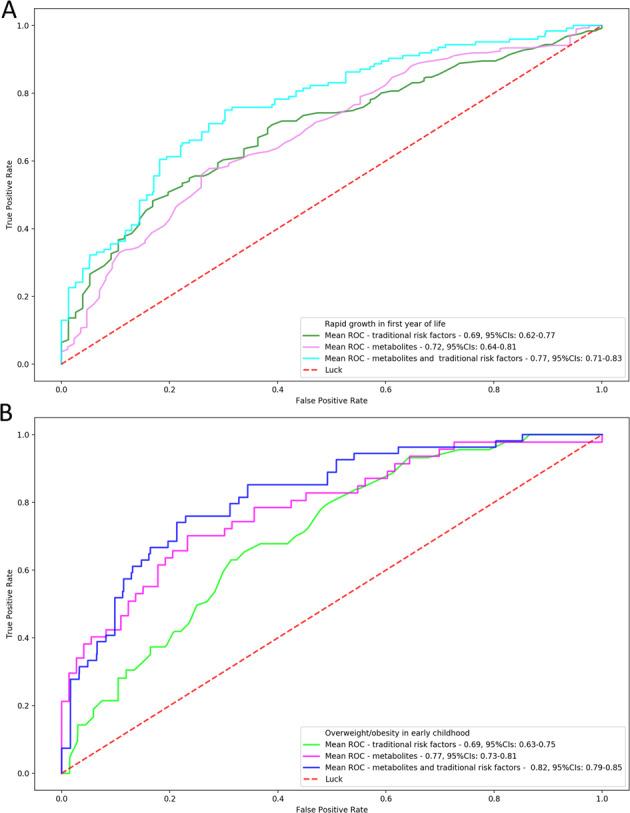
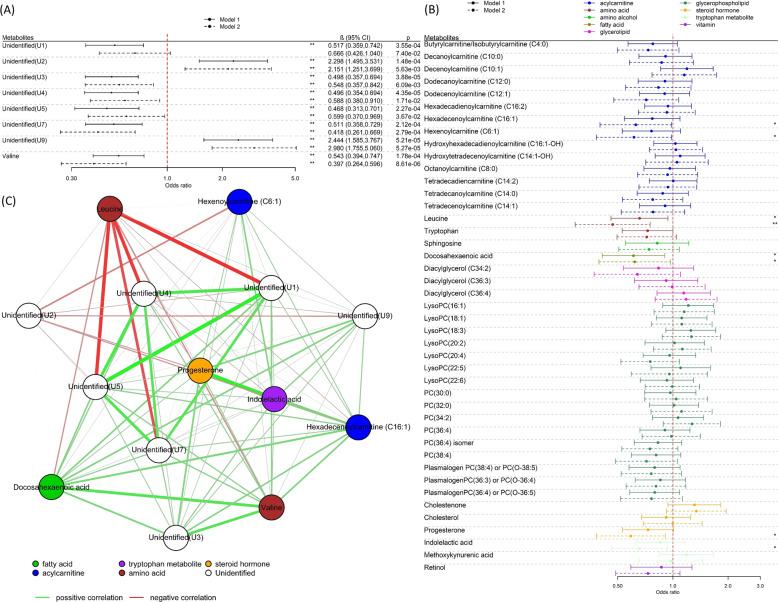
In the Metabolome-Wide Association Study analysis, we identified three and eight metabolites associated with rapid growth and overweight, respectively, after FDR correction. Higher levels of cholestenone, a cholesterol derivative produced by microbial catabolism, were predictive of rapid growth (p = 1.6 × 10). Lower levels of the branched-chain amino acid (BCAA) valine (p = 8.6 × 10) were predictive of overweight in childhood. The area under the receiver operator curve for multivariate prediction models including these metabolites and traditional risk factors was 0.77 for rapid growth and 0.82 for overweight, compared with 0.69 and 0.69, respectively, for models using traditional risk factors alone. Among the 43 pre-annotated metabolites, seven and five metabolites were nominally associated (P < 0.05) with rapid growth and overweight, respectively. The BCAA leucine, remained associated (1.6 × 10) with overweight after FDR correction.
CONCLUSION
The metabolites identified here may assist in the identification of children at risk of developing obesity and improve understanding of mechanisms involved in postnatal growth. Cholestenone and BCAAs are suggestive of a role of the gut microbiome and nutrient signalling respectively in child growth trajectories.
简介
代谢组学可能可以确定使儿童易患超重和肥胖风险的生物学途径。在这项研究中,我们调查了四个欧洲出生队列中婴儿期快速生长和儿童早期超重的脐带血代谢特征。
方法
对来自四个欧洲队列(ENVIRONAGE、Rhea、INMA 和 Piccolipiu)的 399 名新生儿的脐带血进行非靶向液相色谱-质谱代谢组学分析。根据世界卫生组织的生长图表,将生命第一年的快速生长和超重定义为参考。使用多个调整后的逻辑混合效应模型对超过 4500 个代谢特征进行了快速生长和超重的代谢组全关联扫描,并控制假发现率(FDR)为 5%。此外,我们对与出生体重或快速生长相关的 43 种预注释代谢物进行了查找分析。
结果
在代谢组全关联研究分析中,我们在 FDR 校正后分别鉴定出与快速生长和超重相关的三种和八种代谢物。较高水平的胆甾酮,一种由微生物代谢产生的胆固醇衍生物,与快速生长有关(p=1.6×10)。支链氨基酸(BCAA)缬氨酸水平较低(p=8.6×10)与儿童期超重有关。包括这些代谢物和传统危险因素的多元预测模型的受试者工作特征曲线下面积(AUC)为快速生长 0.77,超重 0.82,而仅使用传统危险因素的模型分别为 0.69 和 0.69。在 43 种预注释代谢物中,有七种和五种代谢物与快速生长和超重分别有显著关联(P<0.05)。在 FDR 校正后,BCAA 亮氨酸仍然与超重有关(1.6×10)。
结论
这里鉴定的代谢物可能有助于识别有患肥胖风险的儿童,并有助于了解参与出生后生长的机制。胆甾酮和支链氨基酸分别提示肠道微生物组和营养信号在儿童生长轨迹中的作用。


 Zotero 插件