
克罗恩病患者放置直肠环后,采用自体脂肪组织源性干细胞移植或抗肿瘤坏死因子药物治疗的肛旁瘘管闭合率比较:一项回顾性观察研究。
Comparative perianal fistula closure rates following autologous adipose tissue-derived stem cell transplantation or treatment with anti-tumor necrosis factor agents after seton placement in patients with Crohn's disease: a retrospective observational study.
机构信息
Department of Colon and Rectal Surgery, Asan Medical Center, University of College of Medicine, 88, Olympic-ro 43-gil, Songpa-gu, Seoul, 05505, Republic of Korea.
Department of Gastroenterology, Asan Medical Center, University of Ulsan College of Medicine, Seoul, Republic of Korea.
出版信息
Stem Cell Res Ther. 2021 Jul 13;12(1):401. doi: 10.1186/s13287-021-02484-6.
BACKGROUND
Perianal fistula is one of the most common complications in Crohn's disease, and various medical and surgical treatments are being tried. The aim of this study was to compare the perianal fistula closure rates following treatment with anti-tumor necrosis factor (TNF) agents or autologous adipose tissue-derived stem cell (auto-ASC) transplantation with Crohn's disease (CD).
METHODS
CD patients who underwent seton placement for perianal fistula from January 2015 to December 2019 at a tertiary referral center were retrospectively reviewed. Patients were divided into two groups, one that received sequential treatments with anti-TNF agents (anti-TNF group) and the other that underwent auto-ASC transplantation (stem cell group). Clinical variables and fistula closure rates were compared in the two groups.
RESULTS
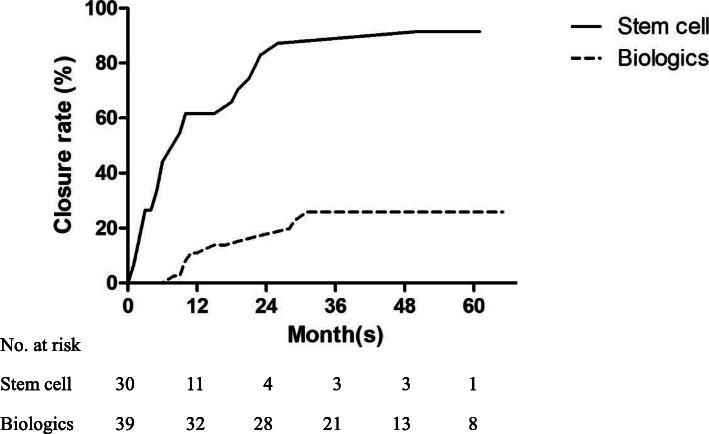
Of the 69 patients analyzed, 39 were treated with anti-TNF agents and 30 underwent auto-ASC transplantation. Compared with the stem cell group, patients in the anti-TNF group were older (p=0.028), were more frequently male (p=0.019), had fistulas with more penetrating behavior (p=0.002), had undergone surgery more frequently (p=0.010), and had a shorter interval from seton placement to intended treatment (p<0.001). During a median follow-up of 46 months (range, 30-52.5 months), fistula closure rates were significantly faster (83.3% vs. 23.1%, p<0.001), and the mean interval from seton placement to fistula closure significantly shorter (14 vs. 37 months, p<0.001) in the stem cell than in the anti-TNF group. Three patients experienced fistula recurrence, all in the stem cell group.
CONCLUSIONS
Medical treatment using anti-TNF agents and auto-ASC transplantation are feasible treatment options after seton placement for Crohn's perianal fistula. However, the closure rate was significantly faster and the time to closure significantly shorter in patients who underwent auto-ASC transplantation than medical treatment.
TRIAL REGISTRATION
This study was retrospectively registered and approved by the Institutional Review Board of Asan Medical Center, number 2020-1059 .
背景
肛周瘘是克罗恩病最常见的并发症之一,目前正在尝试各种医学和手术治疗。本研究旨在比较抗 TNF 药物或自体脂肪组织源性干细胞(auto-ASC)移植治疗克罗恩病(CD)后肛周瘘的闭合率。
方法
回顾性分析 2015 年 1 月至 2019 年 12 月在一家三级转诊中心接受皮筋放置治疗肛周瘘的 CD 患者。患者分为两组,一组接受抗 TNF 药物序贯治疗(抗 TNF 组),另一组接受自体 ASC 移植(干细胞组)。比较两组的临床变量和瘘管闭合率。
结果
在分析的 69 名患者中,39 名接受抗 TNF 药物治疗,30 名接受自体 ASC 移植。与干细胞组相比,抗 TNF 组患者年龄较大(p=0.028),男性比例较高(p=0.019),瘘管穿透行为较多(p=0.002),手术频率较高(p=0.010),皮筋放置至意向治疗的时间间隔较短(p<0.001)。中位随访 46 个月(范围 30-52.5 个月)期间,干细胞组瘘管闭合率显著更快(83.3%比 23.1%,p<0.001),皮筋放置至瘘管闭合的平均时间间隔显著缩短(14 比 37 个月,p<0.001)。干细胞组有 3 名患者出现瘘管复发,均为干细胞组。
结论
皮筋放置后,抗 TNF 药物和自体 ASC 移植的药物治疗是克罗恩病肛周瘘的可行治疗选择。然而,与药物治疗相比,自体 ASC 移植患者的闭合率显著更高,达到闭合的时间间隔显著更短。
临床试验注册
本研究是回顾性注册,并得到了 Asan 医疗中心机构审查委员会的批准,注册号为 2020-1059。
 Zotero 插件