
鼻窦恶性肿瘤的点扫描质子治疗
Spot Scanning Proton Therapy for Sinonasal Malignant Tumors.
作者信息
Nakajima Koichiro, Iwata Hiromitsu, Hattori Yukiko, Nomura Kento, Hashimoto Shingo, Toshito Toshiyuki, Hayashi Kensuke, Kuroda Yo, Fukano Hideo, Ogino Hiroyuki, Shibamoto Yuta
机构信息
Department of Radiation Oncology, Nagoya Proton Therapy Center, Nagoya City West Medical Center, Nagoya, Japan.
Department of Radiology, Nagoya City University Graduate School of Medical Sciences, Nagoya, Japan.
出版信息
Int J Part Ther. 2021 Jun 25;8(1):189-199. doi: 10.14338/IJPT-D-20-00043.1. eCollection 2021 Summer.
PURPOSE
Treatment of sinonasal malignant tumors is challenging, and evidence to establish a standard treatment is limited. Our objective was to evaluate the efficacy and safety of spot scanning proton therapy (SSPT) for sinonasal malignant tumors.
PATIENTS AND METHODS
We retrospectively analyzed patients with sinonasal malignant tumors (T1-4bN0-2M0) who underwent SSPT between May 2014 and September 2019. The prescription dose was typically either 60 GyRBE in 15 fractions or 60.8 GyRBE in 16 fractions for mucosal melanoma and 70.2 GyRBE in 26 fractions for other histologic subtypes. Endpoints included local control (LC), progression-free survival, overall survival (OS), and incidence of toxicity. Prognostic factors were analyzed using the Kaplan-Meier method and log-rank test.
RESULTS
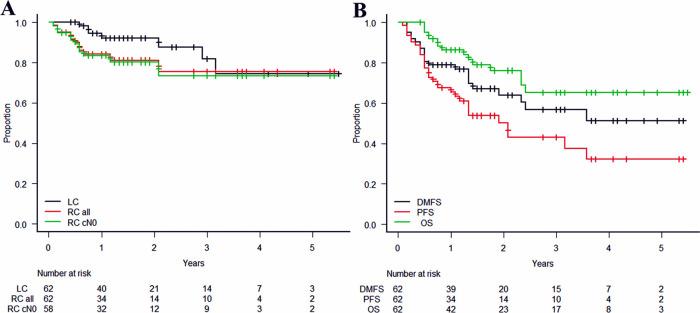
Of 62 enrolled patients, the common histologic subtypes were mucosal melanoma (35%), squamous cell carcinoma (27%), adenoid cystic carcinoma (16%), and olfactory neuroblastoma (10%). Locally advanced stages were common (T3 in 42% and T4 in 53%). Treatment-naïve tumors and postsurgical recurrent tumors accounted for 73% and 27%, respectively. No patient had previous radiotherapy. The median follow-up was 17 months (range, 6-66) for all patients and 21.5 months (range, 6-66) for survivors. The 2-year LC, progression-free survival, and OS rates of all patients were 92%, 50%, and 76%, respectively. Univariate analysis revealed histology as a prognostic factor for OS, being higher in adenoid cystic carcinoma and olfactory neuroblastoma than in other tumors. Sixteen grade ≥3 late toxicities were observed in 12 patients (19%), including 11 events resulting in visual impairment; the most common was cataract. There was 1 grade 4 toxicity, and there were no grade 5 toxicities.
CONCLUSION
SSPT was well tolerated and yielded good LC for sinonasal malignant tumors. Although we consider SSPT to be a leading treatment modality, further studies are required to establish its status as a standard treatment.
目的
鼻窦恶性肿瘤的治疗具有挑战性,确立标准治疗方案的证据有限。我们的目的是评估点扫描质子治疗(SSPT)用于鼻窦恶性肿瘤的疗效和安全性。
患者与方法
我们回顾性分析了2014年5月至2019年9月期间接受SSPT治疗的鼻窦恶性肿瘤(T1 - 4bN0 - 2M0)患者。对于黏膜黑色素瘤,处方剂量通常为15次分割给予60 Gy相对生物学效应剂量(GyRBE)或16次分割给予60.8 GyRBE;对于其他组织学亚型,为26次分割给予70.2 GyRBE。观察终点包括局部控制(LC)、无进展生存期、总生存期(OS)和毒性发生率。采用Kaplan - Meier法和对数秩检验分析预后因素。
结果
62例入组患者中,常见的组织学亚型为黏膜黑色素瘤(35%)、鳞状细胞癌(27%)、腺样囊性癌(16%)和嗅神经母细胞瘤(10%)。局部晚期阶段常见(T3占42%,T4占53%)。未经治疗的肿瘤和术后复发肿瘤分别占73%和27%。所有患者均未接受过放疗。所有患者的中位随访时间为17个月(范围6 - 66个月),存活患者为21.5个月(范围6 - 66个月)。所有患者的2年LC、无进展生存期和OS率分别为92%、50%和76%。单因素分析显示组织学是OS的预后因素,腺样囊性癌和嗅神经母细胞瘤的OS高于其他肿瘤。12例患者(19%)出现16次≥3级晚期毒性反应,其中11次导致视力损害;最常见的是白内障。有1次4级毒性反应,无5级毒性反应。
结论
SSPT耐受性良好,对鼻窦恶性肿瘤产生了良好的局部控制效果。尽管我们认为SSPT是一种主要的治疗方式,但仍需要进一步研究以确立其作为标准治疗的地位。

 Zotero 插件