
医护人员的职业倦怠与代谢综合征:亚临床甲状腺功能减退是中介因素吗?
Burnout and metabolic syndrome among healthcare workers: Is subclinical hypothyroidism a mediator?
作者信息
Tsou Meng-Ting, Chen Jau-Yuan
机构信息
Department of Family Medicine, MacKay Memorial Hospital, Taipei City, Taiwan.
Department of Occupation Medicine, MacKay Memorial Hospital, Taipei City, Taiwan.
出版信息
J Occup Health. 2021 Jan;63(1):e12252. doi: 10.1002/1348-9585.12252.
OBJECTIVES
Evidence suggests that subclinical hypothyroidism (SCH) is associated with burnout and metabolic syndrome (MetS). We examined the relationship between burnout and MetS among healthcare workers (HCWs) and investigated the potential mediation of SCH.
METHODS
This cross-sectional study included HCWs from a tertiary medical center; demographic data were obtained using a questionnaire. Burnout was evaluated according to the Chinese version of the Maslach Burnout Inventory-Health Services Survey (MBI-HSS). MetS and thyroid function data were obtained from a physical check-up. Logistic regression models were used to evaluate the adjusted odds ratio (aOR), and mediation analysis was employed to examine the mediation effect.
RESULTS
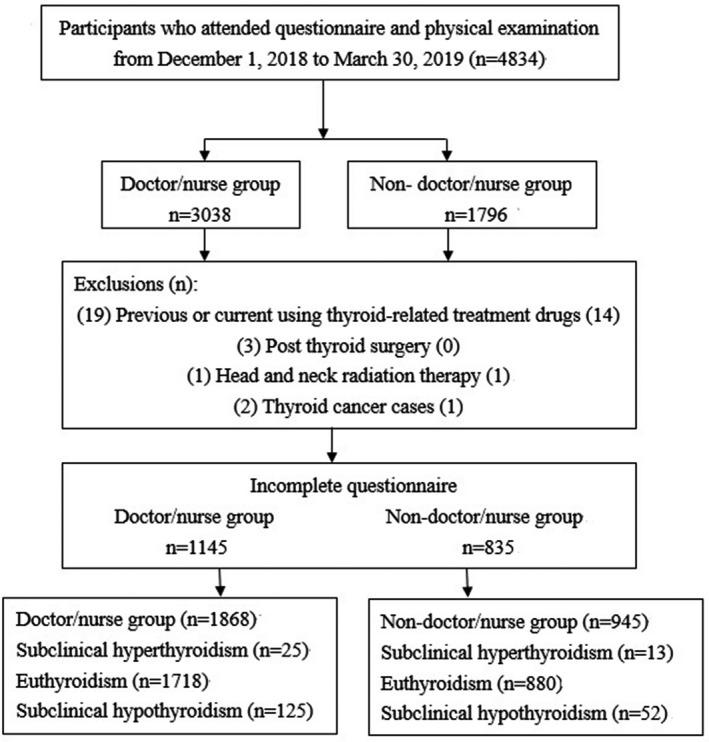
Among 945 non-doctor/nurse and 1868 doctor/nurse staff, MetS was 30% and 14%, respectively, and the prevalence of burnout was nearly 6.5%. The results showed that burnout induced higher aOR of MetS in the doctor/nurse group (1.27, 95% confidence interval [CI]: 1.05-3.62). Thyroid-stimulating hormone (TSH) showed a positive association factor of MetS in doctor/nurse group-adjusted burnout (aOR = 1.15, 95% CI: 1.01-4.19). A higher TSH level was associated with an increased odds of MetS in younger doctor/nurse staff with burnout syndrome (aOR = 1.74; 95% CI: 1.04-3.22). There was a borderline significant mediation effect of SCH in the association between burnout and MetS in doctor/nurse staff.
CONCLUSIONS
The results showed that higher TSH levels were positively associated with burnout and MetS in doctor/nurse professionals, especially in the young cohort. Burnout may rely on the borderline mediation effect of SCH, which is likely to affect MetS.
目的
有证据表明亚临床甲状腺功能减退(SCH)与职业倦怠和代谢综合征(MetS)有关。我们研究了医护人员(HCWs)职业倦怠与MetS之间的关系,并探讨了SCH的潜在中介作用。
方法
这项横断面研究纳入了一家三级医疗中心的医护人员;通过问卷调查获取人口统计学数据。根据中文版的马氏职业倦怠量表-医疗卫生服务调查(MBI-HSS)评估职业倦怠。MetS和甲状腺功能数据来自体格检查。采用逻辑回归模型评估调整后的优势比(aOR),并进行中介分析以检验中介效应。
结果
在945名非医生/护士和1868名医生/护士工作人员中,MetS的患病率分别为30%和14%,职业倦怠的患病率近6.5%。结果显示,职业倦怠在医生/护士组中导致MetS的aOR更高(1.27,95%置信区间[CI]:1.05 - 3.62)。在医生/护士组调整职业倦怠后,促甲状腺激素(TSH)显示为MetS的正相关因素(aOR = 1.15,95% CI:1.01 - 4.19)。在患有职业倦怠综合征的年轻医生/护士工作人员中,较高的TSH水平与MetS的发生几率增加相关(aOR = 1.74;95% CI:1.04 - 3.22)。在医生/护士工作人员中,SCH在职业倦怠与MetS的关联中存在临界显著的中介效应。
结论
结果表明,在医生/护士专业人员中,尤其是在年轻人群体中,较高的TSH水平与职业倦怠和MetS呈正相关。职业倦怠可能依赖于SCH的临界中介作用,这可能会影响MetS。

 Zotero 插件