
一种简单的逆转录 PCR 熔解温度测定法,用于快速筛选广泛传播的 SARS-CoV-2 变体。
A Simple Reverse Transcriptase PCR Melting-Temperature Assay To Rapidly Screen for Widely Circulating SARS-CoV-2 Variants.
机构信息
Public Health Research Institute, Center for Emerging Pathogens, Rutgers New Jersey Medical School, Newark, New Jersey, USA.
Institute of Genomic Medicine, Rutgers New Jersey Medical School, Newark, New Jersey, USA.
出版信息
J Clin Microbiol. 2021 Sep 20;59(10):e0084521. doi: 10.1128/JCM.00845-21. Epub 2021 Jul 21.
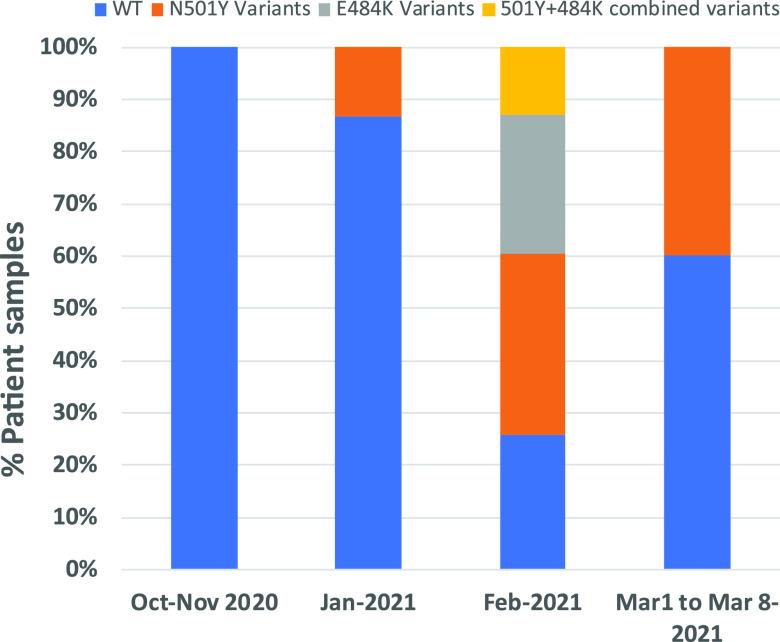
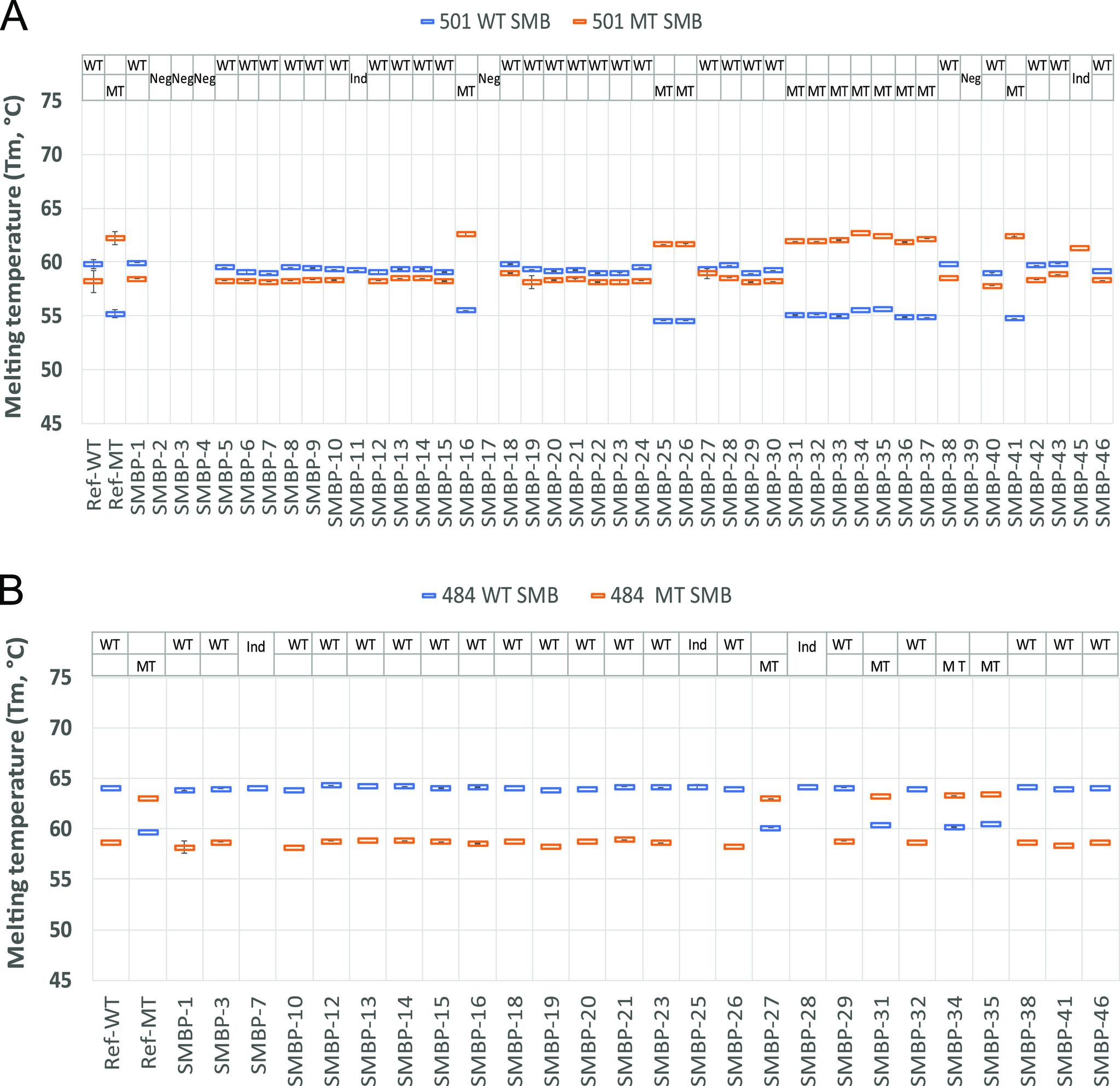
The increased transmission of SARS-CoV-2 variants of concern (VOC), which originated in the United Kingdom (B.1.1.7/alpha), South Africa (B1.351/beta), Brazil (P.1/gamma), the United States (B.1.427/429 or epsilon), and India (B.1.617.2/delta), requires a vigorous public health response, including real-time strain surveillance on a global scale. Although genome sequencing is the gold standard for identifying these VOCs, it is time-consuming and expensive. Here, we describe a simple, rapid, and high-throughput reverse transcriptase PCR (RT-PCR) melting-temperature () screening assay that identifies the first three major VOCs. RT-PCR primers and four sloppy molecular beacon (SMB) probes were designed to amplify and detect the SARS-CoV-2 N501Y (A23063T) and E484K (G23012A) mutations and their corresponding wild-type sequences. After RT-PCR, the VOCs were identified by a characteristic of each SMB. Assay optimization and testing was performed with RNA from SARS-CoV-2 USA WA1/2020 (wild type [WT]), B.1.1.7, and B.1.351 variant strains. The assay was then validated using clinical samples. The limit of detection for both the WT and variants was 4 and 10 genomic copies/reaction for the 501- and 484-codon assays, respectively. The assay was 100% sensitive and 100% specific for identifying the N501Y and E484K mutations in cultured virus and in clinical samples, as confirmed by Sanger sequencing. We have developed an RT-PCR melt screening test for the major VOCs that can be used to rapidly screen large numbers of patient samples, providing an early warning for the emergence of these variants and a simple way to track their spread.
关注的严重急性呼吸综合征冠状病毒 2 变异株(VOC)的传播增加,这些变异株最初起源于英国(B.1.1.7/alpha)、南非(B1.351/beta)、巴西(P.1/gamma)、美国(B.1.427/429 或 epsilon)和印度(B.1.617.2/delta),这需要采取有力的公共卫生措施应对,包括在全球范围内实时进行菌株监测。虽然基因组测序是识别这些 VOC 的金标准,但它既耗时又昂贵。在这里,我们描述了一种简单、快速和高通量的逆转录聚合酶链反应(RT-PCR)熔解温度()筛选检测方法,该方法可识别前三种主要的 VOC。设计了 RT-PCR 引物和四个宽松分子信标(SMB)探针,以扩增和检测 SARS-CoV-2 N501Y(A23063T)和 E484K(G23012A)突变及其相应的野生型序列。RT-PCR 后,通过每个 SMB 的特征来识别 VOC。使用 SARS-CoV-2 USA WA1/2020(野生型 [WT])、B.1.1.7 和 B.1.351 变异株的 RNA 进行了检测优化和测试。然后使用临床样本对该检测进行了验证。501 密码子和 484 密码子检测的 WT 和变体的检测限分别为 4 和 10 个基因组拷贝/反应。该检测方法对培养病毒和临床样本中的 N501Y 和 E484K 突变的检测具有 100%的敏感性和特异性,这通过 Sanger 测序得到了证实。我们开发了一种用于主要 VOC 的 RT-PCR 熔解筛选检测方法,该方法可用于快速筛选大量患者样本,为这些变异株的出现提供早期预警,并为跟踪其传播提供一种简单的方法。

 Zotero 插件