
尼泊尔基本产科和新生儿急救护理服务的提供情况和准备情况:2015 年尼泊尔卫生机构调查分析。
Basic emergency obstetric and newborn care service availability and readiness in Nepal: Analysis of the 2015 Nepal Health Facility Survey.
机构信息
New ERA, RudramatiMarga, Kalopul, Kathmandu, Nepal.
Bhaskar Tejshree Memorial Foundation, Kathmandu, Nepal.
出版信息
PLoS One. 2021 Jul 21;16(7):e0254561. doi: 10.1371/journal.pone.0254561. eCollection 2021.
BACKGROUND
Achieving maternal and newborn related Sustainable Development Goals targets is challenging for Nepal, mainly due to poor quality of maternity services. In this context, we aim to assess the Basic Emergency Obstetric and Newborn Care (BEmONC) service availability and readiness in health facilities in Nepal by analyzing data from Nepal Health Facility Survey (NHFS), 2015.
METHODS
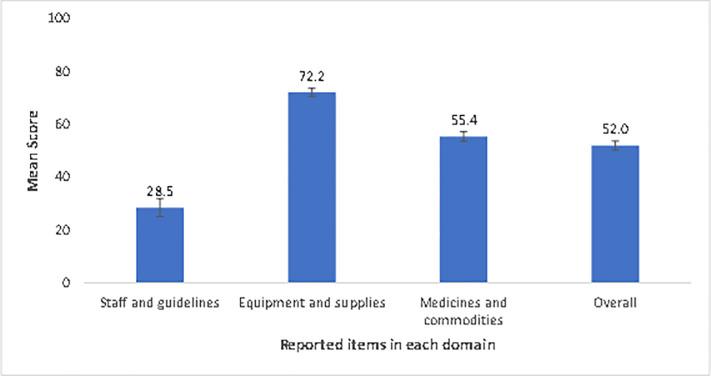
We utilized cross-sectional data from the nationally representative NHFS, 2015. Service availability was measured by seven signal functions of BEmONC, and service readiness by the availability and functioning of supportive items categorized into three domains: staff and guidelines, diagnostic equipment, and basic medicine and commodities. We used the World Health Organization's service availability and readiness indicators to estimate the readiness scores. We performed a multiple linear regression to identify important factors in the readiness of the health facilities to provide BEmONC services.
RESULTS
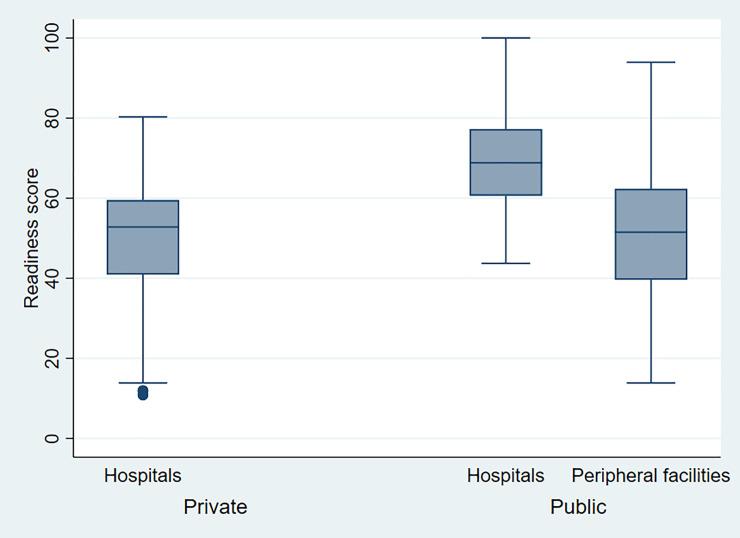
The BEmONC service readiness score was significantly higher in public hospitals compared with private hospitals and peripheral public health facilities. Significant factors associated with service readiness score were the facility type (14.69 points higher in public hospitals, P<0.001), number of service delivery staff (2.49 points increase per each additional delivery staff, P<0.001), the service hours (4.89 points higher in facilities offering 24-hour services, P = 0.01) and status of periodic review of maternal and newborn deaths (4.88 points higher in facilities that conducted periodic review, P = 0.043).
CONCLUSIONS
These findings suggest that BEmONC services in Nepal could be improved by increasing the number of service delivery staff, expanding service hours to 24-hours a day, and conducting periodic review of maternal and newborn deaths at health facilities, mainly in the peripheral public health facilities. The private hospitals need to be encouraged for BEmONC service readiness.
背景
尼泊尔实现与母婴相关的可持续发展目标面临挑战,主要原因是产时服务质量较差。在此背景下,我们旨在通过分析尼泊尔卫生设施调查(NHFS)2015 年的数据,评估尼泊尔卫生机构基本产科和新生儿急救护理(BEmONC)服务的提供情况和准备情况。
方法
我们利用具有全国代表性的 NHFS 2015 年的横断面数据。服务提供情况通过 BEmONC 的七个信号功能进行衡量,服务准备情况则通过人员和指南、诊断设备、基本药品和商品等三个领域的支持项目的提供和运行情况进行衡量。我们使用世界卫生组织的服务提供和准备情况指标来估计准备情况评分。我们进行了多元线性回归分析,以确定卫生机构提供 BEmONC 服务的准备情况的重要因素。
结果
与私立医院和外围公立卫生机构相比,公立医院的 BEmONC 服务准备情况评分显著更高。与服务准备情况评分相关的显著因素包括机构类型(公立机构比私立机构高 14.69 分,P<0.001)、服务提供人员数量(每增加一名分娩人员,得分增加 2.49 分,P<0.001)、服务时间(24 小时服务的机构高 4.89 分,P=0.01)以及孕产妇和新生儿死亡定期审查情况(定期审查的机构高 4.88 分,P=0.043)。
结论
这些发现表明,尼泊尔可以通过增加服务提供人员数量、将服务时间延长至 24 小时/天、并主要在周边公立卫生机构定期审查孕产妇和新生儿死亡情况来改善 BEmONC 服务,同时还需要鼓励私立医院做好 BEmONC 服务准备。

 Zotero 插件