
双糖链蛋白聚糖作为胃腺癌患者预后和治疗标志物的鉴定与验证
Identification and Validation of Biglycan as Prognosis and Therapy Markers for Patients with Stomach Adenocarcinoma.
作者信息
Shao Changming, Cheng Chunfa, Shao Qinshu, Chen Bing
机构信息
Department of Vascular Surgery, The Second Affiliated Hospital, Zhejiang University School of Medicine, Hangzhou, 310000, Zhejiang, People's Republic of China.
Department of Vascular Surgery, The First People's Hospital of Yuhang District, Hangzhou, 311100, Zhejiang, People's Republic of China.
出版信息
Int J Gen Med. 2021 Jul 15;14:3497-3509. doi: 10.2147/IJGM.S321641. eCollection 2021.
OBJECTIVE
Previous studies have confirmed the biglycan (BGN) as a core gene in stomach adenocarcinoma (STAD). Present study aimed at conducting further investigations to reveal the potential function of BGN in STAD.
METHODS
The mRNA and protein expressions of BGN in STAD were firstly evaluated, followed by immune infiltration analyses. The influence of BGN expression on the overall survival of STAD patients was subsequently analyzed, and a restrict survival analysis was performed as well. The protein-protein interaction (PPI) network analysis on the co-expressed genes with BGN was finally adopted to obtain the most important module in the whole network, and significant Kyoto Encyclopedia of Genes and Genomes (KEGG) pathway associated with hub genes within the main module was further predicted.
RESULTS
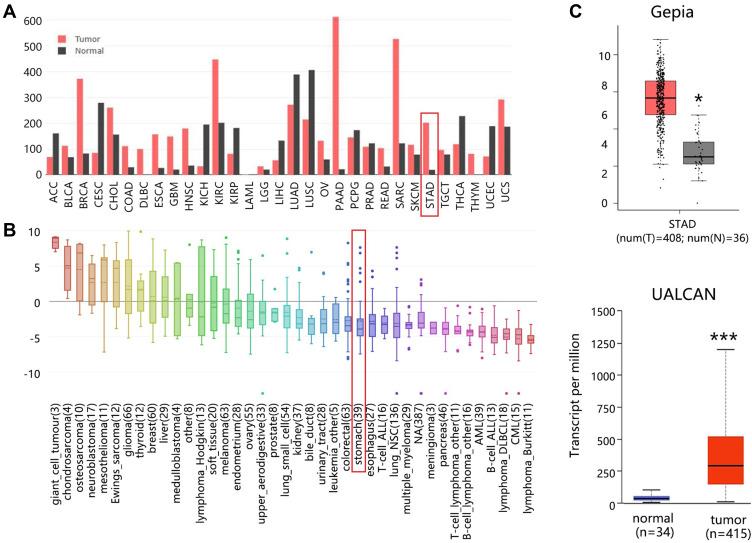
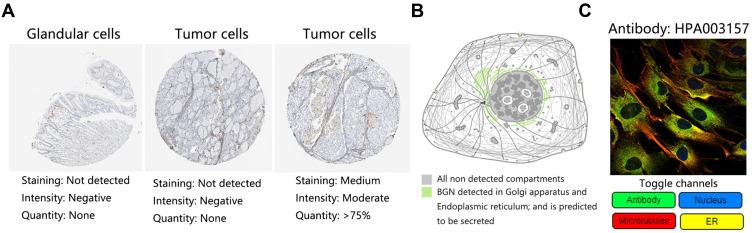
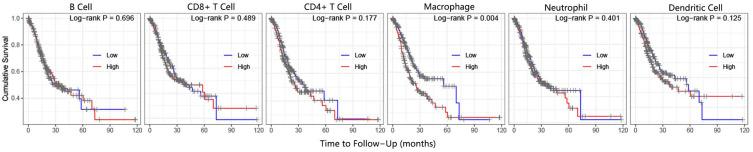
(1) We verified the mRNA high expression of BGN in STAD (all <0.05), and higher expression was observed in patients with stage 4 (<0.001) and grade 3 (<0.001). The BGN protein was mainly localized to the golgi apparatus, and protein expression displayed an individual difference. (2) Immune infiltration analysis showed the strongest correlation between BGN expression and abundance of natural killer cell (<0.001), Transforming Growth Factor beta 1 (TGFB1) (<0.001), TNF Receptor Superfamily Member 4 (TNFRSF4) (<0.001) and C-X-C Motif Chemokine Ligand 12 (CXCL12) (<0.001) in STAD. BGN expression was also correlated to immune subtypes (=0.0347) and molecular subtypes (=0.0263) in STAD. (3) High expression of BGN shortened the overall survival time of STAD patients (all <0.01). The influence of BGN expression on the prognosis was statistically affected by several clinical phenotypes and cohorts of patients. Cox regression showed that BGN can be considered as a prognostic predictor of STAD (<0.05). (4) Pathway analysis indicated that BGN possibly participated in ECM-receptor interaction, focal adhesion, human papillomavirus infection and PI3K-Akt signaling pathway (all <0.001).
CONCLUSION
BGN was highly expressed in STAD, implying a poor prognosis of patients. Relevant signal pathways associated with BGN were distinguished as well. BGN could be used as a potential therapeutic biomarker for STAD.
目的
以往研究已证实双糖链蛋白聚糖(BGN)是胃腺癌(STAD)的核心基因。本研究旨在进一步探究BGN在STAD中的潜在功能。
方法
首先评估STAD中BGN的mRNA和蛋白表达,随后进行免疫浸润分析。接着分析BGN表达对STAD患者总生存期的影响,并进行限制性生存分析。最后采用与BGN共表达基因的蛋白质-蛋白质相互作用(PPI)网络分析来获取整个网络中最重要的模块,并进一步预测与主要模块内枢纽基因相关的重要京都基因与基因组百科全书(KEGG)通路。
结果
(1)我们验证了STAD中BGN的mRNA高表达(均<0.05),在4期(<0.001)和3级(<0.001)患者中观察到更高的表达。BGN蛋白主要定位于高尔基体,且蛋白表达存在个体差异。(2)免疫浸润分析显示,STAD中BGN表达与自然杀伤细胞丰度(<0.001)、转化生长因子β1(TGFB1)(<0.001)、肿瘤坏死因子受体超家族成员4(TNFRSF4)(<0.001)和C-X-C基序趋化因子配体12(CXCL12)(<0.001)之间的相关性最强。BGN表达也与STAD中的免疫亚型(=0.0347)和分子亚型(=0.0263)相关。(3)BGN高表达缩短了STAD患者的总生存时间(均<0.01)。BGN表达对预后的影响在统计学上受多种临床表型和患者队列的影响。Cox回归显示BGN可被视为STAD的预后预测指标(<0.05)。(4)通路分析表明,BGN可能参与细胞外基质-受体相互作用、粘着斑、人乳头瘤病毒感染和PI3K-Akt信号通路(均<0.001)。
结论
BGN在STAD中高表达,提示患者预后不良。还鉴别出了与BGN相关的信号通路。BGN可作为STAD潜在的治疗生物标志物。




 Zotero 插件