
循环游离DNA在胰腺癌预后中作用的Meta分析
Meta-Analysis of Circulating Cell-Free DNA's Role in the Prognosis of Pancreatic Cancer.
作者信息
Milin-Lazovic Jelena, Madzarevic Petar, Rajovic Nina, Djordjevic Vladimir, Milic Nikola, Pavlovic Sonja, Veljkovic Nevena, Milic Natasa M, Radenkovic Dejan
机构信息
Institute for Medical Statistics and Informatics, Faculty of Medicine, University of Belgrade, 11000 Belgrade, Serbia.
Department of Surgery, University Clinical Center of Serbia, 11000 Belgrade, Serbia.
出版信息
Cancers (Basel). 2021 Jul 6;13(14):3378. doi: 10.3390/cancers13143378.
INTRODUCTION
The analysis of cell-free DNA (cfDNA) for genetic abnormalities is a promising new approach for the diagnosis and prognosis of pancreatic cancer patients. Insights into the molecular characteristics of pancreatic cancer may provide valuable information, leading to its earlier detection and the development of targeted therapies.
MATERIAL AND METHODS
We conducted a systematic review and a meta-analysis of studies that reported cfDNA in pancreatic ductal adenocarcinoma (PDAC). The studies were considered eligible if they included patients with PDAC, if they had blood tests for cfDNA/ctDNA, and if they analyzed the prognostic value of cfDNA/ctDNA for patients' survival. The studies published before 22 October 2020 were identified through the PubMED, EMBASE, Web of Science and Cochrane Library databases. The assessed outcomes were the overall (OS) and progression-free survival (PFS), expressed as the log hazard ratio (HR) and standard error (SE). The summary of the HR effect size was estimated by pooling the individual trial results using the Review Manager, version 5.3, Cochrane Collaboration. The heterogeneity was assessed using the Cochran Q test and I statistic.
RESULTS
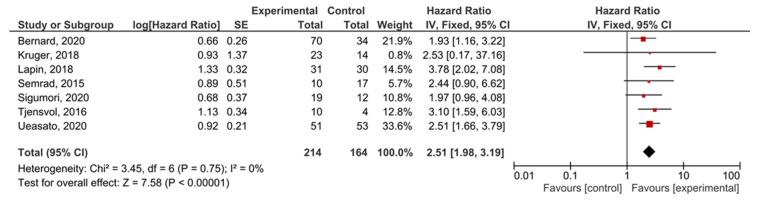
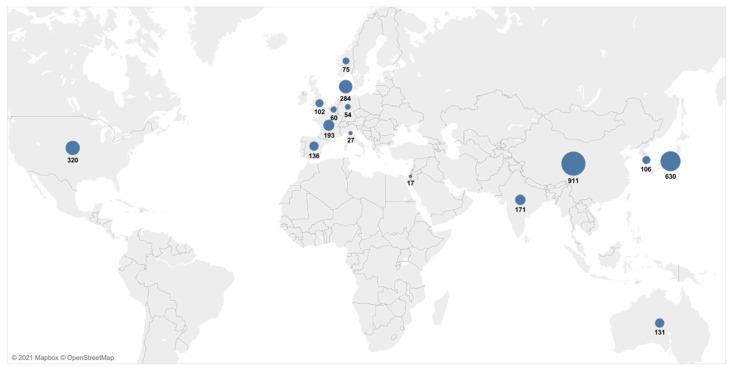
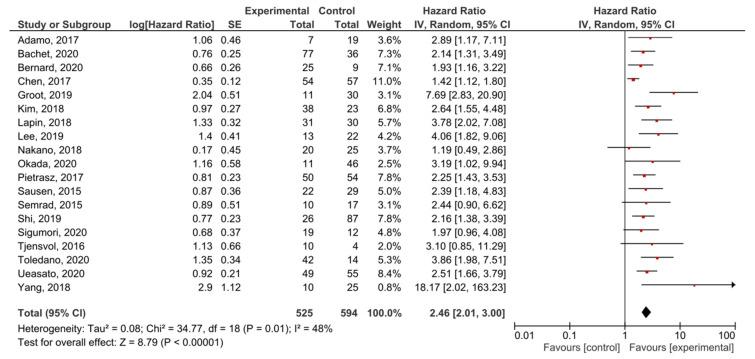
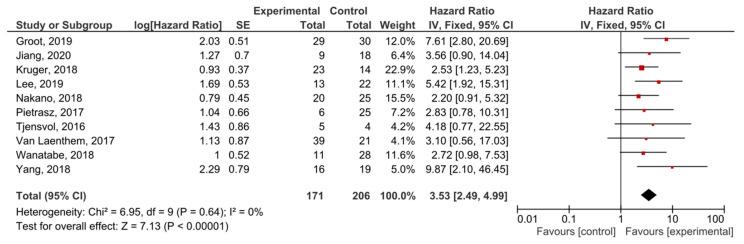
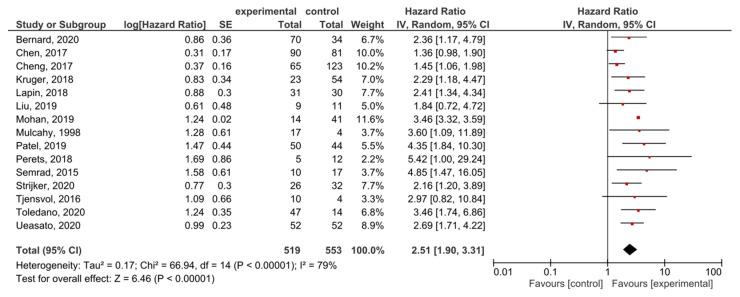
In total, 48 studies were included in the qualitative review, while 44 were assessed in the quantitative synthesis, with the total number of patients included being 3524. Overall negative impacts of cfDNA and mutations on OS and PFS in PDAC (HR = 2.42, 95% CI: 1.95-2.99 and HR = 2.46, 95% CI: 2.01-3.00, respectively) were found. The subgroup analysis of the locally advanced and metastatic disease presented similar results (HR = 2.51, 95% CI: 1.90-3.31). In the studies assessing the pre-treatment presence of , there was a moderate to high degree of heterogeneity (I = 87% and I = 48%, for OS and PFS, respectively), which was remarkably decreased in the analysis of the studies measuring post-treatment (I = 24% and I = 0%, for OS and PFS, respectively). The patients who were positive before but negative after treatment had a better prognosis than the persistently -positive patients (HR = 5.30, 95% CI: 1.02-27.63).
CONCLUSION
The assessment of mutation by liquid biopsy can be considered as an additional tool for the estimation of the disease course and outcome in PDAC patients.
引言
分析游离DNA(cfDNA)中的基因异常是一种很有前景的胰腺癌患者诊断和预后评估新方法。深入了解胰腺癌的分子特征可能会提供有价值的信息,有助于早期发现胰腺癌并开发靶向治疗方法。
材料与方法
我们对报告胰腺导管腺癌(PDAC)中cfDNA的研究进行了系统综述和荟萃分析。如果研究纳入了PDAC患者、进行了cfDNA/ctDNA血液检测并分析了cfDNA/ctDNA对患者生存的预后价值,则这些研究被视为合格。通过PubMed、EMBASE、Web of Science和Cochrane图书馆数据库检索2020年10月22日前发表的研究。评估的结局为总生存期(OS)和无进展生存期(PFS),以对数风险比(HR)和标准误(SE)表示。使用Cochrane协作网的Review Manager 5.3版汇总各个试验结果,估计HR效应量的汇总值。采用Cochran Q检验和I²统计量评估异质性。
结果
定性综述共纳入48项研究,定量分析评估了44项研究,纳入患者总数为3524例。发现cfDNA和[此处原文缺失具体基因或指标名称]突变对PDAC患者的OS和PFS均有总体负面影响(HR分别为2.42,95%CI:1.95 - 2.99和HR为2.46,95%CI:2.01 - 3.00)。局部晚期和转移性疾病的亚组分析结果相似(HR = 2.51,95%CI:1.90 - 3.31)。在评估[此处原文缺失具体基因或指标名称]治疗前存在情况的研究中,存在中度至高度异质性(OS和PFS的I²分别为87%和48%),而在分析测量治疗后[此处原文缺失具体基因或指标名称]的研究中,异质性显著降低(OS和PFS的I²分别为24%和0%)。治疗前[此处原文缺失具体基因或指标名称]阳性但治疗后阴性的患者比持续阳性患者预后更好(HR = 5.30,95%CI:1.02 - 27.63)。
结论
通过液体活检评估[此处原文缺失具体基因或指标名称]突变可被视为评估PDAC患者病程和结局的一种辅助工具。



 Zotero 插件