
机器学习在验证商业可穿戴传感器用于监测患者步态中的作用:系统评价。
The Contribution of Machine Learning in the Validation of Commercial Wearable Sensors for Gait Monitoring in Patients: A Systematic Review.
机构信息
Univ Lyon, INSA Lyon, Inria, CITI, F-69621 Villeurbanne, France.
Univ Lyon, INSA-Lyon, Université Claude Bernard Lyon 1, UJM-Saint Etienne, CNRS, Inserm, CREATIS UMR 5220, U1294, F-69621 Villeurbanne, France.
出版信息
Sensors (Basel). 2021 Jul 14;21(14):4808. doi: 10.3390/s21144808.
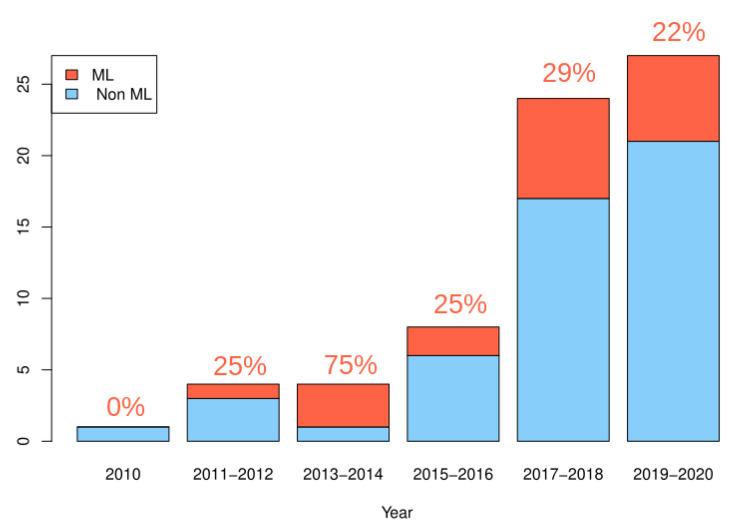
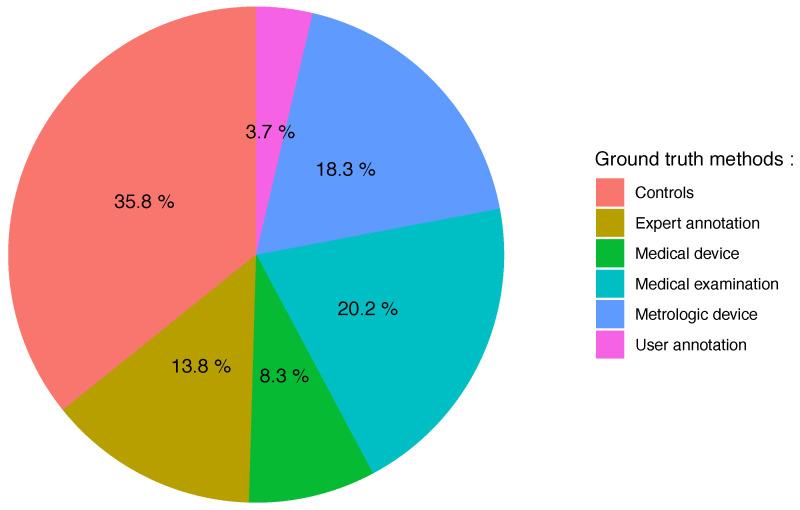
Gait, balance, and coordination are important in the development of chronic disease, but the ability to accurately assess these in the daily lives of patients may be limited by traditional biased assessment tools. Wearable sensors offer the possibility of minimizing the main limitations of traditional assessment tools by generating quantitative data on a regular basis, which can greatly improve the home monitoring of patients. However, these commercial sensors must be validated in this context with rigorous validation methods. This scoping review summarizes the state-of-the-art between 2010 and 2020 in terms of the use of commercial wearable devices for gait monitoring in patients. For this specific period, 10 databases were searched and 564 records were retrieved from the associated search. This scoping review included 70 studies investigating one or more wearable sensors used to automatically track patient gait in the field. The majority of studies (95%) utilized accelerometers either by itself (N = 17 of 70) or embedded into a device (N = 57 of 70) and/or gyroscopes (51%) to automatically monitor gait via wearable sensors. All of the studies (N = 70) used one or more validation methods in which "ground truth" data were reported. Regarding the validation of wearable sensors, studies using machine learning have become more numerous since 2010, at 17% of included studies. This scoping review highlights the current state of the ability of commercial sensors to enhance traditional methods of gait assessment by passively monitoring gait in daily life, over long periods of time, and with minimal user interaction. Considering our review of the last 10 years in this field, machine learning approaches are algorithms to be considered for the future. These are in fact data-based approaches which, as long as the data collected are numerous, annotated, and representative, allow for the training of an effective model. In this context, commercial wearable sensors allowing for increased data collection and good patient adherence through efforts of miniaturization, energy consumption, and comfort will contribute to its future success.
步态、平衡和协调在慢性病的发展中很重要,但传统的有偏评估工具可能会限制在患者日常生活中准确评估这些功能的能力。可穿戴传感器通过定期生成定量数据,提供了最大限度减少传统评估工具主要限制的可能性,从而极大地改善了患者的家庭监测。然而,这些商业传感器必须通过严格的验证方法在这种情况下进行验证。本范围综述总结了 2010 年至 2020 年期间,使用商业可穿戴设备监测患者步态的最新进展。在这个特定时期,共检索了 10 个数据库,并从相关搜索中检索到 564 条记录。本范围综述共纳入了 70 项研究,这些研究调查了一种或多种可穿戴传感器在现场自动跟踪患者步态的应用。大多数研究(95%)使用加速度计(N = 70 中的 17 项)或将其嵌入设备中(N = 70 中的 57 项)和/或陀螺仪(51%),通过可穿戴传感器自动监测步态。所有研究(N = 70)都使用了一种或多种验证方法,其中报告了“真实”数据。关于可穿戴传感器的验证,自 2010 年以来,使用机器学习的研究数量有所增加,占纳入研究的 17%。本范围综述强调了商业传感器通过被动监测日常生活中的步态,在长时间内以最小的用户交互增强传统步态评估方法的能力的现状。考虑到我们对该领域过去 10 年的综述,机器学习方法是未来需要考虑的算法。这些实际上是基于数据的方法,只要收集到的数据数量多、有注释且具有代表性,就可以训练出有效的模型。在这种情况下,通过小型化、能耗和舒适度来增加数据采集和提高患者依从性的商业可穿戴传感器将有助于其未来的成功。

 Zotero 插件