
物理治疗中的数字健康干预:客户与医疗保健提供者调查问卷工具的开发
Digital Health Interventions in Physiotherapy: Development of Client and Health Care Provider Survey Instruments.
作者信息
Merolli Mark, Hinman Rana S, Lawford Belinda J, Choo Dawn, Gray Kathleen
机构信息
Centre for Digital Transformation of Health, Faculty of Medicine Dentistry & Health Sciences, The University of Melbourne, Melbourne, Victoria, Australia.
Centre for Health, Exercise, and Sports Medicine, Department of Physiotherapy, School of Health Sciences, Faculty of Medicine Dentistry & Health Sciences, The University of Melbourne, Melbourne, Victoria, Australia.
出版信息
JMIR Res Protoc. 2021 Jul 28;10(7):e25177. doi: 10.2196/25177.
BACKGROUND
The advancement of digital health has widened the scope of technology use across multiple frontiers of health care services, including personalized therapeutics, mobile health, eHealth record management, and telehealth consultations. The World Health Organization (WHO) responded to this in 2018 by publishing an inaugural broad classification framework of digital health interventions (DHIs) used to address contemporary health system needs.
OBJECTIVE
This study aims to describe the systematic development of dual survey instruments (clinician and patient) to support data collection, administered in a physiotherapy setting, about perceptions toward DHIs. This is achieved by adapting the WHO framework classification for DHIs for application in real-world research.
METHODS
Using a qualitative item review approach, WHO DHI descriptors were adapted and refined systematically to be used in a survey form. This approach was designed to align with the processes of delivering and receiving care in clinical practice, using musculoskeletal physiotherapy as a practical case scenario.
RESULTS
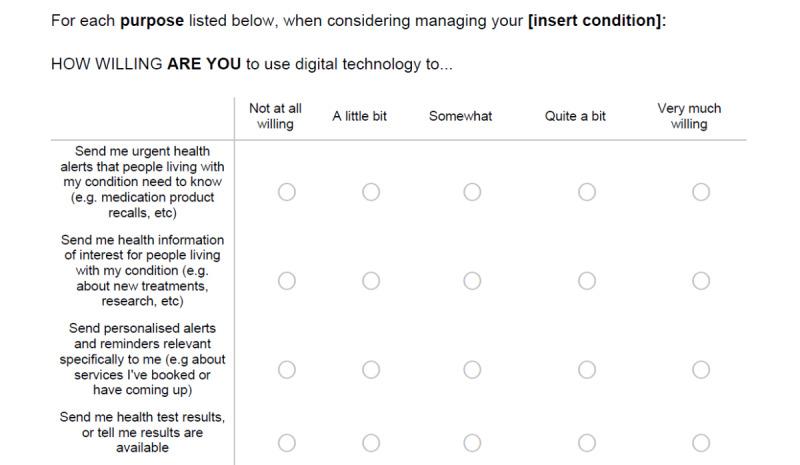
Complementary survey instruments (for health care providers and clients) were developed by adapting descriptor items. These instruments will be used in a larger study exploring the willingness of physiotherapists and patients to use digital technologies in the management of musculoskeletal conditions.
CONCLUSIONS
This study builds on the WHO-standardized DHI framework. We developed dual novel survey instruments by adapting and refining the functions of DHIs. These may be deployed to explore the perceived usefulness and application of DHIs for different clinical care functions. Researchers may wish to use these survey instruments to examine digital health use systematically in a variety of clinical fields or technology scenarios in a way that is standardized and generalizable.
背景
数字健康的发展拓宽了技术在医疗服务多个领域的应用范围,包括个性化治疗、移动健康、电子健康记录管理和远程医疗咨询。世界卫生组织(WHO)在2018年对此做出回应,发布了首个用于满足当代卫生系统需求的数字健康干预措施(DHI)广泛分类框架。
目的
本研究旨在描述双份调查工具(临床医生和患者)的系统开发,以支持在物理治疗环境中收集关于对数字健康干预措施看法的数据。这是通过调整WHO的数字健康干预措施框架分类以应用于实际研究来实现的。
方法
采用定性项目审查方法,对WHO的数字健康干预措施描述符进行系统调整和完善,以用于调查形式。该方法旨在结合临床实践中提供和接受护理的过程,以肌肉骨骼物理治疗作为实际案例。
结果
通过调整描述符项目,开发了互补的调查工具(针对医疗服务提供者和客户)。这些工具将用于一项更大规模的研究,探索物理治疗师和患者在肌肉骨骼疾病管理中使用数字技术的意愿。
结论
本研究以WHO标准化的数字健康干预措施框架为基础。我们通过调整和完善数字健康干预措施的功能,开发了两种新颖的调查工具。这些工具可用于探索数字健康干预措施在不同临床护理功能中的感知有用性和应用情况。研究人员可能希望使用这些调查工具,以标准化和可推广的方式系统地检查各种临床领域或技术场景中的数字健康应用情况。


 Zotero 插件