
家族性阿尔茨海默病患者大脑皮质 Aβ 病理的类型和层分布存在变异性。
Variability in the type and layer distribution of cortical Aβ pathology in familial Alzheimer's disease.
机构信息
The Queen Square Brain Bank for Neurological Disorders, Department of Clinical and Movement Neurosciences, UCL Queen Square Institute of Neurology, London, UK.
Department of Neurodegenerative Disease, UCL Queen Square Institute of Neurology, London, UK.
出版信息
Brain Pathol. 2022 May;32(3):e13009. doi: 10.1111/bpa.13009. Epub 2021 Jul 28.
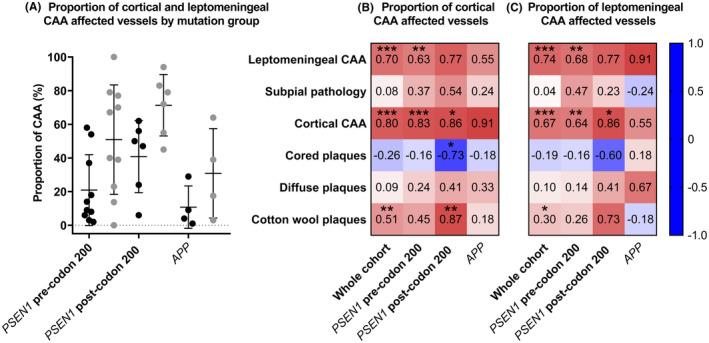
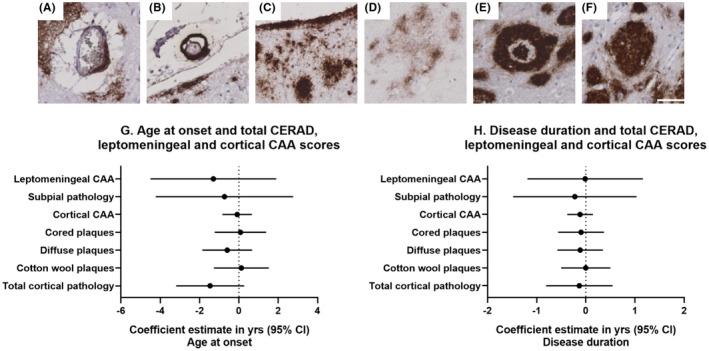
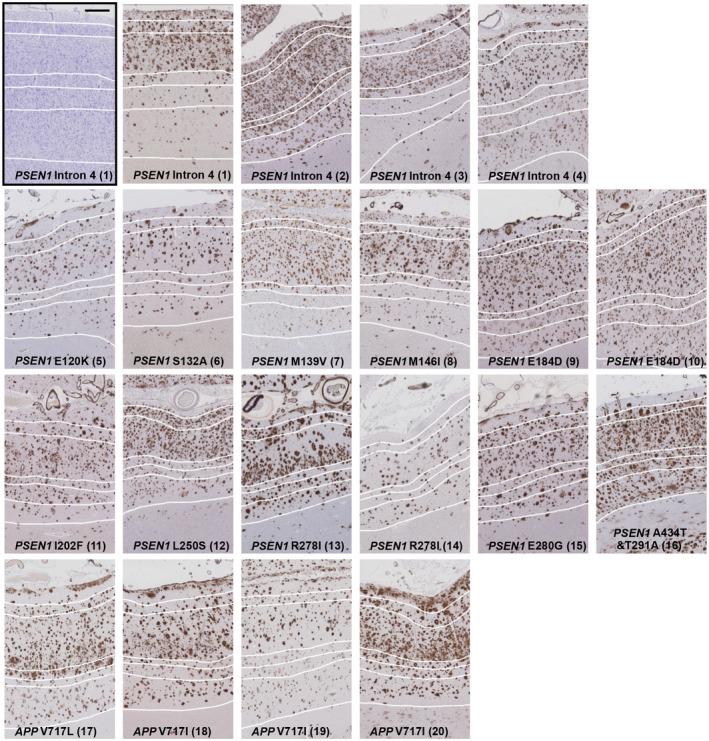
Familial Alzheimer's disease (FAD) is caused by autosomal dominant mutations in the PSEN1, PSEN2 or APP genes, giving rise to considerable clinical and pathological heterogeneity in FAD. Here we investigate variability in clinical data and the type and distribution of Aβ pathologies throughout the cortical layers of different FAD mutation cases. Brain tissue from 20 FAD cases [PSEN1 pre-codon 200 (n = 10), PSEN1 post-codon 200 (n = 6), APP (n = 4)] were investigated. Frontal cortex sections were stained immunohistochemically for Aβ, and Nissl to define the cortical layers. The frequency of different amyloid-beta plaque types was graded for each cortical layer and the severity of cerebral amyloid angiopathy (CAA) was determined in cortical and leptomeningeal blood vessels. Comparisons were made between FAD mutations and APOE4 status, with associations between pathology, clinical and genetic data investigated. In this cohort, possession of an APOE4 allele was associated with increased disease duration but not with age at onset, after adjusting for mutation sub-group and sex. We found Aβ pathology to be heterogeneous between cases although Aβ load was highest in cortical layer 3 for all mutation groups and a higher Aβ load was associated with APOE4. The PSEN1 post-codon 200 group had a higher Aβ load in lower cortical layers, with a small number of this group having increased cotton wool plaque pathology in lower layers. Cotton wool plaque frequency was positively associated with the severity of CAA in the whole cohort and in the PSEN1 post-codon 200 group. Carriers of the same PSEN1 mutation can have differing patterns of Aβ deposition, potentially because of differences in risk factors. Our results highlight possible influences of APOE4 genotype, and PSEN1 mutation type on Aβ deposition, which may have effects on the clinical heterogeneity of FAD.
家族性阿尔茨海默病(FAD)是由 PSEN1、PSEN2 或 APP 基因的常染色体显性突变引起的,导致 FAD 具有相当大的临床和病理异质性。在这里,我们研究了不同 FAD 突变病例的皮质层中临床数据的变异性以及 Aβ病理的类型和分布。我们研究了 20 例 FAD 病例[PSEN1 前密码子 200(n=10),PSEN1 后密码子 200(n=6),APP(n=4)]的脑组织。用 Aβ和尼氏染色对额皮质切片进行免疫组织化学染色,以定义皮质层。对每个皮质层的不同淀粉样蛋白-β斑块类型的频率进行分级,并确定皮质和软脑膜血管的脑淀粉样血管病(CAA)的严重程度。在 FAD 突变和 APOE4 状态之间进行了比较,并研究了病理、临床和遗传数据之间的关联。在该队列中,在调整突变亚组和性别后,携带 APOE4 等位基因与疾病持续时间增加有关,但与发病年龄无关。我们发现尽管所有突变组的皮质层 3 的 Aβ负荷最高,但病例之间的 Aβ病理存在异质性,并且 APOE4 与 Aβ负荷较高有关。PSEN1 后密码子 200 组在较低的皮质层中有较高的 Aβ负荷,该组中少数病例在较低的皮质层中出现了更多的棉绒斑块病理。棉绒斑块的频率与整个队列和 PSEN1 后密码子 200 组的 CAA 严重程度呈正相关。相同 PSEN1 突变的携带者可能具有不同的 Aβ沉积模式,这可能是由于危险因素的不同。我们的结果强调了 APOE4 基因型和 PSEN1 突变类型对 Aβ沉积的可能影响,这可能对 FAD 的临床异质性产生影响。


 Zotero 插件