
新型放射性示踪剂 [Ga]MHLL1 对心肌梗死后成纤维细胞激活蛋白的分子成像。
Molecular imaging of fibroblast activation protein after myocardial infarction using the novel radiotracer [Ga]MHLL1.
机构信息
Department of Nuclear Medicine, Hannover Medical School.
Molecular Imaging and Radiochemistry, Department of Clinical Radiology and Nuclear Medicine, Medical Faculty Mannheim of Heidelberg University.
出版信息
Theranostics. 2021 Jun 22;11(16):7755-7766. doi: 10.7150/thno.51419. eCollection 2021.
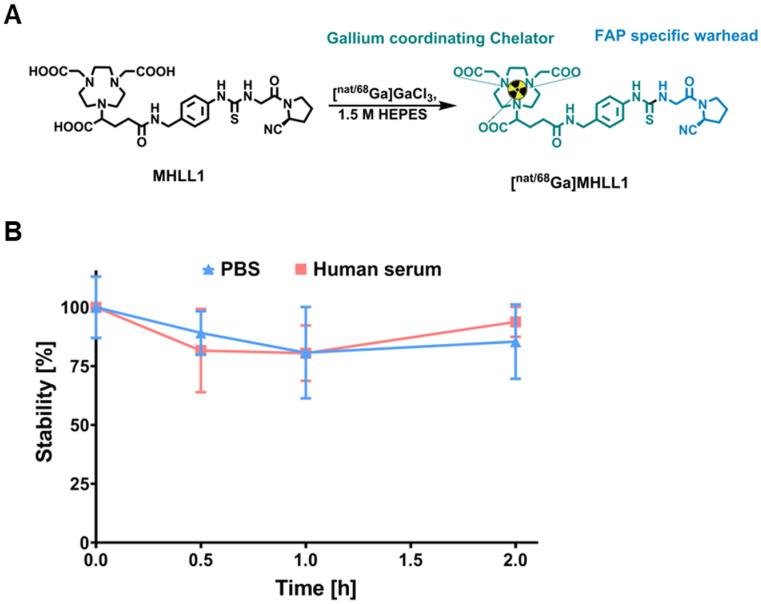
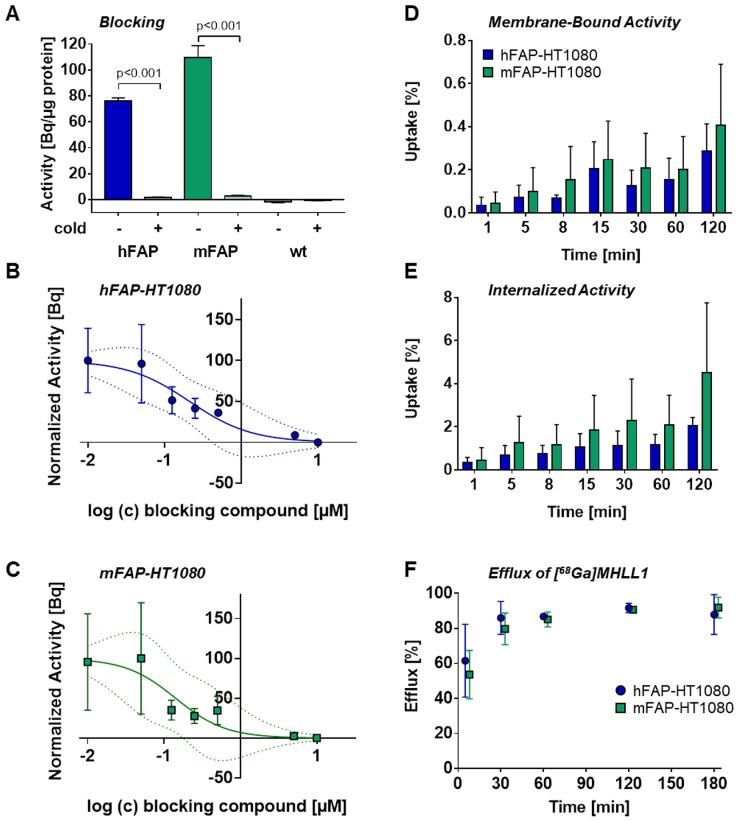
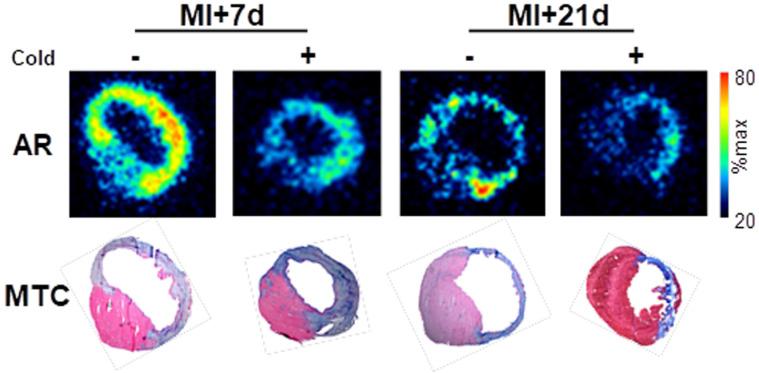
Myocardial infarction (MI) evokes an organized remodeling process characterized by the activation and transdifferentiation of quiescent cardiac fibroblasts to generate a stable collagen rich scar. Early fibroblast activation may be amenable to targeted therapy, but is challenging to identify . We aimed to non-invasively image active fibrosis by targeting the fibroblast activation protein (FAP) expressed by activated (myo)fibroblasts, using a novel positron emission tomography (PET) radioligand [Ga]MHLL1 after acute MI. One-step chemical synthesis and manual as well as module-based radiolabeling yielded [Ga]MHLL1. Binding characteristics were evaluated in murine and human FAP-transfected cells, and stability tested in human serum. Biodistribution in healthy animals was interrogated by dynamic PET imaging, and metabolites were measured in blood and urine. The temporal pattern of FAP expression was determined by serial PET imaging at 7 d and 21 d after coronary artery ligation in mice as percent injected dose per gram (%ID/g). PET measurements were validated by autoradiography and immunostaining for FAP and inflammatory macrophages. [Ga]MHLL1 displayed specific uptake in murine and human FAP-positive cells (p = 0.0208). In healthy mice the tracer exhibited favorable imaging characteristics, with low blood pool retention and dominantly renal clearance. At 7 d after coronary artery ligation, [Ga]MHLL1 uptake was elevated in the infarct relative to the non-infarcted remote myocardium (1.3 ± 0.3 1.0 ± 0.2 %ID/g, p < 0.001) which persisted to 21 d after MI (1.3 ± 0.4 1.1 ± 0.4 %ID/g, p = 0.013). Excess unlabeled compound blocked tracer accumulation in both infarct and non-infarct remote myocardium regions (p < 0.001). Autoradiography and histology confirmed the regional uptake of [Ga]MHLL1 in the infarct and especially border zone regions, as identified by Masson trichrome collagen staining. Immunostaining further delineated persistent FAP expression at 7 d and 21 d post-MI in the border zone, consistent with tracer distribution . The simplified synthesis of [Ga]MHLL1 bears promise for non-invasive characterization of fibroblast activation protein early in remodeling after MI.
心肌梗死(MI)引发了一个有组织的重塑过程,其特征是静止的心肌成纤维细胞被激活并向肌成纤维细胞分化,从而产生稳定的富含胶原的瘢痕。早期成纤维细胞的激活可能适合靶向治疗,但难以识别。我们旨在通过靶向急性心肌梗死后激活的(肌)成纤维细胞表达的成纤维细胞激活蛋白(FAP),使用新型正电子发射断层扫描(PET)放射性配体[Ga]MHLL1 对活性纤维化进行非侵入性成像。一步化学合成和手动以及基于模块的放射性标记生成了[Ga]MHLL1。在小鼠和人 FAP 转染细胞中评估了结合特性,并在人血清中测试了稳定性。通过动态 PET 成像研究了健康动物的生物分布,并在血液和尿液中测量了代谢物。通过在小鼠冠状动脉结扎后 7 天和 21 天进行连续 PET 成像,以每克注射剂量的百分比(%ID/g)来确定 FAP 表达的时间模式。通过放射性自显影和 FAP 和炎症性巨噬细胞的免疫染色对 PET 测量值进行了验证。[Ga]MHLL1 在小鼠和人 FAP 阳性细胞中显示出特异性摄取(p = 0.0208)。在健康小鼠中,该示踪剂具有良好的成像特性,血液池保留率低,主要通过肾脏清除。在冠状动脉结扎后 7 天,与非梗塞远隔心肌相比,[Ga]MHLL1 摄取在梗塞部位升高(1.3±0.3与 1.0±0.2%ID/g,p<0.001),在 MI 后 21 天仍持续存在(1.3±0.4与 1.1±0.4%ID/g,p=0.013)。过量的未标记化合物会阻止示踪剂在梗塞和非梗塞远隔心肌区域的积累(p<0.001)。放射性自显影和组织学证实了[Ga]MHLL1 在梗塞和特别是梗塞边缘区的区域摄取,如 Masson 三色胶原染色所确定的。免疫染色进一步描绘了 MI 后 7 天和 21 天边缘区的持续 FAP 表达,与示踪剂分布一致。[Ga]MHLL1 的简化合成有望在 MI 后重塑早期非侵入性地描述成纤维细胞激活蛋白的激活。



 Zotero 插件