
癌症恶病质患者全身炎症与生存的关系:一项多中心队列研究的结果。
Association of systemic inflammation with survival in patients with cancer cachexia: results from a multicentre cohort study.
机构信息
Department of Gastrointestinal Surgery/Department of Clinical Nutrition, Beijing Shijitan Hospital, Capital Medical University, Beijing, China.
Department of Oncology, Capital Medical University, Beijing, China.
出版信息
J Cachexia Sarcopenia Muscle. 2021 Dec;12(6):1466-1476. doi: 10.1002/jcsm.12761. Epub 2021 Aug 2.
BACKGROUND
Although systemic inflammation is an important feature of the cancer cachexia, studies on the association between systemic inflammation and prognostic of cancer cachexia are limited. The objective of this study is to evaluate whether the neutrophil-to-lymphocyte ratio (NLR) is associated with outcome and quality of life for patients with cancer cachexia and investigated any interaction between NLR and the clinical parameters.
METHODS
This is a multicentre cohort study of 2612 cancer patients suffering from cachexia diagnosed between June 2012 and December 2019. The main parameters measured were overall survival (OS) time and all-cause mortality. The association between NLR and all-cause mortality was evaluated using hazard ratios (HRs) and the restricted cubic spline model with a two-sided P-value. Optimal stratification was used to solve threshold points. We also evaluated the cross-classification of NLR for each variable of survival.
RESULTS
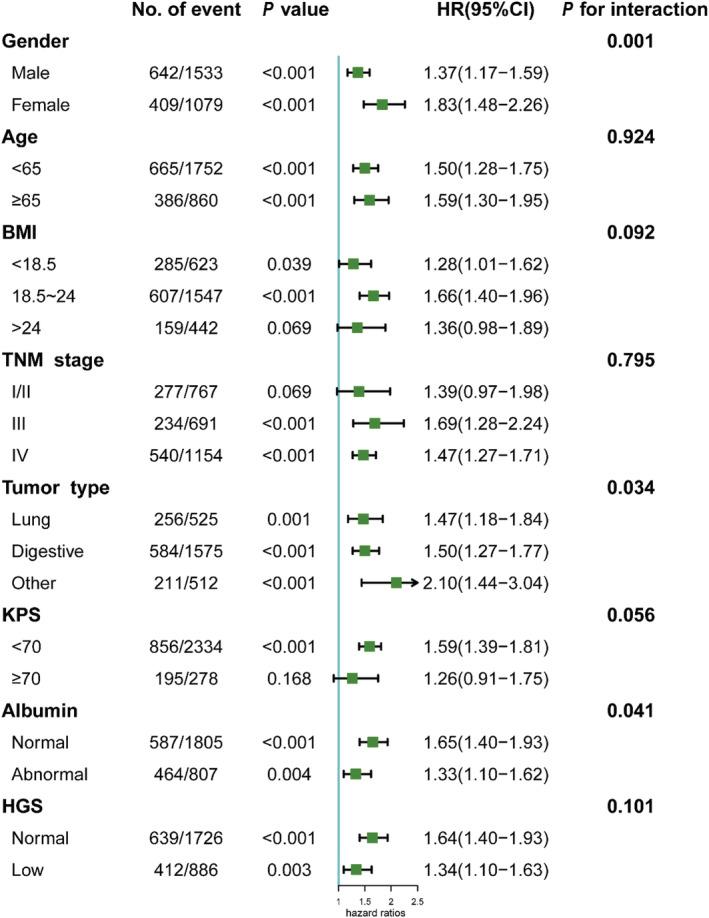
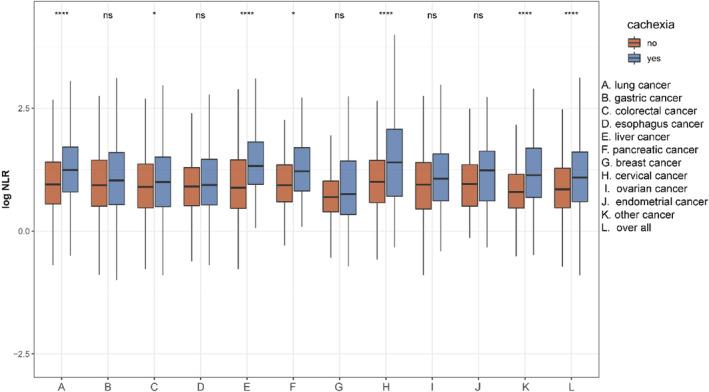
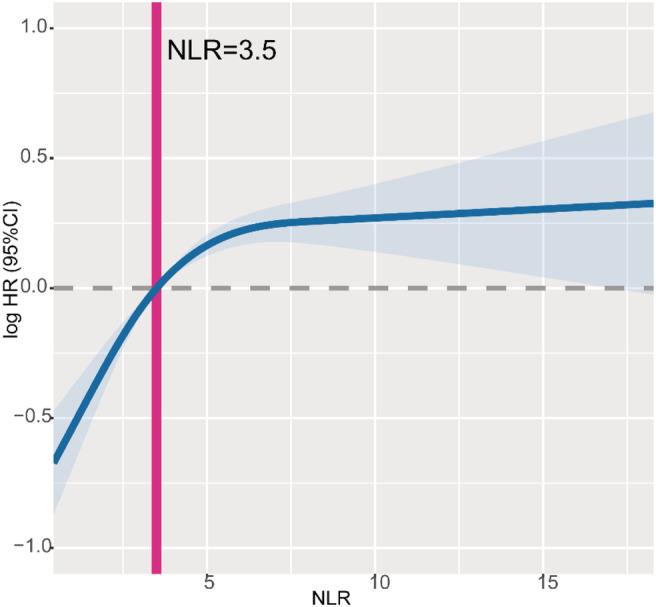
Of the 2612 participants diagnosed with cancer cachexia, 1533 (58.7%) were male, and the mean (SD) age was 58.7 (11.7) years. Over a median follow-up of 4.5 years, we observed 1189 deaths. The overall mortality rate for patients with cancer cachexia during the first 12 months was 30.2% (95%CI: 28.4%-32.0%), resulting in a rate of 226.07 events per 1000 patient-years. An increase in NLR had an inverted L-shaped dose-response association with all-cause mortality. The optimal cut-off point for NLR as a predictor of mortality in cancer patients with cachexia was 3.5. An NLR of 3.5 or greater could independently predict OS (HR, 1.51, 95%CI: 1.33-1.71). These associations were consistent across subtypes of cancer. Several potential effect modifiers were identified including gender, BMI, tumour type, KPS score and albumin in content. Increasing NLRs were independently associated with a worsening in the majority of EORTC QLQ-C30 domains. Elevated baseline NLR was associated with low response and poor survival in patients treated with immunotherapy.
CONCLUSIONS
The baseline NLR status was found to be a significant negative prognostic biomarker for patients with cachexia; this effect was independent of other known prognostic factors.
背景
全身性炎症是癌症恶病质的一个重要特征,但有关全身性炎症与癌症恶病质预后之间关系的研究有限。本研究旨在评估中性粒细胞与淋巴细胞比值(NLR)是否与癌症恶病质患者的结局和生活质量相关,并探讨 NLR 与临床参数之间的任何相互作用。
方法
这是一项多中心队列研究,纳入了 2012 年 6 月至 2019 年 12 月期间诊断为恶病质的 2612 例癌症患者。主要测量的参数是总生存(OS)时间和全因死亡率。使用风险比(HR)和双侧 P 值的限制立方样条模型评估 NLR 与全因死亡率之间的关系。使用最优分层法解决阈值点。我们还评估了 NLR 对每个生存变量的交叉分类。
结果
在诊断为癌症恶病质的 2612 名参与者中,1533 名(58.7%)为男性,平均(SD)年龄为 58.7(11.7)岁。中位随访 4.5 年后,我们观察到 1189 例死亡。癌症恶病质患者在最初 12 个月内的总体死亡率为 30.2%(95%CI:28.4%-32.0%),导致每 1000 名患者年发生 226.07 例事件。NLR 呈倒 L 型剂量反应关系,与全因死亡率相关。NLR 作为癌症恶病质患者死亡预测指标的最佳截断值为 3.5。NLR 为 3.5 或更高可独立预测 OS(HR,1.51,95%CI:1.33-1.71)。这些关联在癌症亚型之间是一致的。确定了几个潜在的效应修饰剂,包括性别、BMI、肿瘤类型、KPS 评分和白蛋白含量。NLR 升高与 EORTC QLQ-C30 大多数领域的生活质量恶化独立相关。基线 NLR 升高与免疫治疗患者的低反应和预后不良相关。
结论
基线 NLR 状态被发现是癌症恶病质患者的一个重要的预后不良生物标志物;这种作用独立于其他已知的预后因素。

 Zotero 插件