
创伤性脑损伤亚急性期的甲状腺功能:创伤后神经和功能结局的潜在预测指标。
Thyroid function in the subacute phase of traumatic brain injury: a potential predictor of post-traumatic neurological and functional outcomes.
机构信息
Department of Clinical-Surgical, Diagnostic and Pediatric Sciences, University of Pavia, Pavia, Italy.
Division of Endocrinology, Diabetology and Metabolism, Department of Medical Sciences, University of Turin, Turin, Italy.
出版信息
J Endocrinol Invest. 2022 Feb;45(2):379-389. doi: 10.1007/s40618-021-01656-8. Epub 2021 Aug 5.
PURPOSE
That thyroid hormones exert pleiotropic effects and have a contributory role in triggering seizures in patients with traumatic brain injury (TBI) can be hypothesized. We aimed at investigating thyroid function tests as prognostic factors of the development of seizures and of functional outcome in TBI.
METHODS
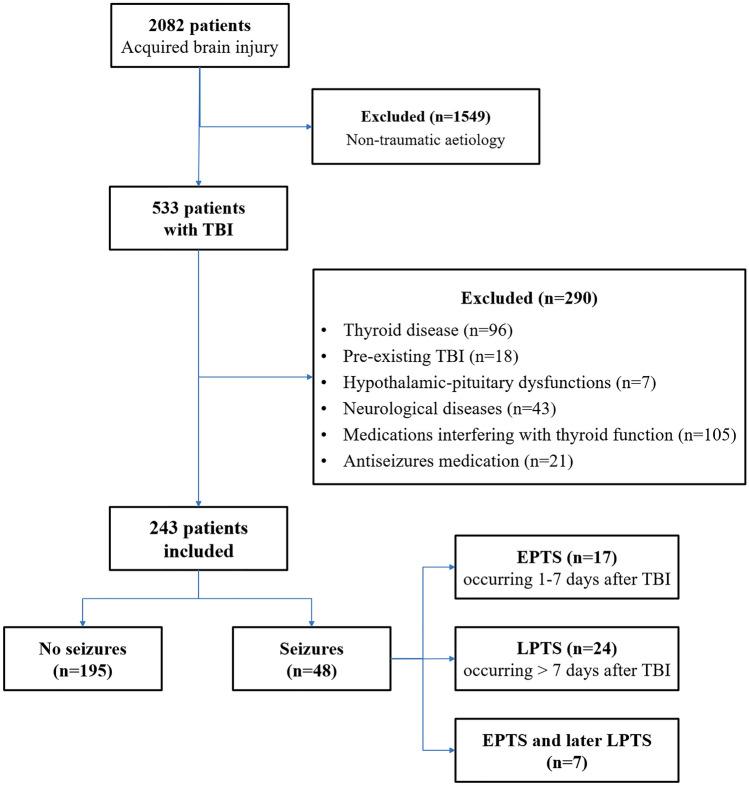
This retrospective study enrolled 243 adult patients with a diagnosis of mild-to-severe TBI, consecutively admitted to our rehabilitation unit for a 6-month neurorehabilitation program. Data on occurrence of seizures, brain imaging, injury characteristics, associated neurosurgical procedures, neurologic and functional assessments, and death during hospitalization were collected at baseline, during the workup and on discharge. Thyroid function tests (serum TSH, fT4, and fT3 levels) were performed upon admission to neurorehabilitation.
RESULTS
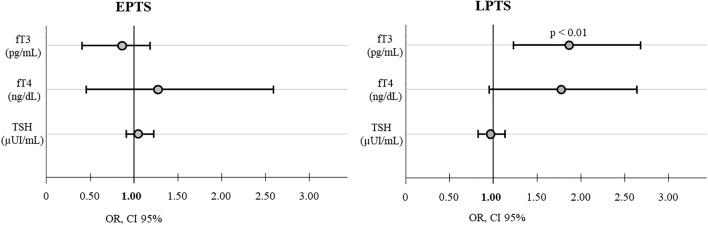
Serum fT3 levels were positively associated with an increased risk of late post-traumatic seizures (LPTS) in post-TBI patients independent of age, sex and TBI severity (OR = 1.85, CI 95% 1.22-2.61, p < 0.01). Measured at admission, fT3 values higher than 2.76 pg/mL discriminated patients with late post-traumatic seizures from those without, with a sensitivity of 74.2% and a specificity of 60.9%. Independently from the presence of post-traumatic epilepsy and TBI severity, increasing TSH levels and decreasing fT3 levels were associated with worse neurological and functional outcome, as well as with higher risk of mortality within 6 months from the TBI event.
CONCLUSIONS
Serum fT3 levels assessed in the subacute phase post-TBI are associated with neurological and functional outcome as well as with the risk of seizure occurrence. Further studies are needed to investigate the mechanisms underlying these associations.
目的
可以假设甲状腺激素具有多效性作用,并在创伤性脑损伤(TBI)患者癫痫发作中起促成作用。我们旨在研究甲状腺功能测试作为 TBI 患者癫痫发作发展和功能结局的预后因素。
方法
这项回顾性研究纳入了 243 名诊断为轻度至重度 TBI 的成年患者,他们连续入住我们的康复病房进行为期 6 个月的神经康复计划。在基线、检查期间和出院时收集了癫痫发作、脑成像、损伤特征、相关神经外科手术、神经和功能评估以及住院期间死亡的数据。在神经康复入院时进行了甲状腺功能测试(血清 TSH、fT4 和 fT3 水平)。
结果
血清 fT3 水平与 TBI 后患者发生迟发性创伤后癫痫(LPTS)的风险增加独立相关,与年龄、性别和 TBI 严重程度无关(OR=1.85,95%CI 1.22-2.61,p<0.01)。在入院时测量时,fT3 值高于 2.76pg/mL 可区分有无迟发性创伤后癫痫的患者,其敏感性为 74.2%,特异性为 60.9%。独立于创伤后癫痫的存在和 TBI 严重程度,TSH 水平升高和 fT3 水平降低与神经和功能结局较差以及 TBI 后 6 个月内死亡风险增加相关。
结论
TBI 后亚急性期评估的血清 fT3 水平与神经和功能结局以及癫痫发作风险相关。需要进一步研究来探讨这些关联的机制。

 Zotero 插件