
伴有临床特征和功能结局的双相I型障碍缓解期纵向认知衰退的异质性
The Heterogeneity of Longitudinal Cognitive Decline in Euthymic Bipolar I Disorder With Clinical Characteristics and Functional Outcomes.
作者信息
Chen Wen-Yin, Huang Ming-Chyi, Lee Ya-Chin, Chang Chiao-Erh, Lin Shih-Ku, Chiu Chih Chiang, Liu Hsing-Cheng, Kuo Chian-Jue, Weng Shih-Han, Chen Po-Yu, Kuo Po-Hsiu
机构信息
Department of Psychiatry, Taipei City Psychiatric Center, Taipei City Hospital, Taipei, Taiwan.
Institute of Epidemiology and Preventive Medicine, College of Public Health, National Taiwan University, Taipei, Taiwan.
出版信息
Front Psychiatry. 2021 Jul 21;12:684813. doi: 10.3389/fpsyt.2021.684813. eCollection 2021.
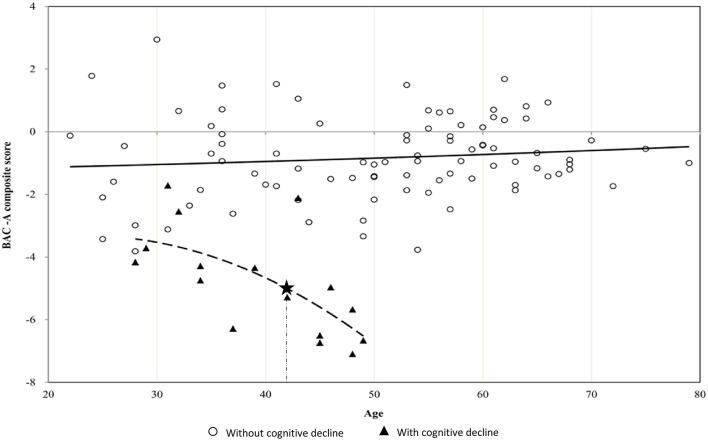
We characterized the heterogeneity and risk factors of cognitive decline in euthymic bipolar disorder (BD), and their magnitude of associations with subjective daily functions. In this retrospective cohort, BD type I patients ( = 128) were followed for an average of 6.5 years. Intelligence quotient (IQ) at index date was recorded, and premorbid IQ was estimated. We used Brief Assessment of Cognition in Affective Disorders (BAC-A) to assess cognition at follow-up. We evaluated current functions with World Health Organization Disability Assessment Schedule 2.0. Clinical and sociodemographic factors were examined for their independent effects on longitudinal cognitive decline. In addition, we employed multivariate adaptive regression spline to detect inflection points for the nature of slope changes in cognitive decline among BD patients. During follow-up years, 21 BD patients (16.4%) showed longitudinal cognitive decline. In cognitive decline group, all cognitive domains of BAC-A were significantly worsened. We found that density of episodes with psychotic features was an independent risk factor for cognitive decline after adjusted for age, gender and dose of mood stabilizer. After the age of 42 years, a steeper cognitive change was observed in the cognitive decline group. The correlation pattern between cognitive domains and functional outcomes differed between patients with and without cognitive decline. The present study characterized cognitive heterogeneity longitudinally in BD patients. As density of episodes play roles for cognitive decline, our results emphasize the importance of relapse prevention. Our findings provide hints for future personalized interventions and facilitating genetic and biological studies for dissecting the heterogeneity of bipolar illness.
我们对心境正常的双相情感障碍(BD)患者认知衰退的异质性和风险因素及其与主观日常功能的关联程度进行了研究。在这项回顾性队列研究中,对128例I型双相情感障碍患者平均随访了6.5年。记录了索引日期时的智商(IQ),并估算了病前智商。我们使用情感障碍认知简短评估量表(BAC-A)在随访时评估认知情况。我们用世界卫生组织残疾评定量表2.0评估当前功能。研究了临床和社会人口学因素对纵向认知衰退的独立影响。此外,我们采用多元自适应回归样条来检测双相情感障碍患者认知衰退斜率变化性质的拐点。在随访期间,21例(16.4%)双相情感障碍患者出现纵向认知衰退。在认知衰退组中,BAC-A的所有认知领域均显著恶化。我们发现,在调整年龄、性别和心境稳定剂剂量后,伴有精神病性特征的发作密度是认知衰退的独立危险因素。42岁以后,认知衰退组的认知变化更为陡峭。认知衰退患者与未出现认知衰退患者的认知领域与功能结局之间的相关模式有所不同。本研究纵向描述了双相情感障碍患者的认知异质性。由于发作密度对认知衰退有影响,我们的结果强调了预防复发的重要性。我们的发现为未来的个性化干预以及推动双相情感障碍异质性剖析的遗传和生物学研究提供了线索。

 Zotero 插件