Suppr超能文献

芯片大脑:表征用于模拟中枢神经系统的下一代先进平台。

Brain-on-a-Chip: Characterizing the next generation of advanced platforms for modeling the central nervous system.

作者信息

Maoz Ben M

出版信息

APL Bioeng. 2021 Jul 30;5(3):030902. doi: 10.1063/5.0055812. eCollection 2021 Sep.

Abstract

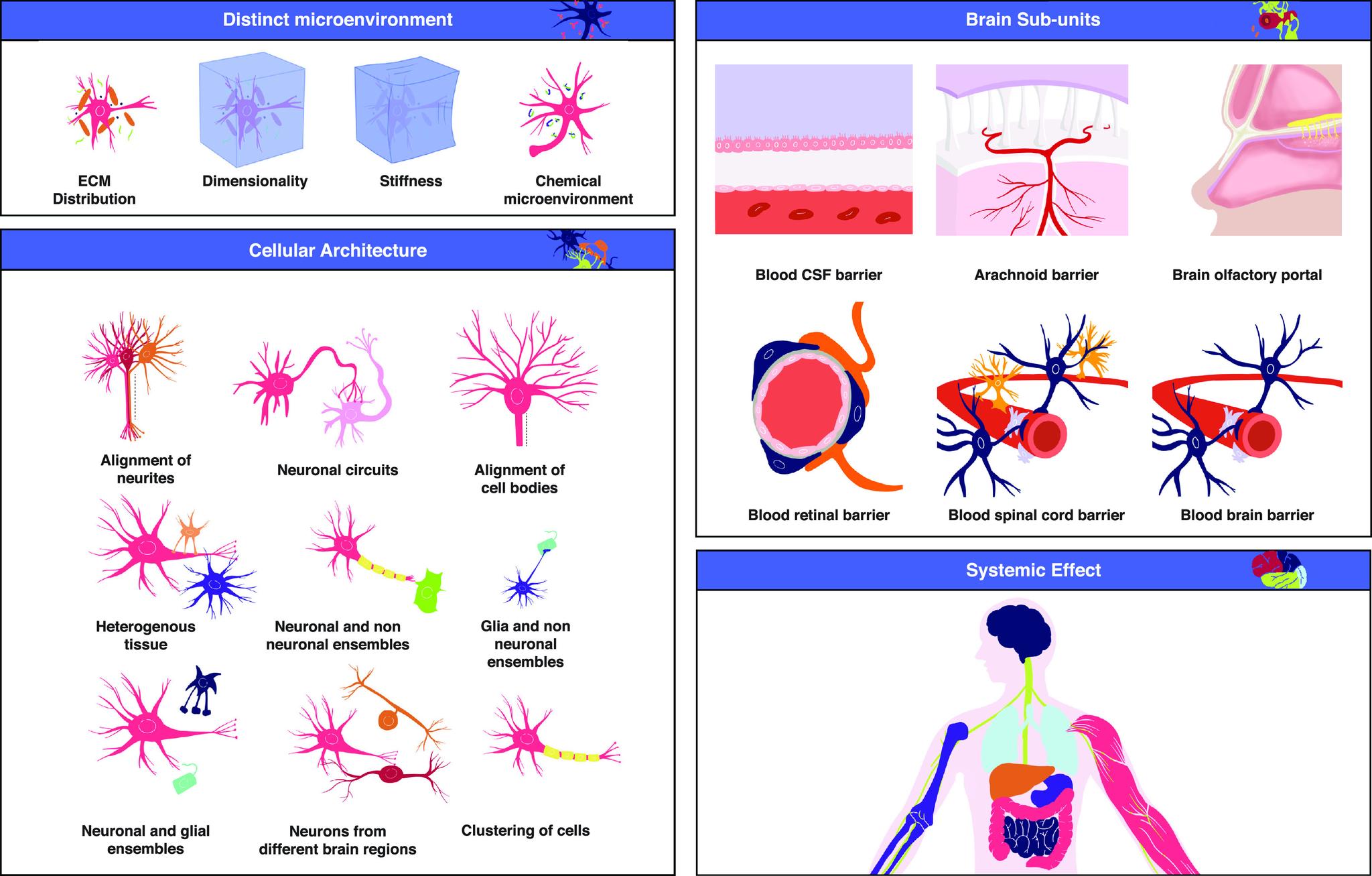
The complexity of the human brain creates significant, almost insurmountable challenges for neurological drug development. Advanced platforms are increasingly enabling researchers to overcome these challenges, by mimicking key features of the brain's composition and functionality. Many of these platforms are called "Brains-on-a-Chip"-a term that was originally used to refer to microfluidics-based systems containing miniature engineered tissues, but that has since expanded to describe a vast range of central nervous system (CNS) modeling approaches. This Perspective seeks to refine the definition of a Brain-on-a-Chip for the next generation of platforms, identifying criteria that determine which systems should qualify. These criteria reflect the extent to which a given platform overcomes the challenges unique to CNS modeling (e.g., recapitulation of the brain's microenvironment; inclusion of critical subunits, such as the blood-brain barrier) and thereby provides meaningful added value over conventional cell culture systems. The paper further outlines practical considerations for the development and implementation of Brain-on-a-Chip platforms and concludes with a vision for where these technologies may be heading.

摘要

人类大脑的复杂性给神经药物研发带来了巨大的、几乎难以克服的挑战。先进的平台越来越能够帮助研究人员克服这些挑战,方法是模拟大脑的组成和功能的关键特征。许多这样的平台被称为“芯片上的大脑”——这个术语最初用于指代包含微型工程组织的基于微流体的系统,但后来已扩展到描述广泛的中枢神经系统(CNS)建模方法。本观点文章旨在为下一代平台完善“芯片上的大脑”的定义,确定哪些系统应符合标准的准则。这些准则反映了特定平台克服中枢神经系统建模独特挑战(例如,重现大脑微环境;纳入关键亚单位,如血脑屏障)的程度,从而相对于传统细胞培养系统提供有意义的附加价值。本文还概述了“芯片上的大脑”平台开发和实施的实际考虑因素,并以对这些技术未来发展方向的展望作为结尾。
https://cdn.ncbi.nlm.nih.gov/pmc/blobs/f7c5/8325567/d07695c29fac/ABPID9-000005-030902_1-g001.jpg

相似文献

1
Brain-on-a-Chip: Characterizing the next generation of advanced platforms for modeling the central nervous system.
APL Bioeng. 2021 Jul 30;5(3):030902. doi: 10.1063/5.0055812. eCollection 2021 Sep.
2
Biosensor integrated brain-on-a-chip platforms: Progress and prospects in clinical translation.
Biosens Bioelectron. 2023 Apr 1;225:115100. doi: 10.1016/j.bios.2023.115100. Epub 2023 Jan 24.
3
Recent progress in translational engineered in vitro models of the central nervous system.
Brain. 2020 Dec 5;143(11):3181-3213. doi: 10.1093/brain/awaa268.
4
Microenvironments Matter: Advances in Brain-on-Chip.
Biosensors (Basel). 2023 May 16;13(5):551. doi: 10.3390/bios13050551.
5
Emerging Brain-Pathophysiology-Mimetic Platforms for Studying Neurodegenerative Diseases: Brain Organoids and Brains-on-a-Chip.
Adv Healthc Mater. 2021 Jun;10(12):e2002119. doi: 10.1002/adhm.202002119. Epub 2021 May 24.
6
Next generation human skin constructs as advanced tools for drug development.
Exp Biol Med (Maywood). 2017 Nov;242(17):1657-1668. doi: 10.1177/1535370217712690. Epub 2017 Jun 7.
7
Organ-On-A-Chip Models of the Blood-Brain Barrier: Recent Advances and Future Prospects.
Small. 2022 Sep;18(39):e2201401. doi: 10.1002/smll.202201401. Epub 2022 Aug 17.
9
Advanced Materials and Sensors for Microphysiological Systems: Focus on Electronic and Electrooptical Interfaces.
Adv Mater. 2022 Apr;34(17):e2107876. doi: 10.1002/adma.202107876. Epub 2022 Mar 14.

引用本文的文献

1
Engineered Chitosan-Derived Nanocarrier for Efficient siRNA Delivery to Peripheral and Central Neurons.
Adv Healthc Mater. 2025 Jun;14(15):e2500107. doi: 10.1002/adhm.202500107. Epub 2025 May 13.
2
Engineered biological neuronal networks as basic logic operators.
Front Comput Neurosci. 2025 Apr 28;19:1559936. doi: 10.3389/fncom.2025.1559936. eCollection 2025.
4
Organ-on-a-Chip Applications in Microfluidic Platforms.
Micromachines (Basel). 2025 Feb 10;16(2):201. doi: 10.3390/mi16020201.
7
Human Brain In Vitro Model for Pathogen Infection-Related Neurodegeneration Study.
Int J Mol Sci. 2024 Jun 13;25(12):6522. doi: 10.3390/ijms25126522.
8
Tailoring epilepsy treatment: personalized micro-physiological systems illuminate individual drug responses.
Ann Med Surg (Lond). 2024 Apr 16;86(6):3557-3567. doi: 10.1097/MS9.0000000000002078. eCollection 2024 Jun.
9
A Comprehensive Review of Organ-on-a-Chip Technology and Its Applications.
Biosensors (Basel). 2024 May 1;14(5):225. doi: 10.3390/bios14050225.
10
Multi-Sensor Origami Platform: A Customizable System for Obtaining Spatiotemporally Precise Functional Readouts in 3D Models.
Adv Sci (Weinh). 2024 Jun;11(24):e2305555. doi: 10.1002/advs.202305555. Epub 2024 Apr 18.

本文引用的文献

1
State of the art in integrated biosensors for organ-on-a-chip applications.
Curr Opin Biomed Eng. 2021 Sep;19. doi: 10.1016/j.cobme.2021.100309. Epub 2021 Jun 9.
2
Biology and Models of the Blood-Brain Barrier.
Annu Rev Biomed Eng. 2021 Jul 13;23:359-384. doi: 10.1146/annurev-bioeng-082120-042814.
3
In-Line Analysis of Organ-on-Chip Systems with Sensors: Integration, Fabrication, Challenges, and Potential.
ACS Biomater Sci Eng. 2021 Jul 12;7(7):2926-2948. doi: 10.1021/acsbiomaterials.0c01110. Epub 2021 Jun 16.
4
Fungal brain infection modelled in a human-neurovascular-unit-on-a-chip with a functional blood-brain barrier.
Nat Biomed Eng. 2021 Aug;5(8):830-846. doi: 10.1038/s41551-021-00743-8. Epub 2021 Jun 14.
6
Transforming a well into a chip: A modular 3D-printed microfluidic chip.
APL Bioeng. 2021 Apr 28;5(2):026103. doi: 10.1063/5.0039366. eCollection 2021 Jun.
7
Review of Design Considerations for Brain-on-a-Chip Models.
Micromachines (Basel). 2021 Apr 15;12(4):441. doi: 10.3390/mi12040441.
8
Advancement of Sensor Integrated Organ-on-Chip Devices.
Sensors (Basel). 2021 Feb 15;21(4):1367. doi: 10.3390/s21041367.
9
Advances in microfluidic in vitro systems for neurological disease modeling.
J Neurosci Res. 2021 May;99(5):1276-1307. doi: 10.1002/jnr.24794. Epub 2021 Feb 13.

文献AI研究员

20分钟写一篇综述,助力文献阅读效率提升50倍。

立即体验

用中文搜PubMed

大模型驱动的PubMed中文搜索引擎

马上搜索

文档翻译

学术文献翻译模型,支持多种主流文档格式。

立即体验