
波兰(西北部)地区 SARS-CoV-2 的分子进化与流行病学特征。
Molecular Evolution and Epidemiological Characteristics of SARS COV-2 in (Northwestern) Poland.
机构信息
Department of Infectious, Tropical Diseases and Immune Deficiency, Pomeranian Medical University in Szczecin, 71-455 Szczecin, Poland.
Department of Forensic Medicine, Pomeranian Medical University in Szczecin, 70-111 Szczecin, Poland.
出版信息
Viruses. 2021 Jul 2;13(7):1295. doi: 10.3390/v13071295.
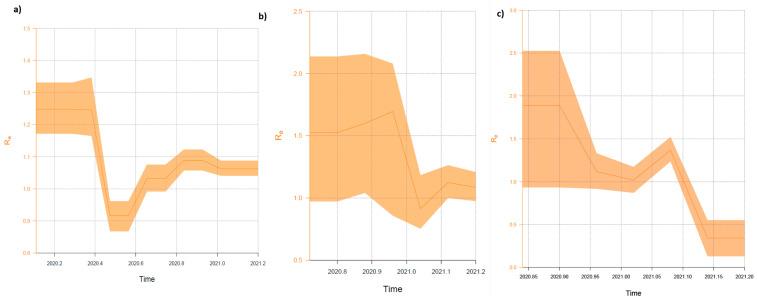
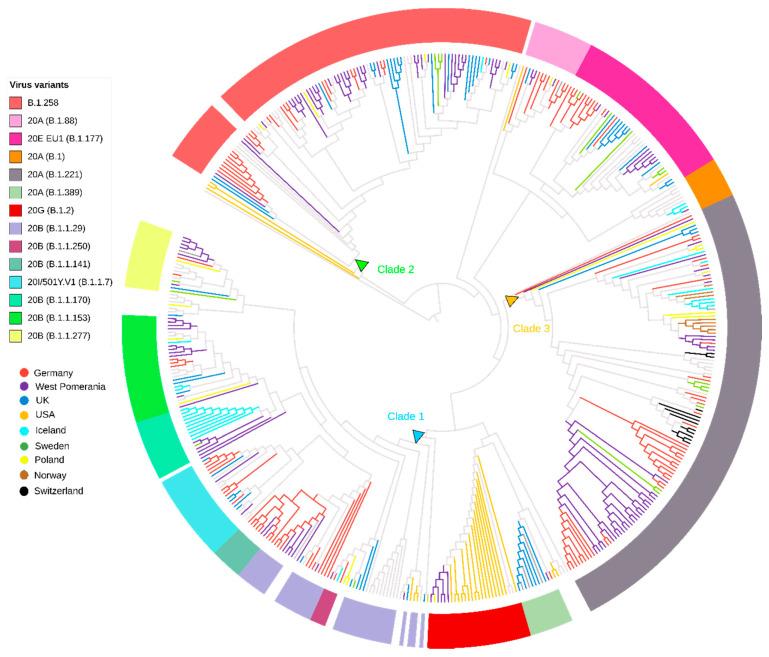
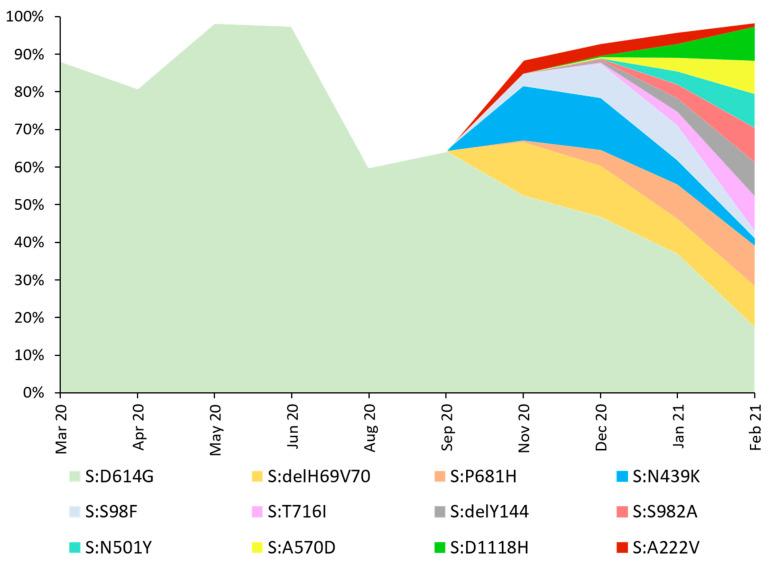
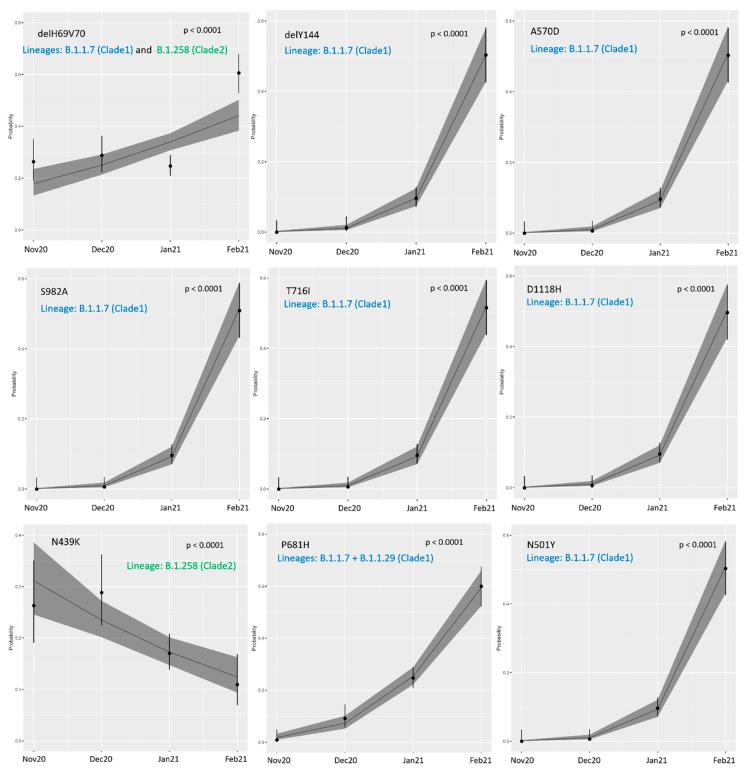
The emergence of severe acute respiratory syndrome coronavirus-2 (SARS-CoV-2) evolved into a worldwide outbreak, with the first Polish cases in February/March 2020. This study aimed to investigate the molecular epidemiology of the circulating virus lineages between March 2020 and February 2021. We performed variant identification, spike mutation pattern analysis, and phylogenetic and evolutionary analyses for 1106 high-coverage whole-genome sequences, implementing maximum likelihood, multiple continuous-time Markov chain, and Bayesian birth-death skyline models. For time trends, logistic regression was used. In the dataset, virus B.1.221 lineage was predominant (15.37%), followed by B.1.258 (15.01%) and B.1.1.29 (11.48%) strains. Three clades were identified, being responsible for 74.41% of infections over the analyzed period. Expansion in variant diversity was observed since September 2020 with increasing frequency of the number in spike substitutions, mainly H69V70 deletion, P681H, N439K, and S98F. In population dynamics inferences, three periods with exponential increase in infection were observed, beginning in March, July, and September 2020, respectively, and were driven by different virus clades. Additionally, a notable increase in infections caused by the B.1.1.7 lineage since February 2021 was noted. Over time, the virus accumulated mutations related to optimized transmissibility; therefore, faster dissemination is reflected by the second wave of epidemics in Poland.
严重急性呼吸综合征冠状病毒 2 (SARS-CoV-2) 的出现演变成了一次全球爆发,波兰的首例病例出现在 2020 年 2 月/3 月。本研究旨在调查 2020 年 3 月至 2021 年 2 月期间循环病毒谱系的分子流行病学。我们对 1106 个高覆盖率全基因组序列进行了变体识别、刺突突变模式分析以及系统发生和进化分析,采用了最大似然法、多个连续时间马尔可夫链和贝叶斯出生-死亡天际线模型。对于时间趋势,我们使用了逻辑回归。在该数据集,病毒 B.1.221 谱系占主导地位(15.37%),其次是 B.1.258(15.01%)和 B.1.1.29(11.48%)株。鉴定出三个分支,在分析期间,它们负责 74.41%的感染。自 2020 年 9 月以来,变体多样性的扩张明显,刺突取代的数量不断增加,主要是 H69V70 缺失、P681H、N439K 和 S98F。在群体动力学推断中,观察到三个感染呈指数增长的时期,分别始于 2020 年 3 月、7 月和 9 月,由不同的病毒分支驱动。此外,自 2021 年 2 月以来,B.1.1.7 谱系引起的感染显著增加。随着时间的推移,病毒积累了与优化传播性相关的突变;因此,波兰第二波疫情反映了更快的传播速度。




 Zotero 插件