
使用多区域放射组学分析预测局部晚期非小细胞肺癌根治性放疗后放射性肺炎。
Prediction of radiation pneumonitis after definitive radiotherapy for locally advanced non-small cell lung cancer using multi-region radiomics analysis.
机构信息
Department of Radiation Oncology, Graduate School of Biomedical Health Sciences, Hiroshima University, 1-3-2 Kagamiyama, Higashihiroshima, Hiroshima, 734-8551, Japan.
Medical and Dental Sciences Course, Graduate School of Biomedical & Health Sciences, Hiroshima University, Hiroshima, Japan.
出版信息
Sci Rep. 2021 Aug 10;11(1):16232. doi: 10.1038/s41598-021-95643-x.
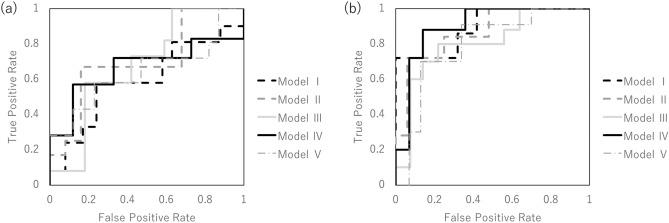
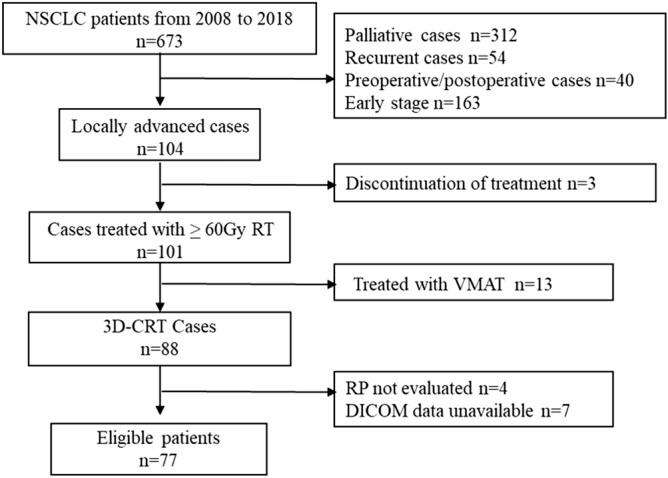
To predict grade ≥ 2 radiation pneumonitis (RP) in patients with locally advanced non-small cell lung cancer (NSCLC) using multi-region radiomics analysis. Data from 77 patients with NSCLC who underwent definitive radiotherapy between 2008 and 2018 were analyzed. Radiomic feature extraction from the whole lung (whole-lung radiomics analysis) and imaging- and dosimetric-based segmentation (multi-region radiomics analysis) were performed. Patients with RP grade ≥ 2 or < 2 were classified. Predictors were selected with least absolute shrinkage and selection operator logistic regression and the model was built with neural network classifiers. A total of 49,383 radiomics features per patient image were extracted from the radiotherapy planning computed tomography. We identified 4 features and 13 radiomics features in the whole-lung and multi-region radiomics analysis for classification, respectively. The accuracy and area under the curve (AUC) without the synthetic minority over-sampling technique (SMOTE) were 60.8%, and 0.62 for whole-lung and 80.1%, and 0.84 for multi-region radiomics analysis. These were improved 1.7% for whole-lung and 2.1% for multi-region radiomics analysis with the SMOTE. The developed multi-region radiomics analysis can help predict grade ≥ 2 RP. The radiomics features in the median- and high-dose regions, and the local intensity roughness and variation were important factors in predicting grade ≥ 2 RP.
利用多区域放射组学分析预测局部晚期非小细胞肺癌(NSCLC)患者 2 级及以上放射性肺炎(RP)。分析了 2008 年至 2018 年间接受根治性放疗的 77 例 NSCLC 患者的数据。对全肺(全肺放射组学分析)和基于影像和剂量分割的区域(多区域放射组学分析)进行放射组学特征提取。将有 2 级及以上或<2 级 RP 的患者进行分类。使用最小绝对值收缩和选择算子逻辑回归选择预测因子,并使用神经网络分类器构建模型。从放疗计划 CT 中提取了每个患者图像的 49383 个放射组学特征。在全肺和多区域放射组学分析中,我们分别确定了 4 个特征和 13 个用于分类的放射组学特征。未使用合成少数过采样技术(SMOTE)的准确性和曲线下面积(AUC)分别为 60.8%和 0.62,全肺为 80.1%和 0.84,多区域放射组学分析为 80.1%和 0.84。使用 SMOTE 后,全肺和多区域放射组学分析分别提高了 1.7%和 2.1%。开发的多区域放射组学分析可以帮助预测 2 级及以上 RP。中值和高剂量区域的放射组学特征以及局部强度粗糙度和变异性是预测 2 级及以上 RP 的重要因素。


 Zotero 插件