
CAR-T细胞产品阿基仑赛、替雷利珠单抗和利司扑兰治疗血液系统恶性肿瘤的疗效和安全性:系统评价与荟萃分析
Efficacy and Safety of CAR-T Cell Products Axicabtagene Ciloleucel, Tisagenlecleucel, and Lisocabtagene Maraleucel for the Treatment of Hematologic Malignancies: A Systematic Review and Meta-Analysis.
作者信息
Meng Jun, Wu XiaoQin, Sun Zhen, Xun RenDe, Liu MengSi, Hu Rui, Huang JianChao
机构信息
Molecular Genetics Laboratory, Suining Central Hospital, Suining, China.
Department of Neurosurgery, The First Affiliated Hospital, University of South China, Hengyang, China.
出版信息
Front Oncol. 2021 Jul 26;11:698607. doi: 10.3389/fonc.2021.698607. eCollection 2021.
BACKGROUND
Currently, three chimeric antigen receptor (CAR)-T cell products axicabtagene ciloleucel, tisagenlecleucel, and lisocabtagene maraleucel have been approved by the U.S. Food and Drug Administration for the treatment of large B cell lymphoma, which provide a novel and promising choice for patients with relapsed or refractory to traditional anti-tumor treatments. Thus, it is pertinent to describe the efficacy and safety profile of the three products available by summarizing the current evidence.
METHODS
Two reviewers independently searched the Embase, PubMed, Web of Science, and Cochrane Library, to identify studies related to the use of the three CAR-T cell products for treating hematologic malignancies published up to October 5, 2020. We pooled the overall response rate, complete response rate, cytokine release syndrome, and immune effector cell-associated neurotoxicity syndrome of three products, and then performed subgroup analysis based on the type of product and type of tumor.
RESULTS
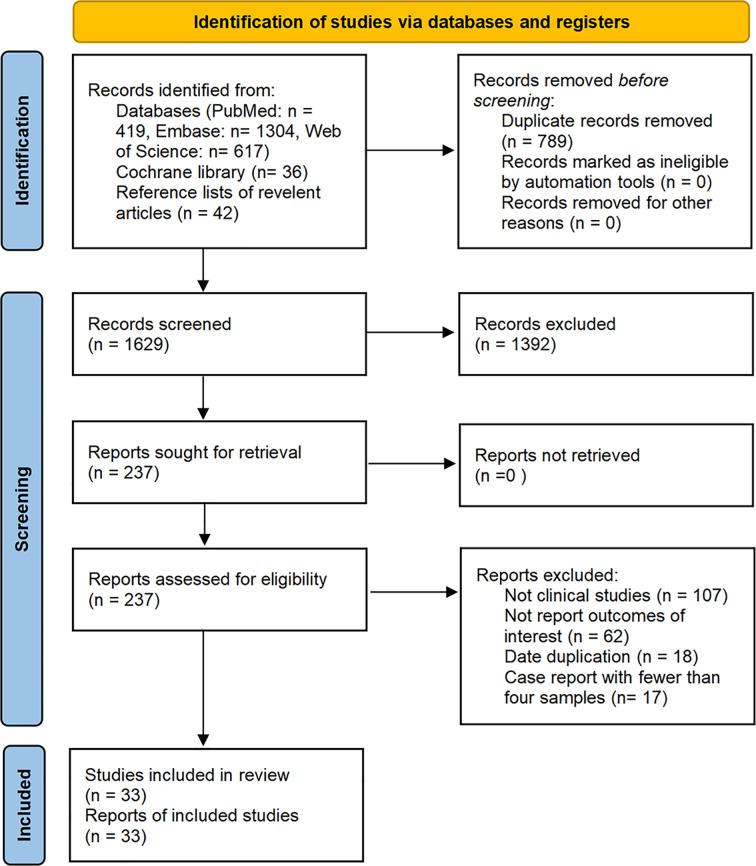
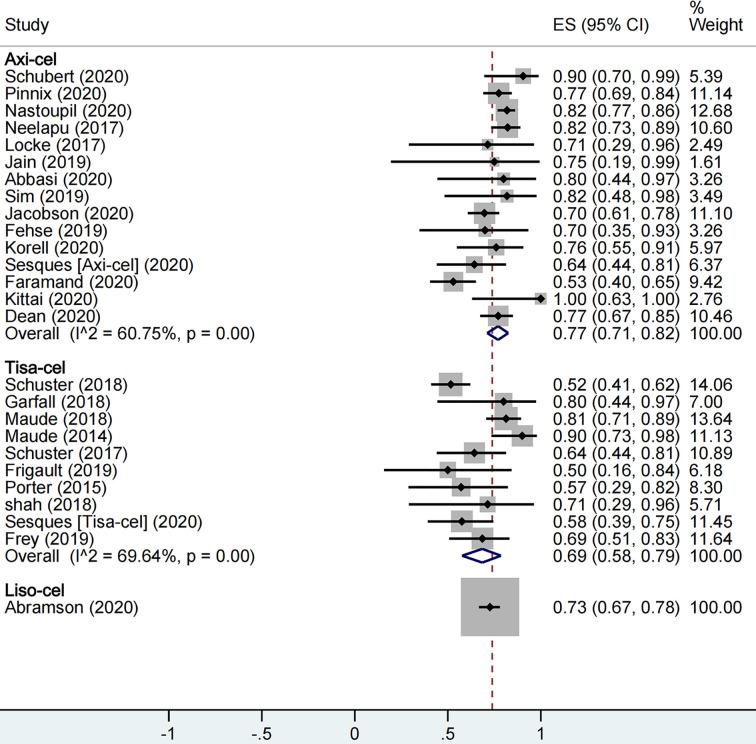
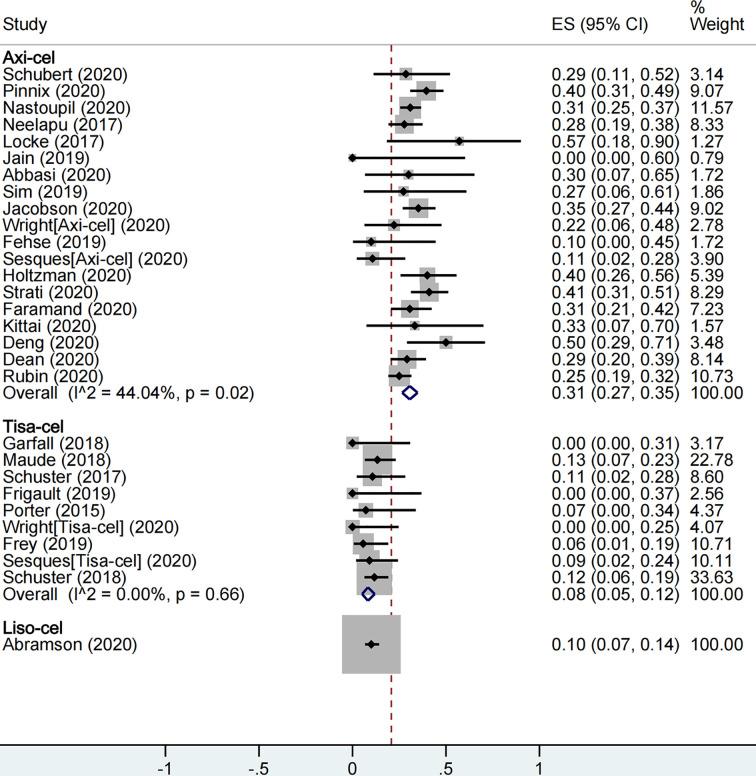
Thirty-three studies involving 2,172 patients were included in the analysis. All three products showed promising results in patients with different pathological subtypes and clinical characteristics that included those who did not meet the eligibility criteria of licensing trials, with overall response rates of nearly 70% or above and complete response rates of more than 50%. However, high rates of severe immune effector cell-associated neurotoxicity syndrome in patients undergoing axicabtagene ciloleucel treatment and life-threatening cytokine release syndrome in patients with leukemia undergoing tisagenlecleucel treatment required special attention in practice (31%; 95% CI: 0.27-0.35 and 55%; 95% CI: 0.45-0.64, respectively). Moreover, lisocabtagene maraleucel that showed a favorable efficacy and safety in the licensing trial lacked corresponding real-world data.
CONCLUSION
Both axicabtagene ciloleucel and tisagenlecleucel showed considerable efficacy in practice, but need special attention with respect to life-threatening toxicity that can occur in certain situations. Lisocabtagene maraleucel demonstrated excellent efficacy and safety profiles in the licensing trial, but lacked corresponding real-world data. Additional data on the three products are needed in rare histological subtypes to benefit a broader patient population.
背景
目前,三种嵌合抗原受体(CAR)-T细胞产品——阿基仑赛注射液、替雷利珠单抗注射液和瑞基奥仑赛注射液已获美国食品药品监督管理局批准用于治疗大B细胞淋巴瘤,这为传统抗肿瘤治疗复发或难治的患者提供了一种新的且有前景的选择。因此,通过总结现有证据来描述这三种可用产品的疗效和安全性特征是很有必要的。
方法
两名研究者独立检索了Embase、PubMed、科学网和考克兰图书馆,以识别截至2020年10月5日发表的与使用这三种CAR-T细胞产品治疗血液系统恶性肿瘤相关的研究。我们汇总了三种产品的总缓解率、完全缓解率、细胞因子释放综合征和免疫效应细胞相关神经毒性综合征,然后根据产品类型和肿瘤类型进行亚组分析。
结果
分析纳入了33项涉及2172例患者的研究。所有三种产品在不同病理亚型和临床特征的患者中均显示出有前景的结果,包括那些不符合许可试验纳入标准的患者,总缓解率接近70%或更高,完全缓解率超过50%。然而,接受阿基仑赛注射液治疗的患者中严重免疫效应细胞相关神经毒性综合征的发生率较高,接受替雷利珠单抗注射液治疗的白血病患者中危及生命的细胞因子释放综合征发生率较高,在实际应用中需要特别关注(分别为31%;95%CI:0.27 - 0.35和55%;95%CI:0.45 - 0.64)。此外,在许可试验中显示出良好疗效和安全性的瑞基奥仑赛注射液缺乏相应的真实世界数据。
结论
阿基仑赛注射液和替雷利珠单抗注射液在实际应用中均显示出相当的疗效,但对于某些情况下可能发生的危及生命的毒性需要特别关注。瑞基奥仑赛注射液在许可试验中显示出优异的疗效和安全性特征,但缺乏相应的真实世界数据。在罕见组织学亚型中需要更多关于这三种产品的数据,以使更广泛的患者群体受益。





 Zotero 插件