
来自六个遥远国家的儿童粪便中的芽囊原虫:流行率、数量、亚型以及与肠道细菌组的关系。
Blastocystis in the faeces of children from six distant countries: prevalence, quantity, subtypes and the relation to the gut bacteriome.
机构信息
Department of Pediatrics, 2nd Faculty of Medicine, Charles University in Prague and University Hospital Motol, V Uvalu 84, Prague 5, Czech Republic.
Department of Pediatrics, School of Medicine, University of Jordan, Amman, Jordan.
出版信息
Parasit Vectors. 2021 Aug 12;14(1):399. doi: 10.1186/s13071-021-04859-3.
BACKGROUND
Blastocystis is a human gut symbiont of yet undefined clinical significance. In a set of faecal samples collected from asymptomatic children of six distant populations, we first assessed the community profiles of protist 18S rDNA and then characterized Blastocystis subtypes and tested Blastocystis association with the faecal bacteriome community.
METHODS
Stool samples were collected from 244 children and young persons (mean age 11.3 years, interquartile range 8.1-13.7) of six countries (Azerbaijan 51 subjects, Czechia 52, Jordan 40, Nigeria 27, Sudan 59 and Tanzania 15). The subjects showed no symptoms of infection. Amplicon profiling of the 18S rDNA was used for verification that Blastocystis was the most frequent protist, whereas specific real-time PCR showed its prevalence and quantity, and massive parallel amplicon sequencing defined the Blastocystis subtypes. The relation between Blastocystis and the stool bacteriome community was characterized using 16S rDNA profiling.
RESULTS
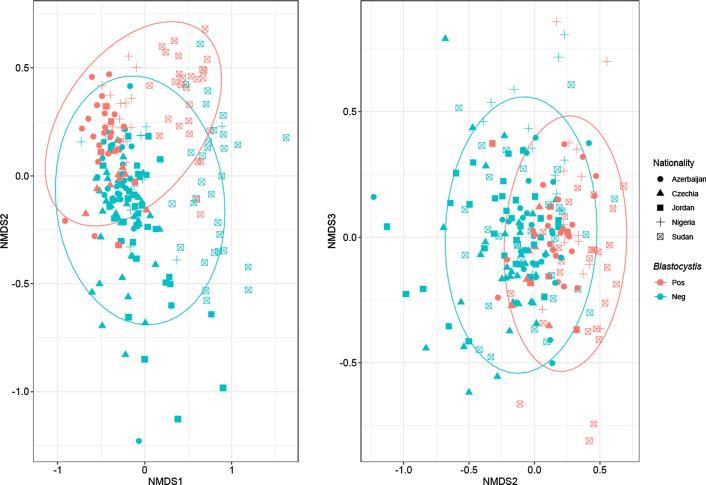
Blastocystis was detected by specific PCR in 36% (88/244) stool samples and was the most often observed faecal protist. Children from Czechia and Jordan had significantly lower prevalence than children from the remaining countries. The most frequent subtype was ST3 (49%, 40/81 sequenced samples), followed by ST1 (36%) and ST2 (25%). Co-infection with two different subtypes was noted in 12% samples. The faecal bacteriome had higher richness in Blastocystis-positive samples, and Blastocystis was associated with significantly different community composition regardless of the country (p < 0.001 in constrained redundancy analysis). Several taxa differed with Blastocystis positivity or quantity: two genera of Ruminococcaceae were more abundant, while Bifidobacterium, Veillonella, Lactobacillus and several other genera were undrerrepresented.
CONCLUSIONS
Asymptomatic children frequently carry Blastocystis, and co-infection with multiple distinct subtypes is not exceptional. Prevalence and quantity of the organism clearly differ among populations. Blastocystis is linked to both faecal bacteriome diversity and its composition.
背景
芽囊原虫是一种尚未明确临床意义的人类肠道共生体。在一组来自六个不同人群的无症状儿童的粪便样本中,我们首先评估了原生动物 18S rDNA 的群落特征,然后对芽囊原虫亚型进行了特征描述,并检测了芽囊原虫与粪便细菌群落的关联。
方法
从六个国家(阿塞拜疆 51 例、捷克 52 例、约旦 40 例、尼日利亚 27 例、苏丹 59 例和坦桑尼亚 15 例)的 244 名儿童和青少年(平均年龄 11.3 岁,四分位距 8.1-13.7)中采集粪便样本。这些受试者没有感染症状。18S rDNA 扩增子分析用于验证芽囊原虫是最常见的原生动物,而特定的实时 PCR 显示其流行率和数量,大规模平行扩增子测序定义了芽囊原虫亚型。通过 16S rDNA 分析来描述芽囊原虫与粪便细菌群落的关系。
结果
特定 PCR 在 36%(88/244)的粪便样本中检测到芽囊原虫,是最常见的粪便原生动物。来自捷克和约旦的儿童的流行率明显低于来自其他国家的儿童。最常见的亚型是 ST3(49%,40/81 测序样本),其次是 ST1(36%)和 ST2(25%)。在 12%的样本中检测到两种不同亚型的混合感染。在芽囊原虫阳性样本中,粪便细菌群落的丰富度更高,芽囊原虫与无论国家(受限冗余分析中 p<0.001)的群落组成显著不同相关。一些分类群与芽囊原虫阳性或数量有关:瘤胃球菌科的两个属更为丰富,而双歧杆菌属、韦荣球菌属、乳杆菌属和其他几个属则代表不足。
结论
无症状儿童常携带芽囊原虫,同时感染多种不同亚型并不罕见。该生物体的流行率和数量在人群中明显不同。芽囊原虫与粪便细菌群落的多样性及其组成有关。


 Zotero 插件