
抗生素耐药性、药物靶点达成率、细菌致病性和毒力,以及抗生素的可及性和可负担性对新生儿败血症结局的影响:一项国际微生物学和药物评价前瞻性子研究(BARNARDS)。
Effects of antibiotic resistance, drug target attainment, bacterial pathogenicity and virulence, and antibiotic access and affordability on outcomes in neonatal sepsis: an international microbiology and drug evaluation prospective substudy (BARNARDS).
机构信息
Institute of Infection and Immunity, School of Medicine, Cardiff University, Cardiff, UK; Oxford Institute of Antimicrobial Research, Department of Zoology, University of Oxford, Oxford, UK.
Institute of Infection and Immunity, School of Medicine, Cardiff University, Cardiff, UK; Centre for Trials Research, Cardiff University, Cardiff, UK.
出版信息
Lancet Infect Dis. 2021 Dec;21(12):1677-1688. doi: 10.1016/S1473-3099(21)00050-5. Epub 2021 Aug 9.
BACKGROUND
Sepsis is a major contributor to neonatal mortality, particularly in low-income and middle-income countries (LMICs). WHO advocates ampicillin-gentamicin as first-line therapy for the management of neonatal sepsis. In the BARNARDS observational cohort study of neonatal sepsis and antimicrobial resistance in LMICs, common sepsis pathogens were characterised via whole genome sequencing (WGS) and antimicrobial resistance profiles. In this substudy of BARNARDS, we aimed to assess the use and efficacy of empirical antibiotic therapies commonly used in LMICs for neonatal sepsis.
METHODS
In BARNARDS, consenting mother-neonates aged 0-60 days dyads were enrolled on delivery or neonatal presentation with suspected sepsis at 12 BARNARDS clinical sites in Bangladesh, Ethiopia, India, Pakistan, Nigeria, Rwanda, and South Africa. Stillborn babies were excluded from the study. Blood samples were collected from neonates presenting with clinical signs of sepsis, and WGS and minimum inhibitory concentrations for antibiotic treatment were determined for bacterial isolates from culture-confirmed sepsis. Neonatal outcome data were collected following enrolment until 60 days of life. Antibiotic usage and neonatal outcome data were assessed. Survival analyses were adjusted to take into account potential clinical confounding variables related to the birth and pathogen. Additionally, resistance profiles, pharmacokinetic-pharmacodynamic probability of target attainment, and frequency of resistance (ie, resistance defined by in-vitro growth of isolates when challenged by antibiotics) were assessed. Questionnaires on health structures and antibiotic costs evaluated accessibility and affordability.
FINDINGS
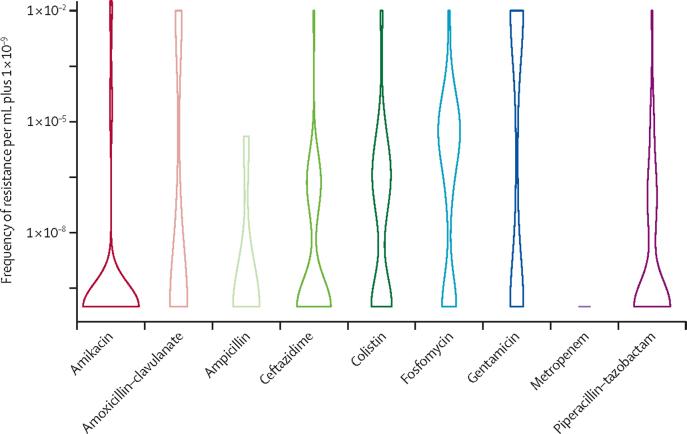
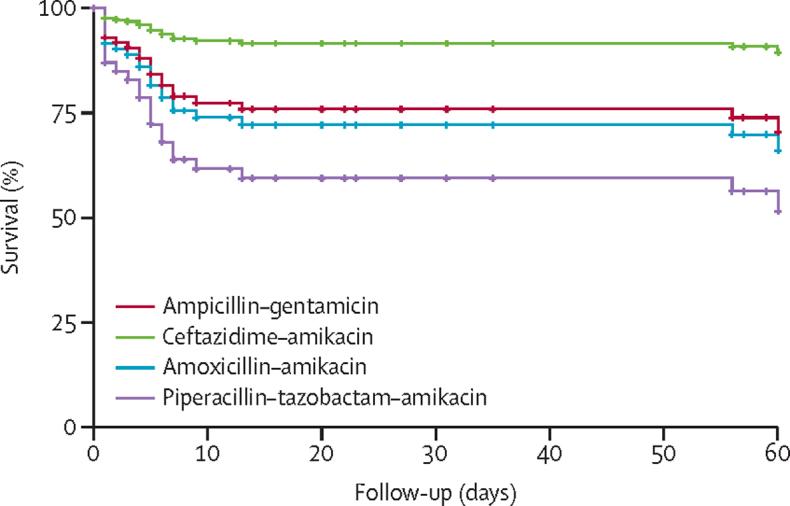
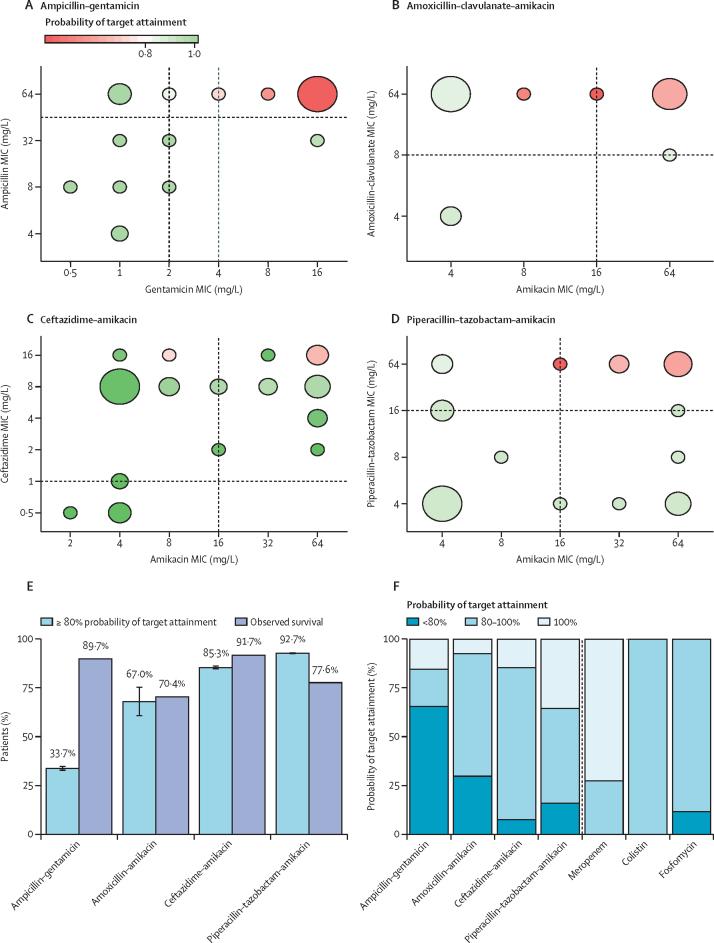
Between Nov 12, 2015, and Feb 1, 2018, 36 285 neonates were enrolled into the main BARNARDS study, of whom 9874 had clinically diagnosed sepsis and 5749 had available antibiotic data. The four most commonly prescribed antibiotic combinations given to 4451 neonates (77·42%) of 5749 were ampicillin-gentamicin, ceftazidime-amikacin, piperacillin-tazobactam-amikacin, and amoxicillin clavulanate-amikacin. This dataset assessed 476 prescriptions for 442 neonates treated with one of these antibiotic combinations with WGS data (all BARNARDS countries were represented in this subset except India). Multiple pathogens were isolated, totalling 457 isolates. Reported mortality was lower for neonates treated with ceftazidime-amikacin than for neonates treated with ampicillin-gentamicin (hazard ratio [adjusted for clinical variables considered potential confounders to outcomes] 0·32, 95% CI 0·14-0·72; p=0·0060). Of 390 Gram-negative isolates, 379 (97·2%) were resistant to ampicillin and 274 (70·3%) were resistant to gentamicin. Susceptibility of Gram-negative isolates to at least one antibiotic in a treatment combination was noted in 111 (28·5%) to ampicillin-gentamicin; 286 (73·3%) to amoxicillin clavulanate-amikacin; 301 (77·2%) to ceftazidime-amikacin; and 312 (80·0%) to piperacillin-tazobactam-amikacin. A probability of target attainment of 80% or more was noted in 26 neonates (33·7% [SD 0·59]) of 78 with ampicillin-gentamicin; 15 (68·0% [3·84]) of 27 with amoxicillin clavulanate-amikacin; 93 (92·7% [0·24]) of 109 with ceftazidime-amikacin; and 70 (85·3% [0·47]) of 76 with piperacillin-tazobactam-amikacin. However, antibiotic and country effects could not be distinguished. Frequency of resistance was recorded most frequently with fosfomycin (in 78 isolates [68·4%] of 114), followed by colistin (55 isolates [57·3%] of 96), and gentamicin (62 isolates [53·0%] of 117). Sites in six of the seven countries (excluding South Africa) stated that the cost of antibiotics would influence treatment of neonatal sepsis.
INTERPRETATION
Our data raise questions about the empirical use of combined ampicillin-gentamicin for neonatal sepsis in LMICs because of its high resistance and high rates of frequency of resistance and low probability of target attainment. Accessibility and affordability need to be considered when advocating antibiotic treatments with variance in economic health structures across LMICs.
FUNDING
The Bill & Melinda Gates Foundation.
背景
败血症是新生儿死亡的主要原因,尤其是在低收入和中等收入国家(LMICs)。世界卫生组织提倡氨苄西林-庆大霉素作为治疗新生儿败血症的一线药物。在针对 LMICs 中新生儿败血症和抗生素耐药性的 BARNARDS 观察性队列研究中,通过全基因组测序(WGS)和抗生素耐药性分析来描述常见的败血症病原体。在 BARNARDS 的这项子研究中,我们旨在评估在 LMICs 中常用于治疗新生儿败血症的经验性抗生素治疗的使用和疗效。
方法
在 BARNARDS 中,在孟加拉国、埃塞俄比亚、印度、巴基斯坦、尼日利亚、卢旺达和南非的 12 个 BARNARDS 临床站点,对 0-60 天的母婴进行了同意参与的前瞻性登记,有疑似败血症的新生儿。死胎婴儿被排除在研究之外。从有临床败血症体征的新生儿中采集血样,并对从培养确认败血症的细菌分离株中进行 WGS 和抗生素治疗最小抑菌浓度测定。在登记后直到 60 天的生命期内收集新生儿结局数据。评估抗生素使用和新生儿结局数据。生存分析调整了与出生和病原体相关的潜在临床混杂变量。此外,评估了耐药谱、药代动力学-药效学目标获得概率和耐药频率(即,当分离株受到抗生素挑战时,通过体外生长定义的耐药性)。对卫生结构和抗生素成本的调查问卷评估了可及性和可负担性。
结果
2015 年 11 月 12 日至 2018 年 2 月 1 日,共有 36285 名新生儿纳入 BARNARDS 主要研究,其中 9874 名新生儿临床诊断为败血症,5749 名新生儿有可用的抗生素数据。在 5749 名新生儿中,4451 名新生儿(77.42%)接受了四种最常用的抗生素联合治疗,分别为氨苄西林-庆大霉素、头孢他啶-阿米卡星、哌拉西林-他唑巴坦-阿米卡星和阿莫西林克拉维酸-阿米卡星。该数据集评估了用 WGS 数据(除印度外,所有 BARNARDS 国家都有代表)治疗 442 名新生儿的 476 种抗生素处方。共分离出 457 株多种病原体。与接受氨苄西林-庆大霉素治疗的新生儿相比,接受头孢他啶-阿米卡星治疗的新生儿死亡率较低(调整了考虑对结果有潜在影响的临床变量后的危险比[0.32,95%CI 0.14-0.72;p=0.0060])。在 390 株革兰氏阴性菌分离株中,379 株(97.2%)对氨苄西林耐药,274 株(70.3%)对庆大霉素耐药。在 111 株(28.5%)对氨苄西林-庆大霉素;286 株(73.3%)对阿莫西林克拉维酸-阿米卡星;301 株(77.2%)对头孢他啶-阿米卡星;和 312 株(80.0%)对哌拉西林-他唑巴坦-阿米卡星的治疗组合中,至少有一种抗生素的敏感性得到了注意。在接受氨苄西林-庆大霉素治疗的 78 名儿童中有 26 名(33.7%[SD 0.59])达到了 80%或更高的目标获得概率;在接受阿莫西林克拉维酸-阿米卡星治疗的 27 名儿童中有 15 名(68.0%[3.84]);在接受头孢他啶-阿米卡星治疗的 109 名儿童中有 93 名(92.7%[0.24]);在接受哌拉西林-他唑巴坦-阿米卡星治疗的 76 名儿童中有 70 名(85.3%[0.47])。然而,抗生素和国家的影响无法区分。最常记录到的耐药频率是磷霉素(在 114 株分离株中为 78 株[68.4%]),其次是黏菌素(在 96 株分离株中为 55 株[57.3%])和庆大霉素(在 117 株分离株中为 62 株[53.0%])。在除南非以外的七个国家中的六个国家的站点表示,抗生素的成本将影响新生儿败血症的治疗。
解释
我们的数据对在 LMICs 中使用氨苄西林-庆大霉素治疗新生儿败血症提出了质疑,因为它的耐药率高,耐药频率高,目标获得概率低。在具有不同经济卫生结构的 LMICs 中,在提倡抗生素治疗时需要考虑可及性和可负担性。
资金
比尔及梅琳达·盖茨基金会。


 Zotero 插件