
人类下颌磨牙不可逆性牙髓炎患者中初次及补充性颊/舌侧浸润麻醉的效果:一项系统评价与荟萃分析
Anesthetic efficacy of primary and supplemental buccal/lingual infiltration in patients with irreversible pulpitis in human mandibular molars: a systematic review and meta-analysis.
作者信息
Gupta Alpa, Sahai Aarushi, Aggarwal Vivek, Mehta Namrata, Abraham Dax, Jala Sucheta, Singh Arundeep
机构信息
Department of Conservative Dentistry and Endodontics, Manav Racha Dental College, Faridabad, India.
Department of Conservative Dentistry and Endodontics, Faculty of Dentistry, Jamia Milia Islamia, New Delhi, India.
出版信息
J Dent Anesth Pain Med. 2021 Aug;21(4):283-309. doi: 10.17245/jdapm.2021.21.4.283. Epub 2021 Jul 30.
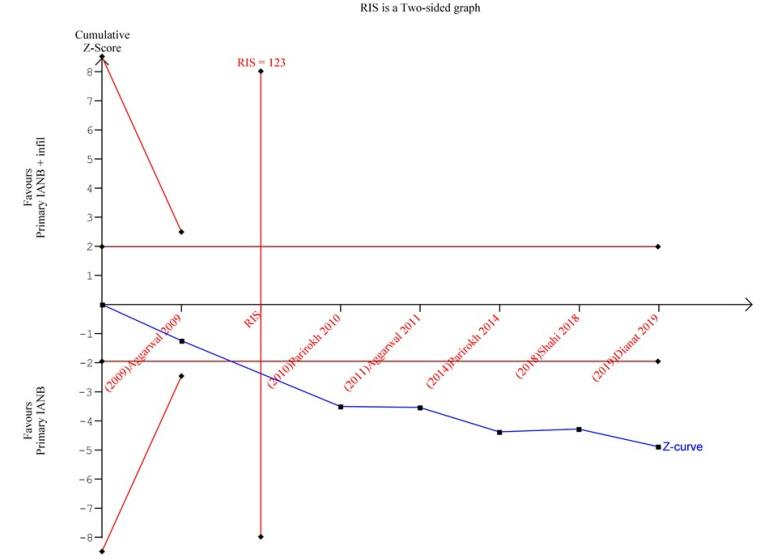
Achieving profound anesthesia in mandibular molars with irreversible pulpitis is a tedious task. This review aimed at evaluating the success of buccal/lingual infiltrations administered with a primary inferior alveolar nerve block (IANB) injection or as a supplemental injection after the failure of the primary injection in symptomatic and asymptomatic patients with irreversible pulpitis in human mandibular molars. The review question was "What will be the success of primary and supplemental infiltration injection in the endodontic treatment of patients with irreversible pulpitis in human mandibular molars?" We searched electronic databases, including Pubmed, Scopus, and Ebsco host and we did a comprehensive manual search. The review protocol was framed according to the Preferred Reporting Items for Systematic Reviews and Meta-Analysis (PRISMA) checklist. We included clinical studies that evaluated and compared the anesthetic outcomes of primary IANB with primary and/or supplementary infiltration injections. Standard evaluation of the included studies was performed and suitable data and inferences were assessed. Twenty-six studies were included, of which 13 were selected for the meta-analysis. In the forest plot representation of the studies evaluating infiltrations, the combined risk ratio (RR) was 1.88 (95% CI: 1.49, 2.37), in favor of the secondary infiltrations with a statistical heterogeneity of 77%. The forest plot analysis for studies comparing primary IANB + infiltration versus primary IANB alone showed a low heterogeneity (0%). The included studies had similar RRs and the combined RR was 1.84 (95% CI: 1.44, 2.34). These findings suggest that supplemental infiltrations given along with a primary IANB provide a better success rate. L'Abbe plots were generated to measure the statistical heterogeneity among the studies. Trial sequential analysis suggested that the number of patients included in the analysis was adequate. Based on the qualitative and quantitative analyses, we concluded that the infiltration technique, either as a primary injection or as a supplementary injection, given after the failure of primary IANB, increases the overall anesthetic efficacy.
在下颌磨牙不可逆性牙髓炎患者中实现深度麻醉是一项繁琐的任务。本综述旨在评估在人类下颌磨牙不可逆性牙髓炎有症状和无症状患者中,在初次下牙槽神经阻滞(IANB)注射时进行颊侧/舌侧浸润注射或初次注射失败后作为补充注射的成功率。综述问题是“在人类下颌磨牙不可逆性牙髓炎患者的牙髓治疗中,初次和补充浸润注射的成功率如何?”我们检索了电子数据库,包括PubMed、Scopus和Ebsco主机,并进行了全面的手工检索。综述方案是根据系统评价和Meta分析的首选报告项目(PRISMA)清单制定的。我们纳入了评估和比较初次IANB与初次和/或补充浸润注射麻醉效果的临床研究。对纳入研究进行了标准评估,并评估了合适的数据和推论。纳入了26项研究,其中13项被选入Meta分析。在评估浸润的研究的森林图表示中,合并风险比(RR)为1.88(95%CI:1.49,2.37),支持二次浸润,统计异质性为77%。比较初次IANB+浸润与单独初次IANB的研究的森林图分析显示异质性较低(0%)。纳入研究的RR相似,合并RR为1.84(95%CI:1.44,2.34)。这些发现表明,与初次IANB一起进行补充浸润注射可提供更高的成功率。生成了L'Abbe图以测量研究之间的统计异质性。试验序贯分析表明,分析中纳入的患者数量足够。基于定性和定量分析,我们得出结论,浸润技术,无论是作为初次注射还是作为初次IANB失败后的补充注射,都能提高总体麻醉效果。




 Zotero 插件