
韩国 COVID-19 大流行期间呼吸道病毒感染趋势变化:公共卫生措施的效果。
Changes in respiratory virus infection trends during the COVID-19 pandemic in South Korea: the effectiveness of public health measures.
机构信息
Division of Pulmonary, Allergy and Critical Care Medicine, Department of Internal Medicine, Hallym University Sacred Heart Hospital, Anyang, Korea.
Division of Infectious Diseases, Department of Internal Medicine, Hallym University Sacred Heart Hospital, Anyang, Korea.
出版信息
Korean J Intern Med. 2021 Sep;36(5):1157-1168. doi: 10.3904/kjim.2021.026. Epub 2021 Aug 18.
BACKGROUND/AIMS: Studies on the effectiveness of public health measures to prevent respiratory virus transmission in real-world settings are lacking. We investigated the effectiveness of universal mask use and adherence to other personal preventive measures on the changing viral respiratory infection patterns during the coronavirus disease 2019 (COVID-19) pandemic.
METHODS
Data were extracted from the South Korean National Respiratory Virus Sentinel Surveillance System. During the COVID-19 pandemic, a cross-sectional survey on adherence to personal preventive measures was conducted. Additionally, the number of subway passengers was analyzed to estimate physical distancing compliance.
RESULTS
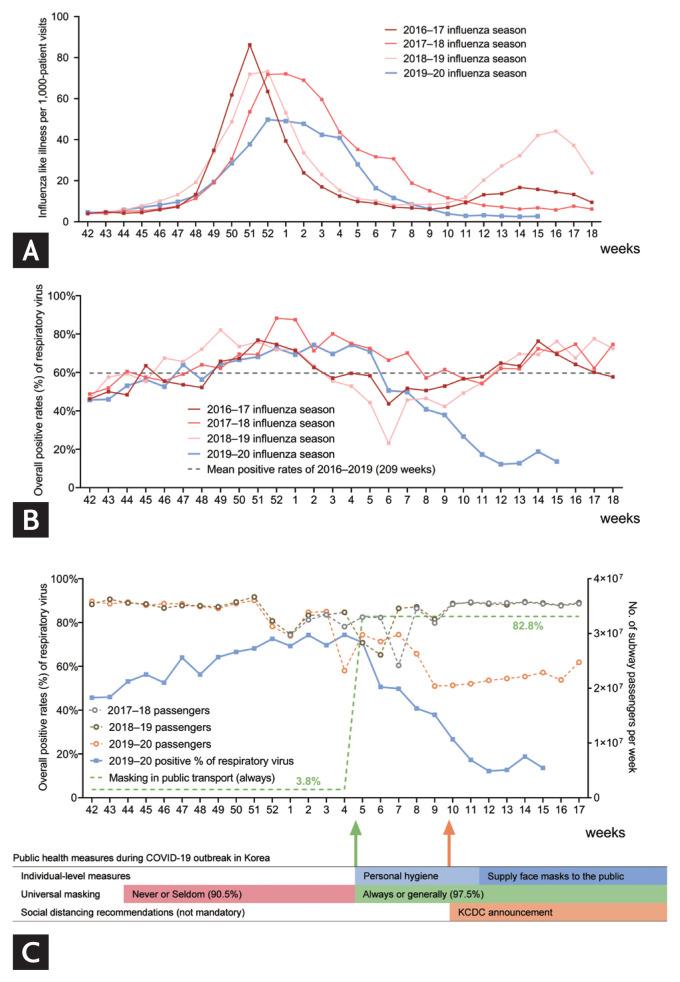
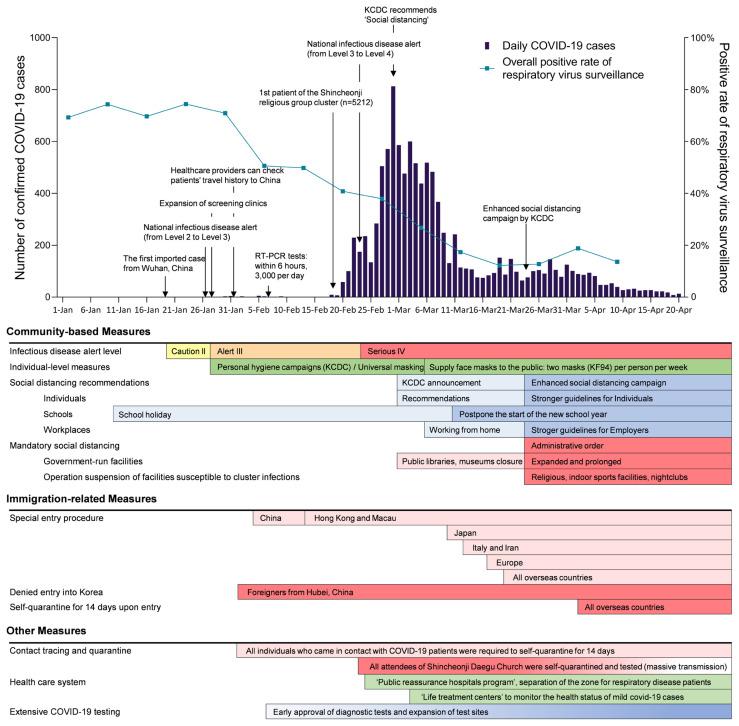
During the pandemic, adherence to personal preventive measures significantly increased, particularly indoors and on public transportation. Respiratory virus trends were compared based on laboratory surveillance data of 47,675 patients with acute respiratory infections (2016 to 2020). The 2019 to 2020 influenza epidemic ended within 3 weeks, from the epidemic peak to the epidemic end, quickly ending the inf luenza season; with a 1.8- to 2.5-fold faster decline than in previous seasons. Previously, the overall respiratory virus positivity rate remained high after the influenza seasons had ended (47.7% to 69.9%). During the COVID-19 pandemic, this positive rate, 26.5%, was significantly lower than those in previous years. Hospital-based surveillance showed a decreased number of hospitalized patients with acute viral respiratory illnesses.
CONCLUSION
This study suggests that high compliance to the use of personal preventive measures in public might reduce the incidence of all respiratory virus infections and its hospitalization rates, with no additional quarantine, isolation, or contact screening.
背景/目的:缺乏关于公共卫生措施在真实环境中预防呼吸道病毒传播的有效性的研究。我们研究了在 2019 冠状病毒病(COVID-19)大流行期间,普遍使用口罩和遵守其他个人预防措施对改变呼吸道病毒感染模式的有效性。
方法
从韩国国家呼吸道病毒哨点监测系统中提取数据。在 COVID-19 大流行期间,进行了一项关于个人预防措施遵守情况的横断面调查。此外,还分析了地铁乘客人数,以估计遵守身体距离的情况。
结果
在大流行期间,个人预防措施的遵守情况显著增加,尤其是在室内和公共交通工具上。根据对 47675 例急性呼吸道感染患者的实验室监测数据(2016 年至 2020 年)比较呼吸道病毒趋势。2019 年至 2020 年流感疫情在 3 周内结束,从疫情高峰到疫情结束,迅速结束了流感季节;与以往季节相比,下降速度快了 1.8-2.5 倍。此前,流感季节结束后,总体呼吸道病毒阳性率仍保持较高水平(47.7%至 69.9%)。在 COVID-19 大流行期间,这一阳性率为 26.5%,明显低于往年。基于医院的监测显示,急性病毒性呼吸道疾病住院患者人数减少。
结论
本研究表明,在公众中高度遵守使用个人预防措施可能会降低所有呼吸道病毒感染的发病率和住院率,而无需额外的检疫、隔离或接触筛查。


 Zotero 插件