
用于确定具有强光吸收的无机纳米颗粒生物分布的荧光成像与元素分析之间的比较。
Comparison between Fluorescence Imaging and Elemental Analysis to Determine Biodistribution of Inorganic Nanoparticles with Strong Light Absorption.
作者信息
Tamarov Konstantin, Wang Julie Tzu-Wen, Kari Juuso, Happonen Emilia, Vesavaara Ilkka, Niemelä Matti, Perämäki Paavo, Al-Jamal Khuloud T, Xu Wujun, Lehto Vesa-Pekka
机构信息
Department of Applied Physics, Faculty of Science and Forestry, University of Eastern Finland, Kuopio 70211, Finland.
School of Cancer and Pharmaceutical Sciences, Faculty of Life Sciences & Medicine, King's College London, London SE1 9NH, U.K.
出版信息
ACS Appl Mater Interfaces. 2021 Sep 1;13(34):40392-40400. doi: 10.1021/acsami.1c11875. Epub 2021 Aug 16.
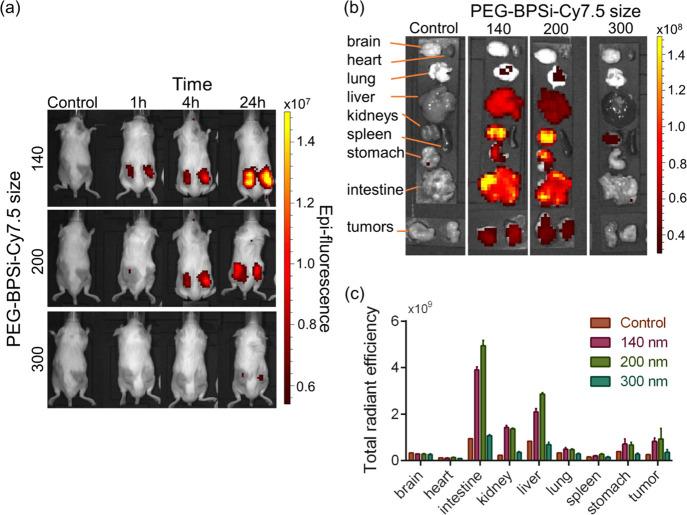
Black porous silicon nanoparticles (BPSi NPs) are known as highly efficient infrared light absorbers that are well-suitable for photothermal therapy (PTT) and photoacoustic imaging (PAI). PTT and PAI require a sufficient number of effectively light-absorbing NPs to be accumulated in tumor after intravenous administration. Herein, biodistribution of PEGylated BPSi NPs with different sizes (i.e., 140, 200, and 300 nm in diameter) is investigated after intravenous administration in mice. BPSi NPs were conjugated with fluorescent dyes Cy5.5 and Cy7.5 to track them and , respectively. Optical imaging with an imaging system (IVIS) was found to be an inadequate technique to assess the biodistribution of the dye-labeled BPSi NPs because the intrinsic strong absorbance of the BPSi NPs interfered fluorescence detection. This challenge was resolved via the use of inductively coupled plasma optical emission spectrometry to analyze the silicon content in different tissues and tumors. The results indicated that most of the polyethylene glycol-coated BPSi NPs were found to accumulate in the liver and spleen after intravenous injection. The smallest 140 nm particles accumulated the most in tumors at an amount of 9.5 ± 3.4% of the injected dose (concentration of 0.18 ± 0.08 mg/mL), the amount known to produce sufficient heat for cancer PTT. Furthermore, the findings from the present study also suggest that techniques other than optical imaging should be considered to study the organ biodistribution of NPs with strong light absorbance properties.
黑色多孔硅纳米颗粒(BPSi NPs)是一种高效的红外光吸收剂,非常适合用于光热疗法(PTT)和光声成像(PAI)。PTT和PAI要求在静脉给药后有足够数量的有效光吸收纳米颗粒在肿瘤中蓄积。在此,研究了不同尺寸(即直径分别为140、200和300 nm)的聚乙二醇化BPSi NPs在小鼠静脉给药后的生物分布。BPSi NPs分别与荧光染料Cy5.5和Cy7.5偶联以追踪它们。发现使用成像系统(IVIS)进行光学成像不足以评估染料标记的BPSi NPs的生物分布,因为BPSi NPs固有的强吸光度干扰了荧光检测。通过使用电感耦合等离子体发射光谱法分析不同组织和肿瘤中的硅含量解决了这一难题。结果表明,静脉注射后,大多数聚乙二醇包被的BPSi NPs蓄积在肝脏和脾脏中。最小的140 nm颗粒在肿瘤中的蓄积量最大,为注射剂量的9.5±3.4%(浓度为0.18±0.08 mg/mL),这一量已知可为癌症PTT产生足够的热量。此外,本研究的结果还表明,应考虑使用光学成像以外的技术来研究具有强光吸收特性的纳米颗粒的器官生物分布。




 Zotero 插件