
一种关于悲伤、抑郁及情绪调节作用的生物心理社会方法
A Biopsychosocial Approach to Grief, Depression, and the Role of Emotional Regulation.
作者信息
Peña-Vargas Cristina, Armaiz-Peña Guillermo, Castro-Figueroa Eida
机构信息
Ponce's Research Institute, Ponce Health Sciences University, Ponce, PR 00716, USA.
School of Medicine, Ponce Health Sciences University, Ponce, PR 00716, USA.
出版信息
Behav Sci (Basel). 2021 Aug 4;11(8):110. doi: 10.3390/bs11080110.
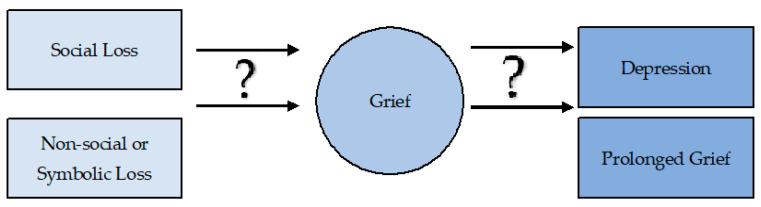
According to the field of affective neuroscience, grief has been identified as one of the seven primary emotions necessary for human survival. However, maladaptive grief could cause significant impairment in an individual's life, leading to psychopathologies such as major depressive disorder. Research on grief has shifted to a biopsychosocial approach, leaving behind outdated models-such as the Kübler-Ross theory-that have shown poor consistency. The field of psychoneuroimmunology has identified adverse life events such as social loss as being associated with major depressive disorder, and inflammatory processes in chronic health conditions. Likewise, scientists in the field of affective neuroscience have theorized that prolonged and sustained activation of the grief neurological pathway can cause a cascade of neurotransmitters that inhibits the reward-seeking system, causing symptoms of depression. The objective of this review is to highlight findings on the grief process using a biopsychosocial approach to explore grief's impact on psychopathophysiology.
根据情感神经科学领域的研究,悲伤已被确定为人类生存所必需的七种主要情绪之一。然而,适应不良的悲伤可能会对个人生活造成重大损害,导致诸如重度抑郁症等精神病理学问题。对悲伤的研究已转向生物心理社会方法,摒弃了诸如库伯勒-罗斯理论等已显示出较差一致性的过时模型。心理神经免疫学领域已确定诸如社会丧失等不良生活事件与重度抑郁症以及慢性健康状况中的炎症过程有关。同样,情感神经科学领域的科学家们推测,悲伤神经通路的长期持续激活会引发一系列神经递质,抑制寻求奖励系统,从而导致抑郁症状。本综述的目的是突出使用生物心理社会方法对悲伤过程的研究结果,以探讨悲伤对精神病理生理学的影响。
 Zotero 插件