
显微切割组织与组织切片——芯片上和芯片外培养的肿瘤外植体模型的比较研究
Microdissected Tissue vs Tissue Slices-A Comparative Study of Tumor Explant Models Cultured On-Chip and Off-Chip.
作者信息
Dorrigiv Dina, Simeone Kayla, Communal Laudine, Kendall-Dupont Jennifer, St-Georges-Robillard Amélie, Péant Benjamin, Carmona Euridice, Mes-Masson Anne-Marie, Gervais Thomas
机构信息
Centre de Recherche du Centre hospitalier de l'Université de Montréal, (CRCHUM) and Institut du Cancer de Montréal, Montreal, QC H2X 0A9, Canada.
Institute of Biomedical Engineering Polytechnique Montréal, Montreal, QC H3T 1J4, Canada.
出版信息
Cancers (Basel). 2021 Aug 21;13(16):4208. doi: 10.3390/cancers13164208.
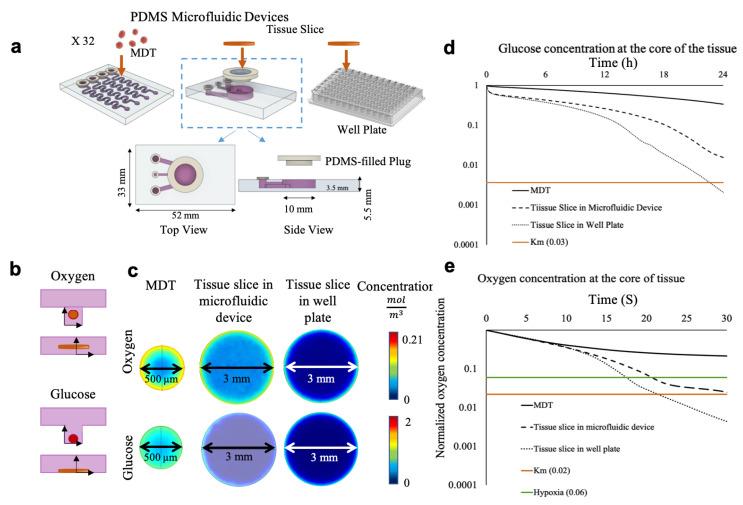
Predicting patient responses to anticancer drugs is a major challenge both at the drug development stage and during cancer treatment. Tumor explant culture platforms (TECPs) preserve the native tissue architecture and are well-suited for drug response assays. However, tissue longevity in these models is relatively low. Several methodologies have been developed to address this issue, although no study has compared their efficacy in a controlled fashion. We investigated the effect of two variables in TECPs, specifically, the tissue size and culture vessel on tissue survival using micro-dissected tumor tissue (MDT) and tissue slices which were cultured in microfluidic chips and plastic well plates. Tumor models were produced from ovarian and prostate cancer cell line xenografts and were matched in terms of the specimen, total volume of tissue, and respective volume of medium in each culture system. We examined morphology, viability, and hypoxia in the various tumor models. Our observations suggest that the viability and proliferative capacity of MDTs were not affected during the time course of the experiments. In contrast, tissue slices had reduced proliferation and showed increased cell death and hypoxia under both culture conditions. Tissue slices cultured in microfluidic devices had a lower degree of hypoxia compared to those in 96-well plates. Globally, our results show that tissue slices have lower survival rates compared to MDTs due to inherent diffusion limitations, and that microfluidic devices may decrease hypoxia in tumor models.
预测患者对抗癌药物的反应在药物研发阶段和癌症治疗过程中都是一项重大挑战。肿瘤外植体培养平台(TECPs)保留了天然组织结构,非常适合进行药物反应测定。然而,这些模型中的组织寿命相对较短。虽然已经开发了几种方法来解决这个问题,但尚无研究以可控方式比较它们的效果。我们使用微切割肿瘤组织(MDT)和在微流控芯片及塑料微孔板中培养的组织切片,研究了TECPs中两个变量,即组织大小和培养容器对组织存活的影响。肿瘤模型由卵巢癌和前列腺癌细胞系异种移植产生,并在样本、组织总体积以及每个培养系统中相应的培养基体积方面进行了匹配。我们检查了各种肿瘤模型的形态、活力和缺氧情况。我们的观察结果表明,在实验过程中MDT的活力和增殖能力未受影响。相比之下,在两种培养条件下,组织切片的增殖均减少,细胞死亡增加且缺氧情况加剧。与在96孔板中培养的组织切片相比,在微流控装置中培养的组织切片缺氧程度较低。总体而言,我们的结果表明,由于固有的扩散限制,组织切片的存活率低于MDT,并且微流控装置可能会降低肿瘤模型中的缺氧情况。



 Zotero 插件