
经皮骨水泥成形术治疗骨盆骨转移瘤:12 年经验
Percutaneous Cementoplasty for the Pelvis in Bone Metastasis: 12-Year Experience.
机构信息
Orthopaedic Oncology Clinic, National Cancer Center, Goyang, Gyeonggi-do, Republic of Korea.
Division of Convergence Technology, National Cancer Center, Goyang, Gyeonggi-do, Republic of Korea.
出版信息
Ann Surg Oncol. 2022 Feb;29(2):1413-1422. doi: 10.1245/s10434-021-10640-8. Epub 2021 Aug 26.
BACKGROUND
In advanced cancer patients, pelvic bone metastasis often causes pain and gait disturbance. The use of percutaneous bone cement [polymethylmethacrylate (PMMA)] injection for pain management and strengthening in pelvic bone metastasis has rarely been reported. To evaluate this method, we aimed to determine surgical outcomes and complications over a long-term follow-up period using a large patient group.
PATIENTS AND METHODS
We retrospectively collected data from 178 patients who underwent percutaneous cementoplasty for pelvic metastatic lesions, 201 in total. Surgical outcomes evaluated included pain reduction and improvement of ambulation. Mortality within 1 month after procedure and pulmonary embolism caused by thrombus, fat, tumor emboli, or bone cement were investigated as surgical complications. For long-term survivors, pain relapse and mechanical failure were analyzed. The mean follow-up period was 12.6 months, and there were 159 fatalities at last follow-up.
RESULTS
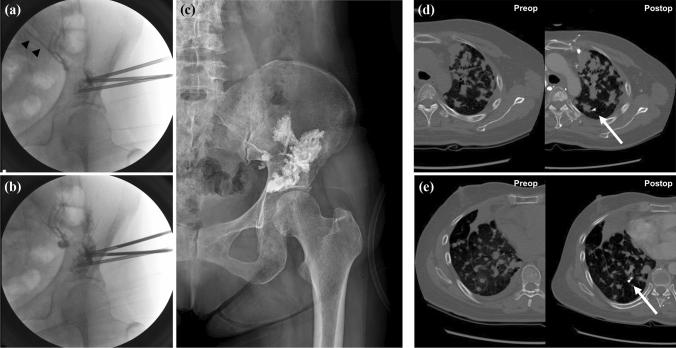
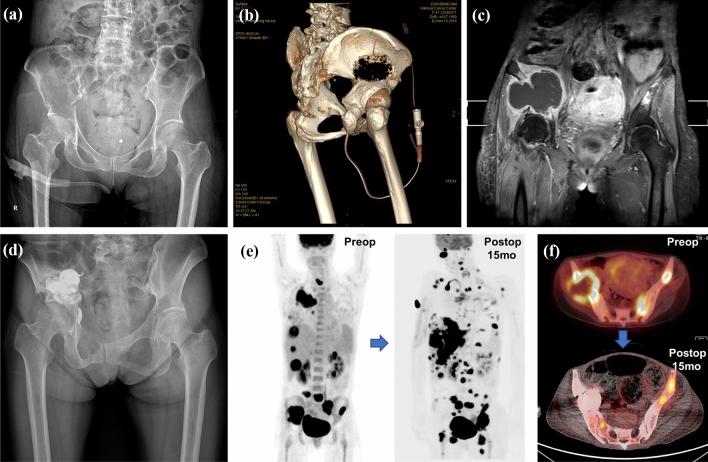
The mean regional pain numerical rating scale scores decreased from 6.1 preoperatively to 2.4 1 month after procedure (p < 0.01). Gait function was maintained, worsened, and uncheckable in 68%, 24%, and 8% of patients, respectively, 1 month after procedure. Of long-term survivors followed up for > 12 months (n = 53), there were no significant changes in serial plain radiographs, and regional pain aggravation was observed in 9%. Pulmonary cement embolism and bone cement implantation syndrome was observed in 11% and 10%, respectively. However, all patients with these complications were asymptomatic.
CONCLUSIONS
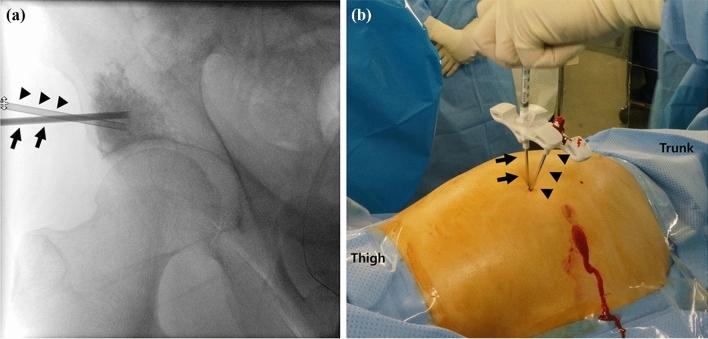
Percutaneous cement injection into the pelvis is a feasible and safe palliative surgical option for patients with advanced malignancy in terms of pain reduction and maintenance of ambulatory function under regional anesthesia.
背景
在晚期癌症患者中,骨盆骨转移常引起疼痛和步态障碍。经皮骨水泥(聚甲基丙烯酸甲酯[PMMA])注射用于骨盆骨转移的疼痛管理和强化治疗的应用鲜有报道。为了评估这种方法,我们旨在通过大样本患者群体确定长期随访期间的手术结果和并发症。
患者和方法
我们回顾性收集了 178 例接受骨盆转移性病变经皮骨水泥成形术治疗的患者数据,共 201 例。评估的手术结果包括疼痛缓解和步行能力改善。术后 1 个月内的死亡率以及由血栓、脂肪、肿瘤栓子或骨水泥引起的肺栓塞被视为手术并发症。对于长期存活者,分析疼痛复发和机械故障。平均随访时间为 12.6 个月,末次随访时共有 159 例死亡。
结果
术前区域疼痛数字评分量表平均得分为 6.1,术后 1 个月降至 2.4(p < 0.01)。术后 1 个月,患者的步态功能分别保持、恶化和无法评估占 68%、24%和 8%。对随访时间> 12 个月的长期存活者(n = 53)进行连续平片检查,未见明显变化,9%患者出现区域疼痛加重。11%和 10%患者分别出现肺水泥栓塞和骨水泥植入综合征,但所有有这些并发症的患者均无症状。
结论
在区域麻醉下,经皮骨盆骨水泥注射是晚期恶性肿瘤患者减轻疼痛和保持步行功能的一种可行且安全的姑息性手术选择。

 Zotero 插件