
软骨细胞肥大的功能二元性与骨关节炎的生物医学应用趋势
Functional Duality of Chondrocyte Hypertrophy and Biomedical Application Trends in Osteoarthritis.
作者信息
Park Sunghyun, Bello Alvin, Arai Yoshie, Ahn Jinsung, Kim Dohyun, Cha Kyung-Yup, Baek Inho, Park Hansoo, Lee Soo-Hong
机构信息
Department of Medical Biotechnology, Dongguk University-Seoul, Seoul 04620, Korea.
Department of Biomedical Science, CHA University, 335 Pangyo-ro, Bundang-gu, Seongnam-si 13488, Korea.
出版信息
Pharmaceutics. 2021 Jul 26;13(8):1139. doi: 10.3390/pharmaceutics13081139.
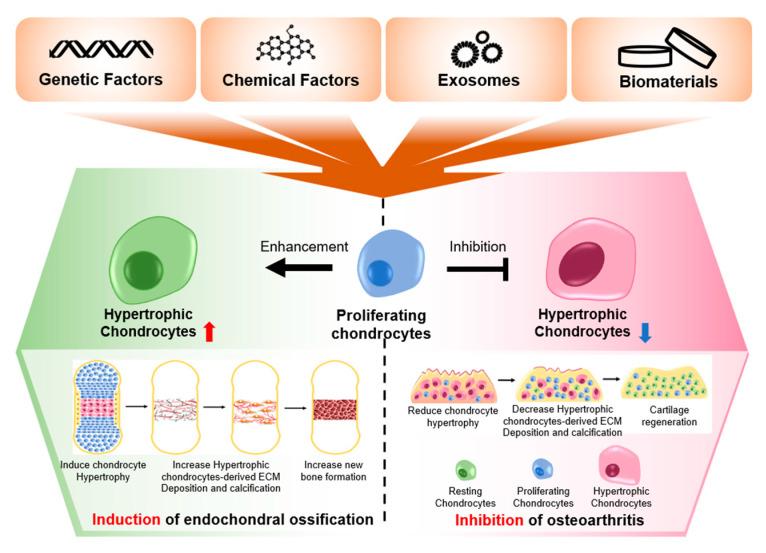
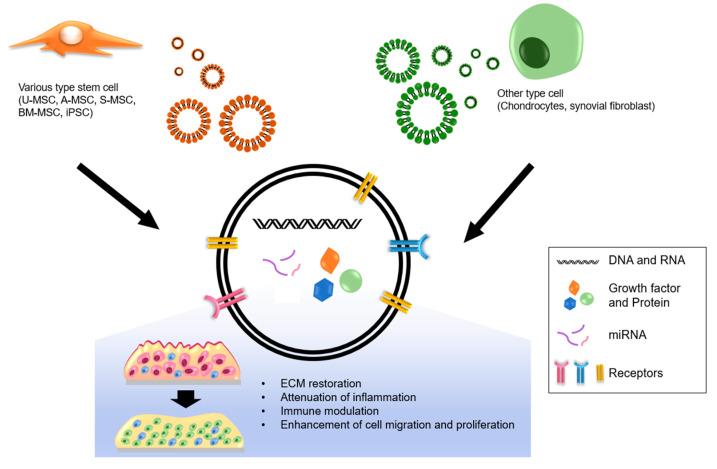
Chondrocyte hypertrophy is one of the key indicators in the progression of osteoarthritis (OA). However, compared with other OA indications, such as cartilage collapse, sclerosis, inflammation, and protease activation, the mechanisms by which chondrocyte hypertrophy contributes to OA remain elusive. As the pathological processes in the OA cartilage microenvironment, such as the alterations in the extracellular matrix, are initiated and dictated by the physiological state of the chondrocytes, in-depth knowledge of chondrocyte hypertrophy is necessary to enhance our understanding of the disease pathology and develop therapeutic agents. Chondrocyte hypertrophy is a factor that induces OA progression; it is also a crucial factor in the endochondral ossification. This review elaborates on this dual functionality of chondrocyte hypertrophy in OA progression and endochondral ossification through a description of the characteristics of various genes and signaling, their mechanism, and their distinguishable physiological effects. Chondrocyte hypertrophy in OA progression leads to a decrease in chondrogenic genes and destruction of cartilage tissue. However, in endochondral ossification, it represents an intermediate stage at the process of differentiation of chondrocytes into osteogenic cells. In addition, this review describes the current therapeutic strategies and their mechanisms, involving genes, proteins, cytokines, small molecules, three-dimensional environments, or exosomes, against the OA induced by chondrocyte hypertrophy. Finally, this review proposes that the contrasting roles of chondrocyte hypertrophy are essential for both OA progression and endochondral ossification, and that this cellular process may be targeted to develop OA therapeutics.
软骨细胞肥大是骨关节炎(OA)进展的关键指标之一。然而,与其他OA指征,如软骨塌陷、硬化、炎症和蛋白酶激活相比,软骨细胞肥大导致OA的机制仍不清楚。由于OA软骨微环境中的病理过程,如细胞外基质的改变,是由软骨细胞的生理状态启动和决定的,因此深入了解软骨细胞肥大对于增强我们对疾病病理学的理解和开发治疗药物是必要的。软骨细胞肥大是诱导OA进展的一个因素;它也是软骨内骨化的关键因素。本综述通过描述各种基因和信号的特征、它们的机制以及它们可区分的生理效应,阐述了软骨细胞肥大在OA进展和软骨内骨化中的双重功能。OA进展中的软骨细胞肥大导致软骨生成基因减少和软骨组织破坏。然而,在软骨内骨化中,它代表软骨细胞向成骨细胞分化过程中的一个中间阶段。此外,本综述描述了目前针对软骨细胞肥大诱导的OA的治疗策略及其机制,涉及基因、蛋白质、细胞因子、小分子、三维环境或外泌体。最后,本综述提出,软骨细胞肥大的对比作用对OA进展和软骨内骨化都至关重要,并且这个细胞过程可能是开发OA治疗方法的靶点。

 Zotero 插件