
神经内分泌标志物在黑色素瘤中异常表达的预后意义。
Prognostic significance of the aberrant expression of neuroendocrine markers in melanomas.
机构信息
Department of Pathology, Key Laboratory of Carcinogenesis and Translational Research (Ministry of Education), Peking University Cancer Hospital and Institute, No. 52, Fucheng Road, Haidian District, Beijing, 100142, China.
出版信息
Diagn Pathol. 2021 Aug 28;16(1):78. doi: 10.1186/s13000-021-01135-x.
BACKGROUND
Melanoma is a highly malignant tumor with diverse histopathological morphology and frequent aberrant expression of immunohistochemical markers. An occasionally reported phenomenon is the abnormal expression of neuroendocrine markers. Awareness of this situation is essential because such tumors need to be differentiated from neuroendocrine tumors because of their significant therapeutic and prognostic implications.
METHODS
We retrospectively analyzed the expression of chromogranin A (CgA), synaptophysin (Syn) and CD56 as neuroendocrine markers in 308 cases with melanomas. Kaplan-Meier curves and Cox regression analyses were used for overall survival (OS) and progression-free survival (PFS) evaluation and comparison between neuroendocrine markers expression status in all melanoma cases or stage I-II cases.
RESULTS
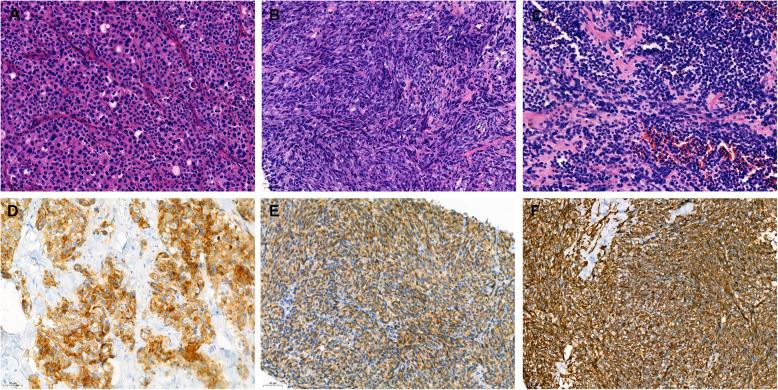
The expression of neuroendocrine markers in melanomas is not uncommon. CgA was positive in 6/304 (2.0%) cases, Syn in 26/304 (8.6%), and CD56 in 56/189 (29.6%). None of the cases co-expressed all the three markers. Focal or weak expression of at least one neuroendocrine marker was identified in 70/188 (37.2%) cases. The expression of CgA was correlated with age (p = 0.019), while the positive expression of Syn and CD56 showed borderline significance (p = 0.078 and 0.083, respectively), but not for any neuroendocrine marker expression. The expression of any neuroendocrine marker showed borderline significance with staging (p = 0.066). The expression of CgA, Syn, CD56, or any neuroendocrine marker did not correlate with clinicopathological features including sex, specimen type, origin, location, and histology subtype. Survival analyses revealed that the expression of neuroendocrine markers was not associated with OS or PFS.
CONCLUSIONS
Our study confirms that neuroendocrine marker expression is a common phenomenon in melanomas, but it has no prognostic significance. Nevertheless, awareness can avoid misdiagnosis in cases of melanomas with unusual morphology and immunophenotypes.
背景
黑色素瘤是一种高度恶性肿瘤,具有多种组织病理学形态,并且经常出现免疫组织化学标志物的异常表达。一种偶尔报道的现象是神经内分泌标志物的异常表达。了解这种情况至关重要,因为这些肿瘤需要与神经内分泌肿瘤区分开来,因为它们具有重要的治疗和预后意义。
方法
我们回顾性分析了 308 例黑色素瘤中嗜铬粒蛋白 A(CgA)、突触素(Syn)和 CD56 作为神经内分泌标志物的表达。使用 Kaplan-Meier 曲线和 Cox 回归分析进行总生存(OS)和无进展生存(PFS)评估,并比较所有黑色素瘤病例或 I-II 期病例中神经内分泌标志物表达状态之间的差异。
结果
黑色素瘤中神经内分泌标志物的表达并不罕见。CgA 在 6/304(2.0%)例中阳性,Syn 在 26/304(8.6%)例中阳性,CD56 在 189/304(56.1%)例中阳性。没有一个病例同时表达所有三种标志物。至少有一种神经内分泌标志物的局灶性或弱阳性表达在 70/188(37.2%)例中发现。CgA 的表达与年龄相关(p=0.019),而 Syn 和 CD56 的阳性表达具有边缘意义(p=0.078 和 0.083),但任何神经内分泌标志物的表达均无相关性。任何神经内分泌标志物的表达与分期均具有相关性(p=0.066)。CgA、Syn、CD56 或任何神经内分泌标志物的表达与性别、标本类型、起源、位置和组织学亚型等临床病理特征均无相关性。生存分析表明,神经内分泌标志物的表达与 OS 或 PFS 无关。
结论
我们的研究证实,神经内分泌标志物的表达在黑色素瘤中是一种常见现象,但它没有预后意义。然而,在形态学和免疫表型异常的黑色素瘤病例中,这种认识可以避免误诊。

 Zotero 插件