
血栓炎症支持 COVID-19 癌症患者的补体激活。
Thromboinflammation Supports Complement Activation in Cancer Patients With COVID-19.
机构信息
Department of Laboratory Medicine, Memorial Sloan Kettering Cancer Center, New York, NY, United States.
出版信息
Front Immunol. 2021 Aug 18;12:716361. doi: 10.3389/fimmu.2021.716361. eCollection 2021.
BACKGROUND
COVID-19 pathology is associated with exuberant inflammation, vascular damage, and activation of coagulation. In addition, complement activation has been described and is linked to disease pathology. However, few studies have been conducted in cancer patients.
OBJECTIVE
This study examined complement activation in response to COVID-19 in the setting of cancer associated thromboinflammation.
METHODS
Markers of complement activation (C3a, C5a, sC5b-9) and complement inhibitors (Factor H, C1-Inhibitor) were evaluated in plasma of cancer patients with (n=43) and without (n=43) COVID-19 and stratified based on elevated plasma D-dimer levels (>1.0 μg/ml FEU). Markers of vascular endothelial cell dysfunction and platelet activation (ICAM-1, thrombomodulin, P-selectin) as well as systemic inflammation (pentraxin-3, serum amyloid A, soluble urokinase plasminogen activator receptor) were analyzed to further evaluate the inflammatory response.
RESULTS
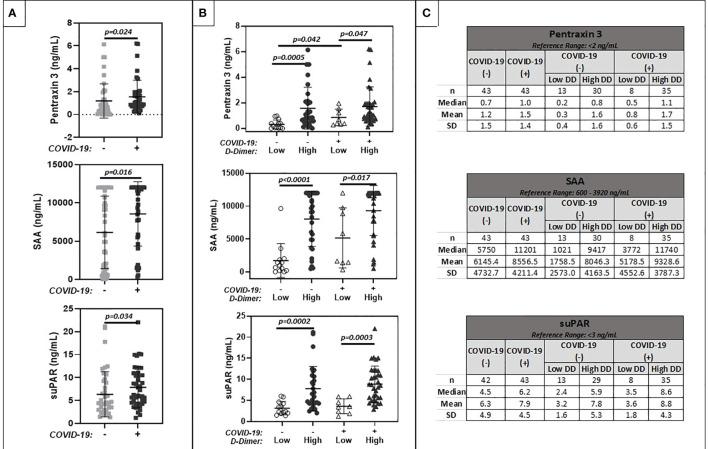
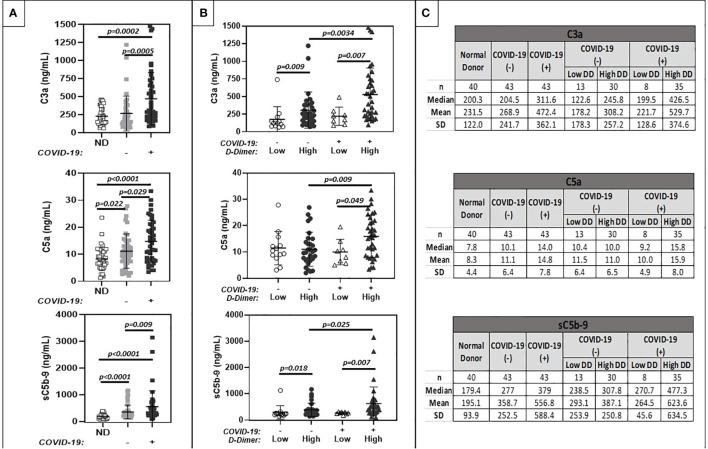
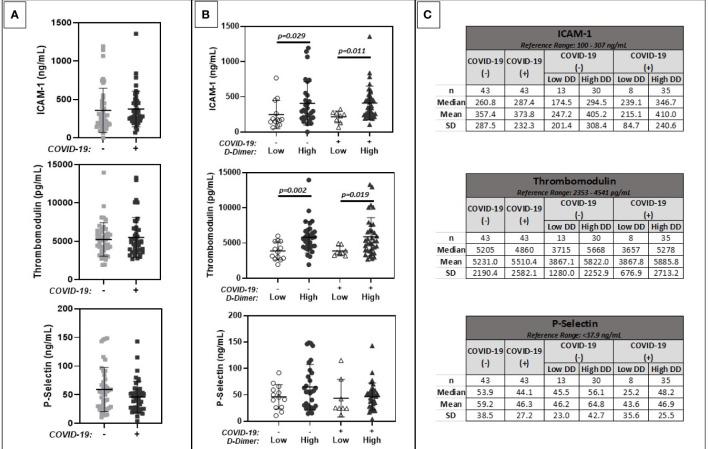
Increases in circulating markers of endothelial cell dysfunction, platelet activation, and systemic inflammation were noted in cancer patients with COVID-19. In contrast, complement activation increased in cancer patients with COVID-19 and elevated D-dimers. This was accompanied by decreased C1-Inhibitor levels in patients with D-dimers > 5 ug/ml FEU.
CONCLUSION
Complement activation in cancer patients with COVID-19 is significantly increased in the setting of thromboinflammation. These findings support a link between coagulation and complement cascades in the setting of inflammation.
背景
COVID-19 病理学与过度炎症、血管损伤和凝血激活有关。此外,已经描述了补体激活,并与疾病病理学相关。然而,在癌症患者中进行的研究很少。
目的
本研究在癌症相关血栓炎症的背景下,研究 COVID-19 中补体的激活。
方法
评估了癌症患者中 COVID-19 患者(n=43)和无 COVID-19 患者(n=43)以及根据血浆 D-二聚体水平升高(>1.0μg/ml FEU)分层的患者血浆中补体激活标志物(C3a、C5a、sC5b-9)和补体抑制剂(因子 H、C1 抑制剂)。分析血管内皮细胞功能障碍和血小板激活标志物(ICAM-1、血栓调节素、P-选择素)以及全身炎症标志物(五聚素-3、血清淀粉样蛋白 A、可溶性尿激酶型纤溶酶原激活物受体),以进一步评估炎症反应。
结果
在 COVID-19 癌症患者中,观察到循环内皮细胞功能障碍、血小板激活和全身炎症标志物的增加。相反,COVID-19 癌症患者和 D-二聚体升高的癌症患者中补体激活增加。这伴随着 D-二聚体>5ug/ml FEU 的患者中 C1 抑制剂水平降低。
结论
在炎症背景下,COVID-19 癌症患者的补体激活显著增加。这些发现支持凝血和补体级联在炎症背景下的联系。

 Zotero 插件