
主要大麻素及其代谢物对 UDP-葡糖醛酸基转移酶的抑制作用。
Inhibition of UDP-Glucuronosyltransferase Enzymes by Major Cannabinoids and Their Metabolites.
机构信息
Department of Pharmaceutical Sciences, College of Pharmacy and Pharmaceutical Sciences, Washington State University, Spokane, Washington.
Department of Pharmaceutical Sciences, College of Pharmacy and Pharmaceutical Sciences, Washington State University, Spokane, Washington
出版信息
Drug Metab Dispos. 2021 Dec;49(12):1081-1089. doi: 10.1124/dmd.121.000530. Epub 2021 Sep 7.
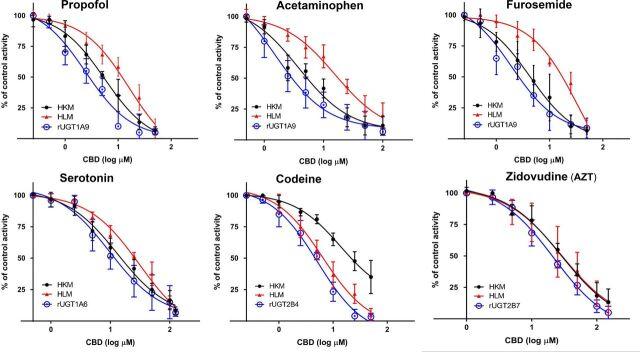
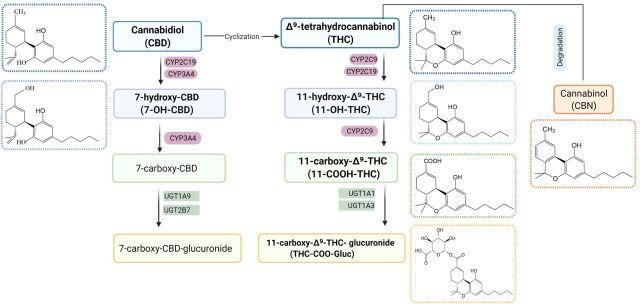
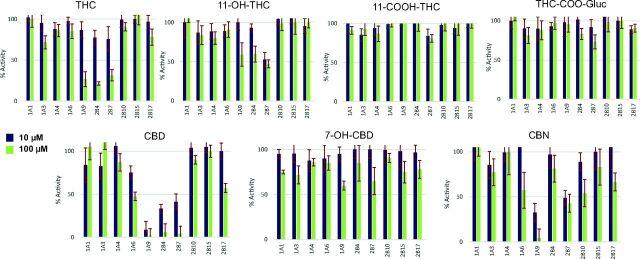
The UDP-glucuronosyltransferase (UGT) family of enzymes play a central role in the metabolism and detoxification of a wide range of endogenous and exogenous compounds. UGTs exhibit a high degree of structural similarity and display overlapping substrate specificity, often making estimations of potential drug-drug interactions difficult to fully elucidate. One such interaction yet to be examined may be occurring between UGTs and cannabinoids, as the legalization of recreational and medicinal cannabis and subsequent co-usage of cannabis and therapeutic drugs increases in the United States and internationally. In the present study, the inhibition potential of the major cannabinoids Δ-tetrahydrocannabinol (THC), cannabidiol (CBD), and cannabinol (CBN), as well as their major metabolites, was determined in microsomes isolated from HEK293 cells overexpressing individual recombinant UGTs and in microsomes from human liver and kidney specimens. The highest inhibition was seen by CBD against the glucuronidation activity of UGTs 1A9, 2B4, 1A6, and 2B7, with binding-corrected IC values of 0.12 ± 0.020 µM, 0.22 ± 0.045 µM, 0.40 ± 0.10 µM, and 0.82 ± 0.15 µM, respectively. Strong inhibition of UGT1A9 was also demonstrated by THC and CBN, with binding-corrected IC values of 0.45 ± 0.12 μM and 0.51 ± 0.063 μM, respectively. Strong inhibition of UGT2B7 was also observed for THC and CBN; no or weak inhibition was observed with cannabinoid metabolites. This inhibition of UGT activity suggests that in addition to playing an important role in drug-drug interactions, cannabinoid exposure may have important implications in patients with impaired hepatic or kidney function. SIGNIFICANCE STATEMENT: Major cannabinoids found in the plasma of cannabis users inhibit several UDP-glucuronosyltransferase (UGT) enzymes, including UGT1A6, UGT1A9, UGT2B4, and UGT2B7. This study is the first to show the potential of cannabinoids and their metabolites to inhibit all the major kidney UGTs as well as the two most abundant UGTs present in liver. This study suggests that as all three major kidney UGTs are inhibited by cannabinoids, greater drug-drug interaction effects might be observed from co-use of cannabinods and therapeutics that are cleared renally.
尿苷二磷酸葡萄糖醛酸基转移酶(UGT)家族的酶在广泛的内源性和外源性化合物的代谢和解毒中起着核心作用。UGTs 表现出高度的结构相似性,并显示出重叠的底物特异性,这使得对潜在药物相互作用的估计很难完全阐明。一种尚未被检查的相互作用可能发生在 UGT 和大麻素之间,因为娱乐性和药用大麻的合法化以及随后在美国和国际上大麻和治疗性药物的共同使用增加。在本研究中,测定了主要大麻素 Δ-四氢大麻酚(THC)、大麻二酚(CBD)和大麻酚(CBN)及其主要代谢物在过表达个体重组 UGT 的 HEK293 细胞分离的微粒体中和人肝和肾标本的微粒体中的抑制潜力。CBD 对 UGTs 1A9、2B4、1A6 和 2B7 的葡萄糖醛酸化活性的抑制作用最强,结合校正的 IC 值分别为 0.12±0.020 µM、0.22±0.045 µM、0.40±0.10 µM 和 0.82±0.15 µM。THC 和 CBN 也强烈抑制 UGT1A9,结合校正的 IC 值分别为 0.45±0.12 µM 和 0.51±0.063 µM。THC 和 CBN 也对 UGT2B7 有强烈的抑制作用;大麻素代谢物无或弱抑制。UGT 活性的这种抑制表明,大麻素暴露除了在药物相互作用中起重要作用外,还可能对肝功能或肾功能受损的患者产生重要影响。意义声明:在大麻使用者的血浆中发现的主要大麻素抑制几种尿苷二磷酸葡萄糖醛酸基转移酶(UGT)酶,包括 UGT1A6、UGT1A9、UGT2B4 和 UGT2B7。这项研究首次表明大麻素及其代谢物有可能抑制所有主要的肾脏 UGT 以及肝脏中存在的两种最丰富的 UGT。这项研究表明,由于所有三种主要的肾脏 UGT 都被大麻素抑制,因此从大麻素和经肾脏清除的治疗药物的共同使用中可能会观察到更大的药物相互作用效应。
 Zotero 插件