
对 137343 只肉鸡 35 日龄体重进行的全基因组关联分析。
A genome-wide association analysis for body weight at 35 days measured on 137,343 broiler chickens.
机构信息
The Roslin Institute, University of Edinburgh, Midlothian, UK.
Department of Animal Breeding and Genetics, Swedish University of Agricultural Sciences, Uppsala, Sweden.
出版信息
Genet Sel Evol. 2021 Sep 8;53(1):70. doi: 10.1186/s12711-021-00663-w.
BACKGROUND
Body weight (BW) is an economically important trait in the broiler (meat-type chickens) industry. Under the assumption of polygenicity, a "large" number of genes with "small" effects is expected to control BW. To detect such effects, a large sample size is required in genome-wide association studies (GWAS). Our objective was to conduct a GWAS for BW measured at 35 days of age with a large sample size.
METHODS
The GWAS included 137,343 broilers spanning 15 pedigree generations and 392,295 imputed single nucleotide polymorphisms (SNPs). A false discovery rate of 1% was adopted to account for multiple testing when declaring significant SNPs. A Bayesian ridge regression model was implemented, using AlphaBayes, to estimate the contribution to the total genetic variance of each region harbouring significant SNPs (1 Mb up/downstream) and the combined regions harbouring non-significant SNPs.
RESULTS
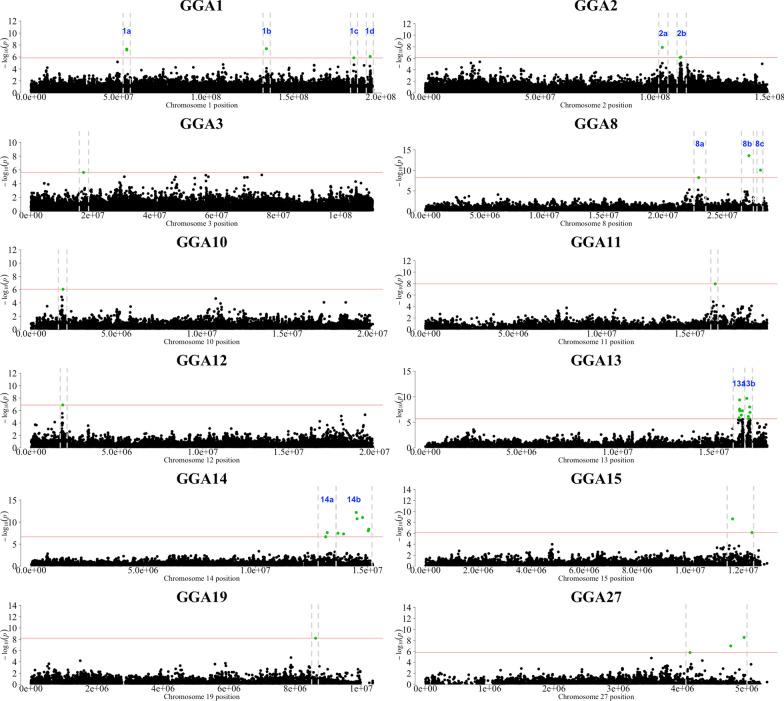
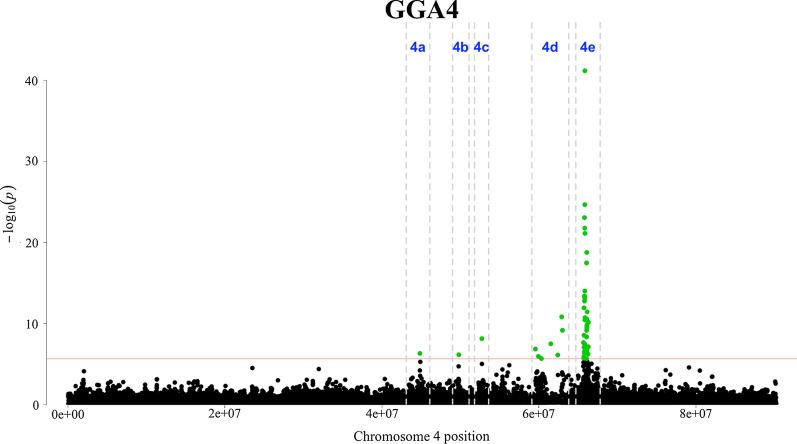
GWAS revealed 25 genomic regions harbouring 96 significant SNPs on 13 Gallus gallus autosomes (GGA1 to 4, 8, 10 to 15, 19 and 27), with the strongest associations on GGA4 at 65.67-66.31 Mb (Galgal4 assembly). The association of these regions points to several strong candidate genes including: (i) growth factors (GGA1, 4, 8, 13 and 14); (ii) leptin receptor overlapping transcript (LEPROT)/leptin receptor (LEPR) locus (GGA8), and the STAT3/STAT5B locus (GGA27), in connection with the JAK/STAT signalling pathway; (iii) T-box gene (TBX3/TBX5) on GGA15 and CHST11 (GGA1), which are both related to heart/skeleton development); and (iv) PLAG1 (GGA2). Combined together, these 25 genomic regions explained ~ 30% of the total genetic variance. The region harbouring significant SNPs that explained the largest portion of the total genetic variance (4.37%) was on GGA4 (~ 65.67-66.31 Mb).
CONCLUSIONS
To the best of our knowledge, this is the largest GWAS that has been conducted for BW in chicken to date. In spite of the identified regions, which showed a strong association with BW, the high proportion of genetic variance attributed to regions harbouring non-significant SNPs supports the hypothesis that the genetic architecture of BW35 is polygenic and complex. Our results also suggest that a large sample size will be required for future GWAS of BW35.
背景
体重(BW)是肉鸡(肉用型鸡)产业中一个具有重要经济意义的性状。在多基因假设下,预计控制 BW 的“大量”基因具有“小”的效应。为了检测这些效应,全基因组关联研究(GWAS)需要大量的样本量。我们的目的是用大量样本进行 BW 35 日龄的 GWAS。
方法
GWAS 包括 137343 只肉鸡,跨越 15 个家系世代和 392295 个推断的单核苷酸多态性(SNP)。采用错误发现率为 1%来考虑在宣布显著 SNP 时的多重测试。使用 AlphaBayes 实现贝叶斯岭回归模型,估计每个包含显著 SNP(上下游 1 Mb)的区域和包含非显著 SNP 的组合区域对总遗传方差的贡献。
结果
GWAS 揭示了 13 个鸡(Gallus gallus)染色体(GGA1 到 4、8、10 到 15、19 和 27)上 25 个含有 96 个显著 SNP 的基因组区域,在 GGA4 上的最强关联位于 65.67-66.31 Mb(Galgal4 组装)。这些区域的关联指向了几个强有力的候选基因,包括:(i)生长因子(GGA1、4、8、13 和 14);(ii)瘦素受体重叠转录本(LEPROT)/瘦素受体(LEPR)基因座(GGA8),以及 STAT3/STAT5B 基因座(GGA27),与 JAK/STAT 信号通路有关;(iii)T 盒基因(TBX3/TBX5)在 GGA15 和 CHST11(GGA1)上,都与心脏/骨骼发育有关;和(iv)PLAG1(GGA2)。综合起来,这 25 个基因组区域解释了大约 30%的总遗传方差。含有显著 SNP 的区域解释了总遗传方差的最大部分(4.37%)位于 GGA4(~65.67-66.31 Mb)。
结论
据我们所知,这是迄今为止对鸡 BW 进行的最大 GWAS。尽管确定了与 BW 强烈相关的区域,但归因于非显著 SNP 区域的遗传方差比例很高,支持 BW35 的遗传结构是多基因和复杂的假设。我们的结果还表明,未来对 BW35 的 GWAS 将需要大量样本。


 Zotero 插件